You received quotes from two agencies for Google Ads. One says “fifteen percent of the ad budget”, the other has written a fixed monthly figure. A third says it has put the management fee inside the budget. Which is more suitable? The answer is found not by looking at the figure but by looking at what the figure covers.
In this article we explain how a Google Ads management fee is calculated, the pros and cons of the three common fee models, the difference between ad budget and management fee and 9 points to check in a quote. The aim is not to give you a price; it is to help you read what sits behind the figure in a quote. If you wonder how ads are set up, see our article on how to run Google Ads.
Management Fee and Ad Budget Are Not the Same Thing
There are two separate money flows in Google Ads. The first is ad spend: the amount you pay Google per click or impression. The second is the management fee: the fee you pay to the agency or consultant who sets up the account, manages campaigns and reports.
If these two items are mixed up in a quote, wrong decisions are made. A “ten thousand lira package a month” may not mean that all ten thousand will go to ads; or conversely, it may mean that the management fee will be paid on top. In every quote you should want to see these two lines separately: the monthly fee paid to the agency and the estimated ad spend paid to Google.
The preferred arrangement for transparency is for ad spend to be paid by your card directly to Google and for the account to be opened in your name. Where the budget is collected through the agency, how spend will be reported should be written clearly.
Three Common Fee Models
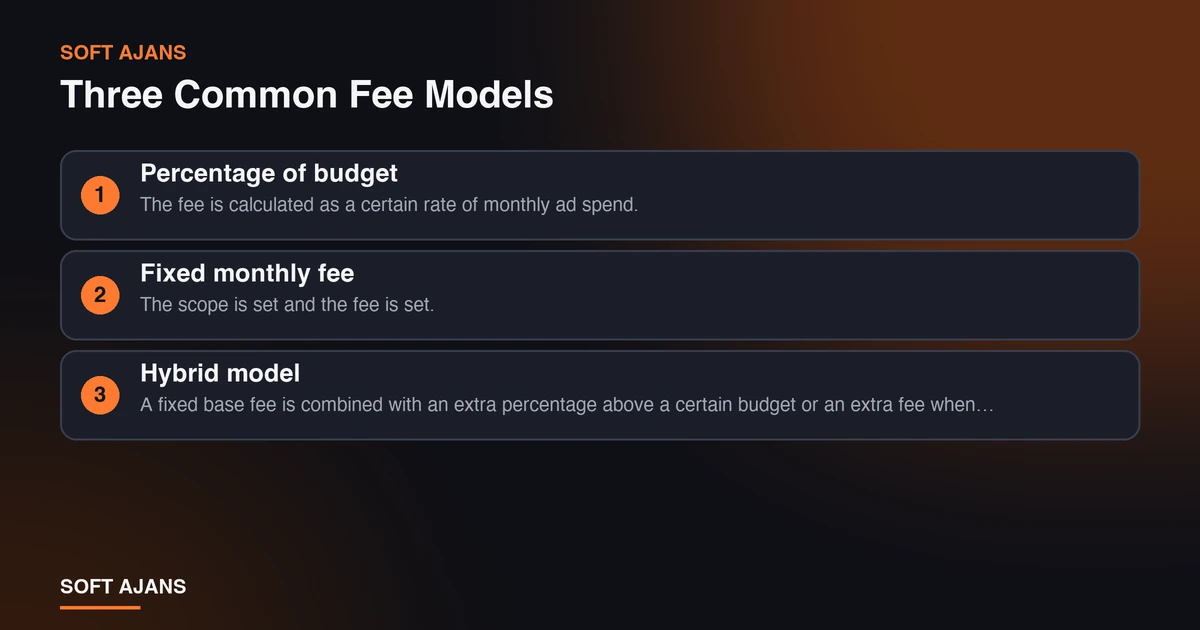
Google Ads management is usually priced in three ways in the market. Each has strengths and weaknesses.
1. Percentage of budget. The fee is calculated as a certain rate of monthly ad spend. As the budget grows the agency’s income grows too; this can create an incentive to raise the budget unnecessarily. At low budgets the percentage is often applied with a floor because it would not cover the agency’s work.
2. Fixed monthly fee. The scope is set and the fee is set. Even if the budget changes the fee does not; this gives predictability. The point to watch is that the scope (number of campaigns, optimization frequency, report) is written clearly. The advantage of a fixed fee is that the agency gains nothing from raising the budget.
3. Hybrid model. A fixed base fee is combined with an extra percentage above a certain budget or an extra fee when scope is added. It gives flexibility in growing accounts but can cause confusion if the calculation rule is not clear in the quote.
Performance-based fees may also be proposed apart from these three. Because there are factors in an ad account that the agency cannot directly control (product price, the conversion strength of the site, the reply speed of the sales team), performance-based models should be read carefully; what counts as “performance” and how it is measured should be written down.
Which Model Suits Whom?
There is no single right model; it changes with your situation.
If your ad budget is small and the scope is limited, a fixed-fee package with a clearly written scope is usually more predictable. If your budget is large and changes often, a hybrid or tiered model may work for you. If you choose the percentage model, asking for a cap or tiers prevents the fee from growing out of control as the budget rises.
Whichever model you choose, the critical thing is the direction of the incentive: is the agency’s income tied to raising the budget or to improving the result? The quote should be structured so that it answers this question.
Items That Affect the Fee
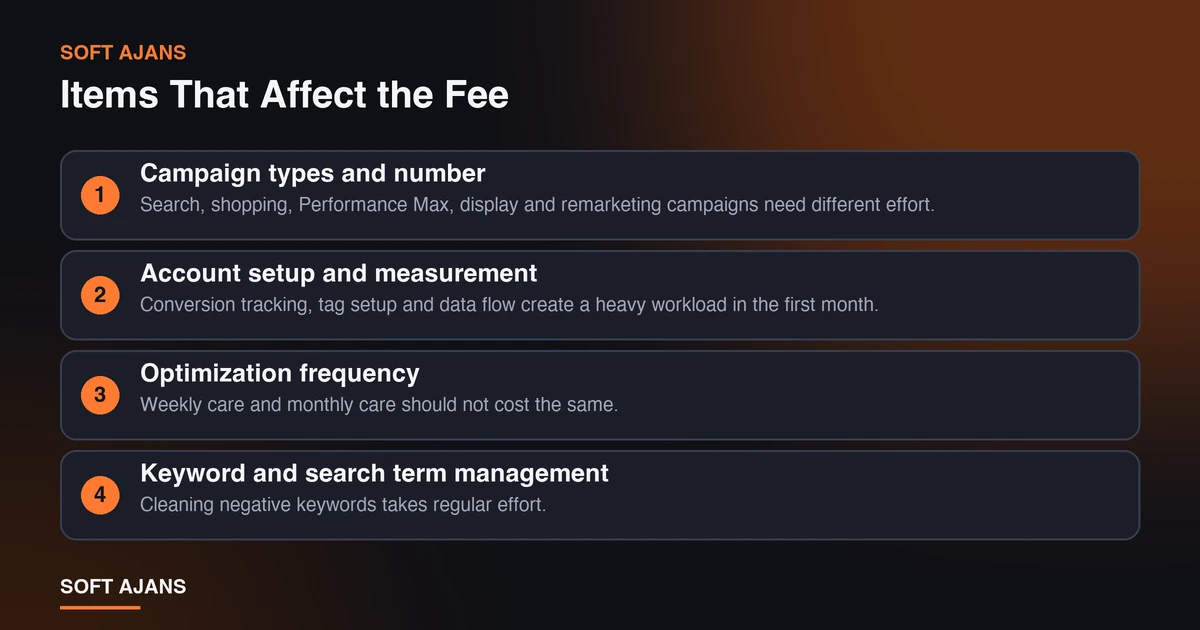
A management fee is not just “opening campaigns”. The main items that affect the price are:
- Campaign types and number. Search, shopping, Performance Max, display and remarketing campaigns need different effort.
- Account setup and measurement. Conversion tracking, tag setup and data flow create a heavy workload in the first month.
- Optimization frequency. Weekly care and monthly care should not cost the same.
- Keyword and search term management. Cleaning negative keywords takes regular effort.
- Ad copy and visual production. Are copy tests and visual assets in scope or separate?
- Reporting and meetings. Report frequency and the scope of strategy meetings.
- Account complexity. Many products, many regions or many languages make management harder.
Seeing which of these items are in the quote explains the reason for the price difference between two quotes.
9 Checks in a Quote
The list below contains 9 points you can tick while reading a Google Ads management quote.
- Are the management fee and the ad spend written separately? The two items should appear on separate lines with clear figures.
- Is the fee model clear? It should be written whether it is percentage, fixed or hybrid; if percentage, how it is calculated and its floor and cap.
- Is the scope written? How many campaigns, which campaign types and how often optimization will be done should be stated.
- Is measurement setup included? Are conversion tracking, tags and data flow in scope or separate?
- In whose name will the account be opened? The ad account and analytics account should be in your name; the agency should get access as an administrator.
- Are report content and frequency set? How often and in what form values such as spend, clicks, conversions and cost per conversion will be reported should be written.
- Is the guarantee language honest? A promise of a certain number of conversions, sales or low cost is a warning sign. An honest quote writes what it will do and how it will measure.
- Are there a minimum term and exit conditions? Contract term, early termination and account handover should be clear.
- Is support for ad copy and landing page defined? Whether copy production and page suggestions are in scope should be written.
You can ask every agency you receive a quote from in the same way. The clarity of the answers gives as much information about the way of working as the price does.
Three Situations That Make the Figure Misleading
A very low management fee. A low fee often means little optimization, a copy-paste campaign structure or no report. A model that keeps the fee low and inflates the budget is also possible; so ask for the reasoning behind the budget suggestion.
A fee hidden inside the ad spend. If the fee is shown inside the spend, you cannot know how much really goes to Google. This breaks transparency and makes performance harder to assess.
The account belonging to the agency. If the account was opened in the agency’s name, you may lose past data and optimization history when you stop working. Account ownership is as important as price.
Which Data Should You Use Before Deciding on the Fee?
When evaluating the fee, you also need to think about what the ad can bring to the business. For this you need three numbers: the average value of a customer, the highest cost you can pay for a sale or application and the current conversion rate of your site. Without these three numbers you cannot say “good” or “expensive”.
For example you may find the management fee high; but the account lowering its cost per conversion and stopping wrong spend may save more than the fee itself. Conversely, even if the fee is low, if the account is left unmaintained the real cost is high. To see the current state of your account, look at the items in our Google Ads account audit checklist.
How Should the Fee Be Assessed in the First Three Months?
The first weeks of a Google Ads account are a period of setup, data collection and learning. Judging the fee by results in this period misleads. A more correct approach is to set up a three-month evaluation frame: measurement and structure in the first month, search terms and copy tests in the second, readjusting the budget distribution by data in the third.
At the end of each month ask the agency for these: what was done, what was learned, what will change next month. An agency that gives concrete answers to these three questions is showing the return on the fee. If the answers are vague or only the number of clicks is shared, it is time to discuss the scope and report items again.
Google Ads or SEO? Think About the Fee with This Question Too
The management fee is part of the general budget plan. When ads stop, traffic stops; SEO starts slower but builds up lastingly. We covered in detail how the two share the budget in our article on Google Ads or SEO: where to put the budget. Knowing the place of Google Ads in your general plan while evaluating the quote helps you read the fee more accurately.
Common Mistakes
- Looking only at the fee percentage. Even if the percentage looks low, scope and budget suggestion can turn out expensive.
- Mixing up ad spend and fee. If the two items are not read separately, the budget plan is broken.
- Having the account opened in the agency’s name. Data and history can be lost when you leave.
- Not asking for the report content. The number of clicks alone is not an indicator of success.
- Believing a guarantee. No agency can guarantee a certain number of conversions or sales.
- Starting ads without setting up measurement. Without conversion tracking you cannot know which campaign works.
- Deciding in a short time. An ad account has a learning and optimization period; drawing a conclusion from a few days of data misleads.
- Not reading the contract exit terms. Long commitments and account handover uncertainty cause trouble later.
What Does Soft Ajans Do in Google Ads Management?
In our Google Ads management service we analyze the account and keywords, build the campaign structure, configure conversion tracking, clean negative keywords regularly and give a monthly report. As of October 2026 the monthly management packages on our service page are published as 7,500 TL, 12,500 TL, 18,500 TL and 27,500 TL; the scope widens with the package. These figures are the service fee; the ad spend to be paid to Google is discussed separately.
We do not give result guarantees; we give in writing what we will do, what we will measure and how often we will report. We explain our pricing approach on our how pricing works page. To see your account you can ask for a free preliminary analysis.
Frequently Asked Questions
How much should a Google Ads management fee be?
There is no single right figure. The fee changes with campaign type and number, optimization frequency, measurement setup, report scope and account complexity. Compare the work inside the figure, not the figure.
Is the percentage model or the fixed fee better?
It depends. A fixed fee gives predictability and creates no incentive to raise the budget. The percentage model is flexible in growing accounts but should be read with a floor and a cap. What matters is that the scope and the calculation rule are written down.
Is the ad budget included in the management fee?
Usually not. The ad spend paid to Google and the management fee paid to the agency are separate items and should appear separately in the quote.
In whose name should the ad account be?
In yours. The agency gets access as an administrator; this way past data and account structure stay yours when the work ends.
Can an agency guarantee conversions or sales?
No. The result depends on many factors such as product, price, site, competition and the reply of the sales team. A quote promising a certain number of conversions or sales is a warning sign.
Is Google Ads management meaningful with a small budget?
If the budget is very small, enough data for learning may not be collected. Clarifying the goal and measurement first and starting with a few focused campaigns is usually more efficient than spreading the whole budget over a broad structure.