When starting a new business, the name is one of the topics that takes the most time, is argued about the most and ends with “we wish we had thought of this earlier”. Once a name is stitched into the logo, signboard, business card, domain and social media account, changing it is both expensive and hard. On top of that, a name you like may already be in use by another business.
In this article we explain the path to follow when choosing a brand name: name types, features of a good name, domain and social media checks, pronunciation and spelling tests, points to look at before trademark registration and a 10-point checklist. This article is not legal advice; trademark registration and name rights are legal matters, and before deciding we recommend consulting a trademark attorney or lawyer.
Features of a Good Brand Name
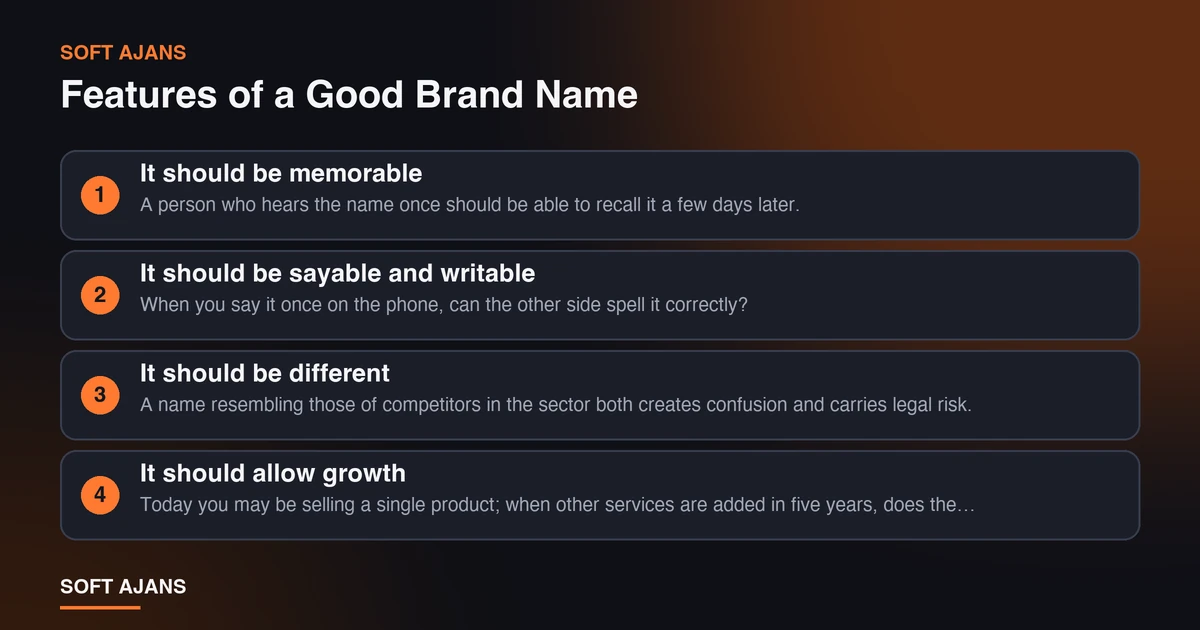
A nice name alone is not enough; a name that works meets a few practical criteria.
It should be memorable. A person who hears the name once should be able to recall it a few days later. Names that are very long, very complicated or built from similar words do not stick in memory.
It should be sayable and writable. When you say it once on the phone, can the other side spell it correctly? Names with special characters or foreign spellings that are hard to write cause problems at the domain and search stage.
It should be different. A name resembling those of competitors in the sector both creates confusion and carries legal risk.
It should allow growth. Today you may be selling a single product; when other services are added in five years, does the name lock you into one area? A name like “Ankara Carpet Cleaning” can feel narrow when you change city or add another service.
It should have no negative association. Check whether the word you choose has an unwanted meaning in other languages or in everyday use.
It should be usable digitally. The domain, the social media username and the situation in search results decide the practical usability of the name.
Name Types: Which One Suits You?
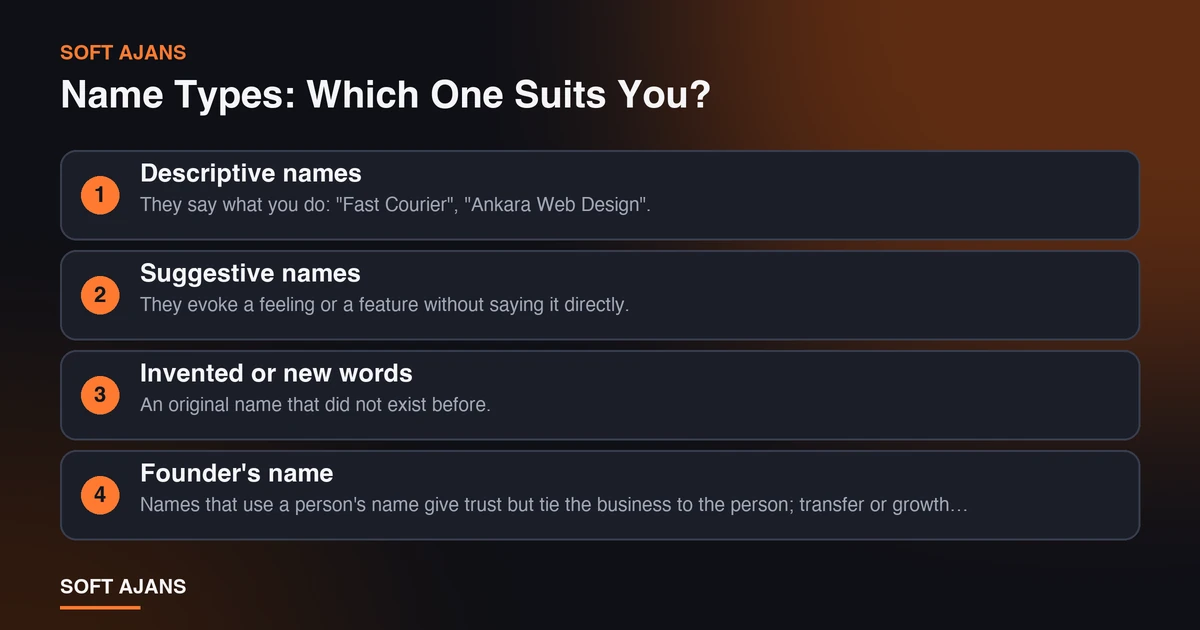
Brand names are generally grouped into a few types. Each has strengths and weaknesses.
Descriptive names. They say what you do: “Fast Courier”, “Ankara Web Design”. They are easy to understand but hard to differentiate and to protect legally, because they are made of generic words.
Suggestive names. They evoke a feeling or a feature without saying it directly. They are both meaningful and distinctive.
Invented or new words. An original name that did not exist before. It is strong in distinctiveness and in finding a domain; however, it takes more promotion effort to build meaning.
Founder’s name. Names that use a person’s name give trust but tie the business to the person; transfer or growth later can become harder.
Abbreviations. The initials of a long name. Short and handy but, since it carries no meaning on its own, hard to promote.
A name can combine several of these types. What matters is that the type you choose suits your target audience and the nature of your work.
Step-by-Step Naming Process
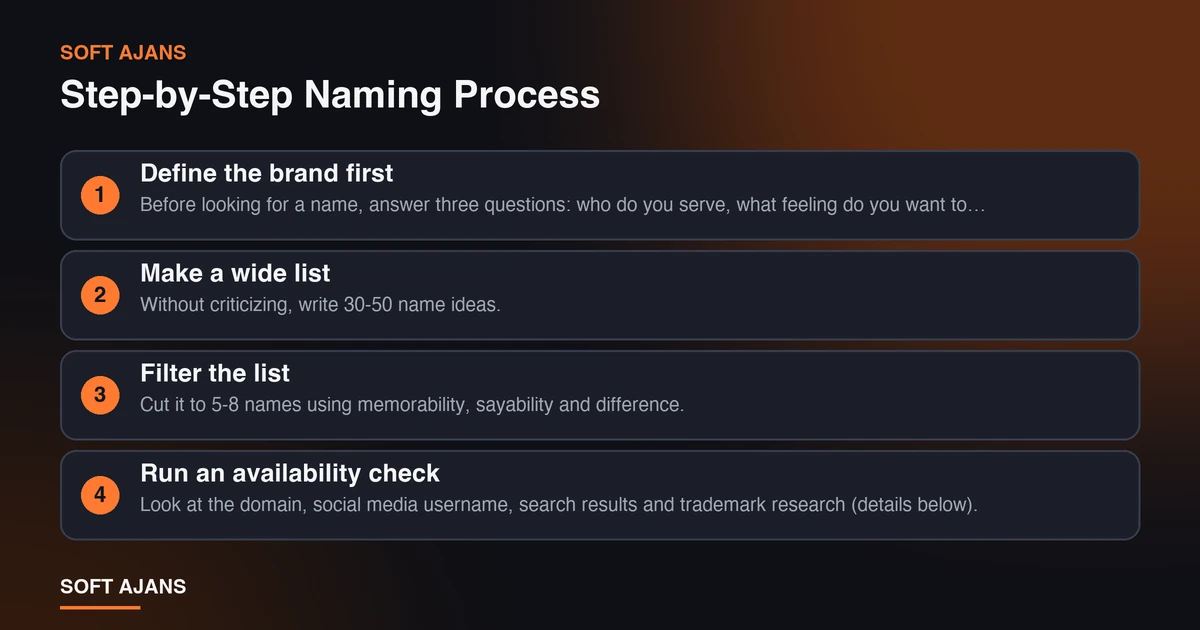
1. Define the brand first. Before looking for a name, answer three questions: who do you serve, what feeling do you want to create, how do you stand apart from competitors? This definition becomes the yardstick for filtering name ideas.
2. Make a wide list. Without criticizing, write 30-50 name ideas. Try word roots, different languages, compound words, associations. Do not separate good from bad at this stage.
3. Filter the list. Cut it to 5-8 names using memorability, sayability and difference.
4. Run an availability check. Look at the domain, social media username, search results and trademark research (details below).
5. Run a pronunciation and spelling test. Say the name to a few people and ask them to write it; ask how they understand it when they hear it from others.
6. Test with the target audience. Show two or three candidate names to a few people from the target audience and get their first impression.
7. Decide and register. After deciding, take the domain and the social media accounts straight away.
Domain and Social Media Check
Whether a name is usable in the digital world is the most practical test. Check whether the name is free as a domain (preferably .com and .com.tr). We explained the principles to watch when choosing a domain in our article on how to choose an SEO-friendly domain name.
On social media, check whether the same username is available on the main platforms (Instagram, X, LinkedIn, Facebook, TikTok). Getting the same name on all of them makes the brand look consistent. If it is not available exactly, you can consider a small variation that does not distort the name; but usernames full of unrelated numbers or underscores do not inspire trust.
Also search the name in a search engine. If another business, a result with a bad association or a very dominant brand comes up on the first page, it becomes harder for your own brand to be visible.
Trademark Research and Points Before Registration
Even if the name is nice, you can run into problems if someone else holds a registered trademark with the same or a very similar name in the same field. In Turkiye trademark registration is done through the Turkish Patent and Trademark Office (TURKPATENT), and it is possible to do preliminary research on existing trademarks in the office’s database.
In preliminary research look at: the same name, names with similar spelling or sound, registered trademarks in the same or close service and product areas. This research is a first filter; judging whether similarity is a legal obstacle needs expertise. Getting professional advice from a trademark attorney before deciding on registration reduces costly problems that may come up later.
The information in this article is for general information and gives no guarantee of outcome. Because the registration process, application conditions and rights of objection can change, turn to official sources and an expert for current information.
How Is a Pronunciation and Spelling Test Done?
This test is the most skipped but the easiest to apply step in choosing a name. Try three simple checks:
Phone test. Say the name to a friend on the phone and ask them to write it. If more than one spelling comes out, you may lose customers at the domain and search stage.
Hearing test. Say the name inside a short sentence (“You can reach us at X”) and see whether the other side understands.
Reading test. Show the name in writing and ask how they read it. Misreading is common in names of foreign origin or with special spelling.
If snags appear in these tests, you may need to simplify the name or get domains and accounts for alternative spellings.
The Relation Between the Name and Corporate Identity
The name is the first and most lasting part of corporate identity. The logo, color and typeface take shape around the name; the length of the name affects the shape of the logo and its letter structure affects the choice of typeface. A very long name can cause problems on business cards and small-size uses.
It is healthy to move on to the logo and identity work after the name is final. We explained what identity includes in our article on what corporate identity design includes and the effect of identity on the brand in our article on the importance of logo and corporate identity design. For how brand awareness is built over time, you can also look at our article on brand awareness.
10 Checks When Naming a Company
The list below contains 10 items you can tick before finalizing a candidate.
- The name is short, memorable and easy to say.
- When said on the phone, it is written in only one way.
- It has no negative or unwanted meaning (checked in other languages too).
- It does not resemble the names of competitors.
- It does not limit growth and new services.
- The domain (.com and/or .com.tr) is available.
- The username is available on the main social media platforms or there is a suitable variation.
- There is no dominant conflicting brand in search results.
- Preliminary research was done in the TURKPATENT database and, if needed, advice taken from a trademark attorney.
- It looks good in logo and identity applications (business card, signboard, social media).
A name that snags on four or more items most probably needs to be rethought.
Deciding with Co-Founders and the Team
Choosing a name is often a process decided by more than one person, and differences of taste prolong the work. To shorten the process, first write the criteria together with everyone (short, sayable, domain available, no negative association), then score the candidates against these criteria. Having everyone score separately prevents the idea of whoever speaks loudest from dominating.
When the last two or three candidates remain, try seeing the name on a logo, business card and signboard draft. A name that looks nice on paper can cause trouble visually; the reverse also happens. To avoid reopening the subject after the decision, record the reasoning of the decision in a short note.
Common Mistakes
- Deciding only on your own taste. The name speaks to the customer; test with the target audience.
- Finalizing the name without checking domains and accounts. A conflict may come up later.
- Choosing a name that is too narrow. Names that contain a city, a product or a single service can limit growth.
- Tying yourself to trend words. Fashionable words age in a few years.
- Picking a name that is hard to spell. It makes you lose customers at the search and domain stage.
- Skipping brand research. An objection with the same or a similar name can waste logo and print costs.
- Relying on meaningless abbreviations. An abbreviation is not remembered unless it is promoted.
- Imitating someone else’s name. It creates both confusion and legal risk.
What Does Soft Ajans Do in Brand and Identity Work?
Deciding on the name and doing the legal research is the job of you and your expert adviser; we help on the visual side of the brand after the name is set. In our logo design service we do logo work suited to the letter structure of the name and to your sector, and in corporate identity design we prepare the color, typeface, business card and usage guide.
We do not provide trademark registration or legal advice, and we give no result guarantees. You can ask for a free preliminary analysis by describing your project.
Frequently Asked Questions
How is a brand name chosen?
First define the brand (whom you serve, with what feeling and how you stand apart), make a wide list of names, filter by memorability and difference, check domain and social media availability, run a pronunciation test and do research before registration.
Can AI be used to find a name?
It can be used to generate name ideas, but you must check yourself whether the names it produces are used by someone else. Domain, social media and trademark research remain your responsibility.
What should I do if the domain is not available?
You can consider a small variation of the name, a different extension or an extra word. However, similar domains that get confused with the main address can lose customers. Prefer the cleanest and most memorable available option.
Where can I register the brand name?
In Turkiye trademark registration is done through TURKPATENT. Application conditions and the process can change; getting support from a trademark attorney is recommended.
Does the company’s legal name have to be the same as the brand name?
No. The trade name is the name in the official register, while the brand name is the name the customer sees. They can differ; however, consistency raises trust. For legal details consult a financial adviser or a lawyer.
Is it possible to change the brand name later?
It is possible but costly: the logo, print materials, domain, social media and search visibility have to be rebuilt. So choosing carefully at the start is cheaper than changing later.