
Choosing hashtags while posting on Instagram turns into a habit for most businesses: you paste a few words that come to mind or a list copied from someone else and publish. But hashtag selection, when done with care, is a detail that helps your content reach the right audience, and when not done is one that does nothing or even causes harm.
In this article we explain the logic of hashtag selection for businesses, hashtag types, the honest answer to how many to use, a step-by-step selection method, a list template you can copy and use, and common mistakes. A hashtag is not a magic wand; we make no promise like “it raises reach by this much”. Used correctly it is a small but useful tool that strengthens the context of the content.
What Does a Hashtag Do and Not Do?
A hashtag is a label that tells the platform and the user what a post is about. Users can search or tap the tag; the platform can also use the tag as an extra clue for understanding the subject of the content.
However, a hashtag does not replace the content itself. A weak visual or an irrelevant text cannot be saved with crowded tags. Platforms change their recommendation and search systems over time; the weight of hashtags can change too. So a hashtag should be thought of not as the main engine of your content strategy but as a supporting part. It is necessary to check Instagram’s current guidelines and hashtag limits from time to time.
Hashtag Types
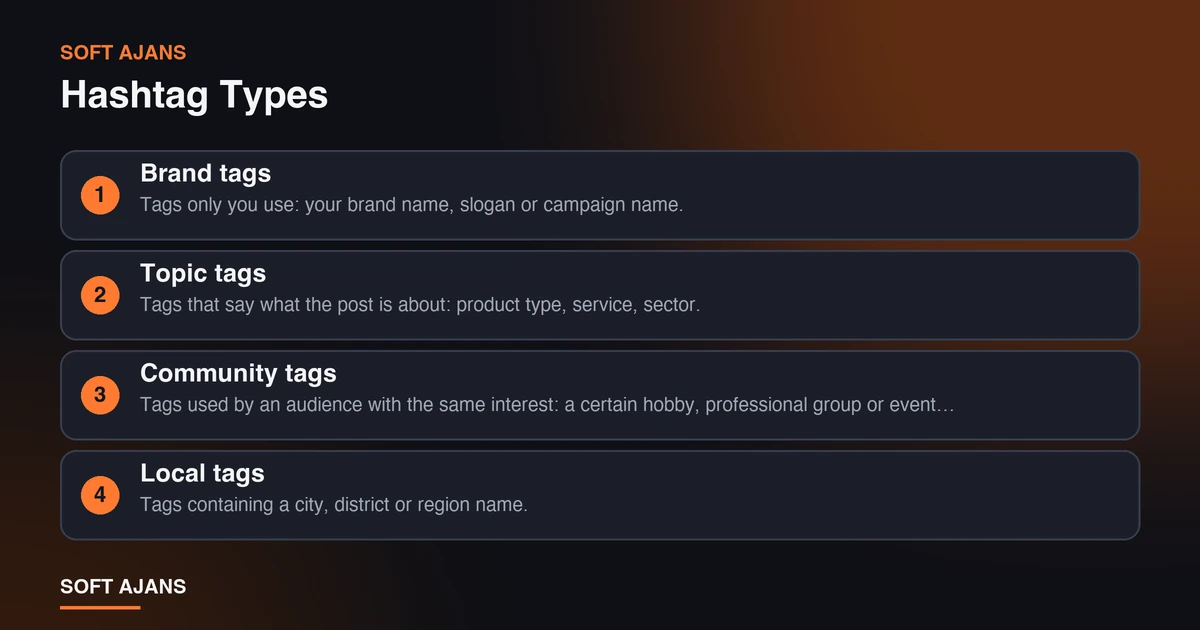
Dividing hashtags into four groups for businesses makes selection easier.
Brand tags. Tags only you use: your brand name, slogan or campaign name. The aim is to gather your content under this tag and to have customers tag you.
Topic tags. Tags that say what the post is about: product type, service, sector. For example coffee types for a cafe, service names for a dental clinic.
Community tags. Tags used by an audience with the same interest: a certain hobby, professional group or event community.
Local tags. Tags containing a city, district or region name. If you have a physical venue or serve a certain region, this group matters.
Mixing several of these groups in balance in one post is usually healthier than loading on a single type.
How Many Hashtags Should You Use?
There is no single exact answer to this question. In the past, using many tags was a common recommendation; over time the platform’s guidelines moved toward preferring few and truly relevant tags. The number of tags Instagram allows and its recommendations can also be updated, so you should check the current limit from the platform’s own help pages.
As a practical start we recommend beginning with 3-5 focused and relevant tags and then looking at your own account’s data. Increasing the number of tags alone does not increase reach; a post inflated with irrelevant tags can look like spam. The real measure is not the number but that each tag is truly relevant to that post.
How to Choose Hashtags, Step by Step
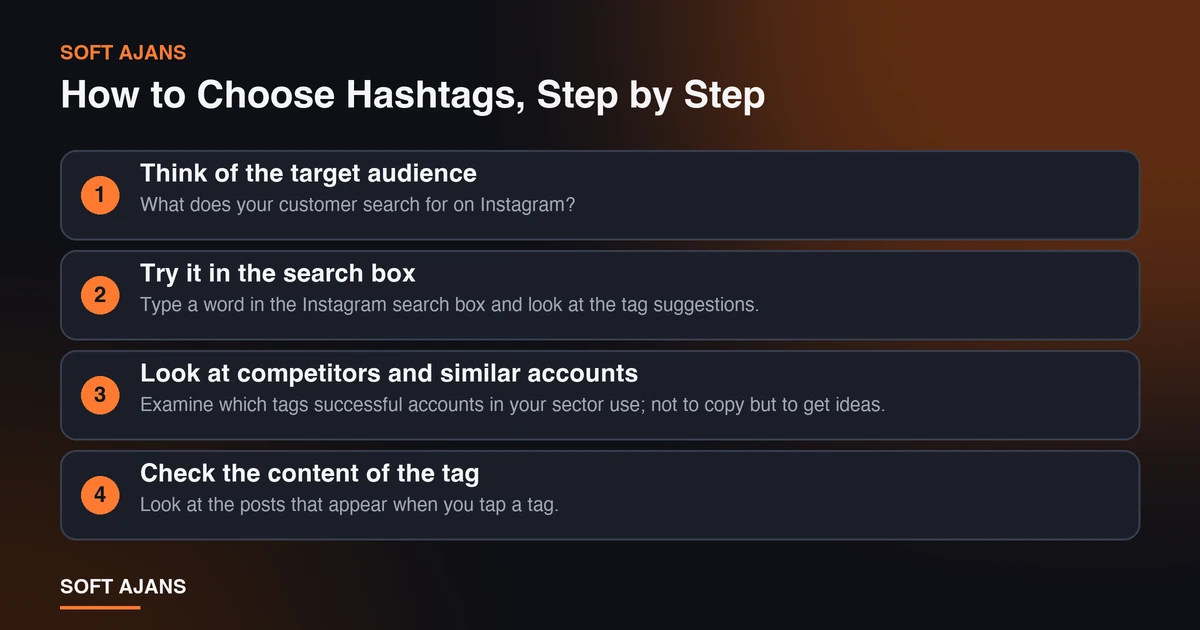
1. Think of the target audience. What does your customer search for on Instagram? The name of your service, the problem it solves or the city it is in? Think of the tag in the customer’s language, not yours.
2. Try it in the search box. Type a word in the Instagram search box and look at the tag suggestions. The tags that appear in suggestions are phrases people really search.
3. Look at competitors and similar accounts. Examine which tags successful accounts in your sector use; not to copy but to get ideas.
4. Check the content of the tag. Look at the posts that appear when you tap a tag. Are there contents similar to your post under the tag, or irrelevant or inappropriate contents? If the latter, do not use the tag.
5. Balance the volume. In very crowded tags your post gets lost quickly; in very small tags nobody searches. A mix of both medium and small volume tags offers a reasonable balance.
6. Build tag lists. Prepare ready lists by topic (see the template below) and adapt them to the content in every post.
7. Monitor the results. Track with Instagram insights which tags go with more views and update the list.
A Sample List Template
You can adapt the template below to your own business. A fictional cafe is used in the examples; change them for your own sector.
- Brand tag (1): the name of your brand, for example
#cafename - Topic tags (2-3): type of service or product, for example
#filtercoffee,#dessert - Local tag (1): city or district, for example
#ankaracafe - Community tag (optional, 1): interest area, for example
#coffeelovers
The most important rule in the template is to change the tags according to the content in every post. Copying and pasting the same list into every post both looks repetitive and carries the risk of tags unrelated to the content. Keeping the tags in a notes file by topic speeds up preparation.
Where Should Hashtags Be Written?
Tags can be written at the end of the caption or in the first comment. No clear superiority has been shown between the two; what matters is readability. Drowning the caption in a crowd of tags weakens the message. Writing a short and clear caption and giving the tags on a separate line usually looks cleaner.
Tags can be used in stories and Reels too. Because terms of use and effects can change, it is best to try the current behavior and look at your own account’s data.
How to Create a Brand Tag and Get It Used
The brand tag is your most valuable tag in the long run, because it belongs only to you. A good brand tag should be short, easy to write and unique. Do not choose a tag that competitors or generic words use.
To get customers to use this tag you can try a small note at the venue, mentioning the tag in campaign posts, or featuring customer posts. When reposting customer content, asking for permission matters both ethically and for trust. The content that builds up under the tag works as social proof over time.
Hashtags and the Content Plan
A hashtag is more efficient when thought of not at the single post level but at the content plan level. In your content calendar, set a tag group for each content series (product introduction, team, customer story, tip). That way you do not think from scratch in every post and your series build up under their own tags.
To build a plan you can use the method in our article on how to prepare a social media content calendar. For the first impression of your profile, take a look at our article on how to write an Instagram bio; the tag strategy and the profile text should complement each other.
How Is Hashtag Performance Measured?
To understand whether a hashtag works, look at Instagram insights. You can see in insights how much of a post’s reach came from hashtags. Trying different tag combinations over several posts and comparing the results shows which tags work.
Points to watch when measuring: do not draw conclusions from a single post, do not ignore the difference of the content itself and look at engagement (saves, comments, profile visits) as well as reach. We explained how social media results are reported in our article on how to prepare a social media report.
Thinking About Hashtags by Sector
Tag logic changes by sector. For a local cafe, restaurant or hairdresser, city and district tags are decisive, because the customer is searching in that area. For an e-commerce brand, product category and purpose-of-use tags come forward. For a service business (clinic, law firm, consultancy), tags carrying the name of the problem the customer asks about are more meaningful than very generic tags.
In areas limited by regulation such as health, finance and law, avoid in tags too wording that contains result promises, comparisons or misleading claims. In these sectors the tag should be chosen with the same care as the content. Compliance with regulation is the business’s responsibility; in doubtful cases take expert advice.
Event, Campaign and Seasonal Tags
Besides the tags you use all the time, you can also plan short-lived tags special to a campaign or event. Set a separate tag for a fair participation, an opening, a sale period or a seasonal period like New Year, and stop using it when the campaign ends. Announcing the event tag in advance makes it easier for participants to use the same tag.
Keep campaign tags on record: on which date it was used in which campaign, how many posts were made with this tag. That way you can use past data when planning the same period next year.
What Matters More Than Hashtags?
Before spending a lot of time on hashtags, look at the factors that determine reach more. First comes the content itself: a visual or video that catches attention in the first second, a clear benefit and a short, readable text. Second is consistency: regular and planned posting. Third is engagement: replying to comments, asking questions, producing content worth saving.
The profile itself matters too. A clear bio, a consistent visual language and a working link turn a visitor into a follower or customer. A hashtag is a small booster added on top of this base; if the base is weak, it saves nothing alone. So give your time first to content quality and then to the tag detail.
Finally, remember that Instagram’s search and recommendation system evaluates the text, the content in the image and engagement signals together. Describing the topic in a natural language in the caption contributes to these signals more directly than a hashtag.
Common Mistakes
- Pasting the same list into every post. Tags unrelated to the content look repetitive and add no value.
- Using irrelevant but popular tags. Tags unrelated to the topic of the post are misleading and can be perceived negatively.
- Not checking the content of the tag. Attaching yourself to a tag that contains inappropriate or irrelevant content harms your reputation.
- Treating many tags as the goal. What matters is not the number but relevance and consistency.
- Using banned or restricted tags. The platform can restrict some tags, which can affect the visibility of the post.
- Not creating a brand tag. If there is no tag to gather your own content, social proof scatters.
- Not measuring tags. Continuing the same method without knowing which tag works.
- Thinking the hashtag is the only strategy. Content quality, regular posting and engagement are more decisive than tags.
What Does Soft Ajans Do in Social Media?
In our social media management service we plan the content calendar, post texts and tag groups according to your business and report performance monthly. We prepare tag lists according to your sector and target audience and update them with the data.
We do not give guarantees of a certain reach, follower count or sales; we share in writing what we do and what we measure. You can ask for a free preliminary analysis to see your account.
Frequently Asked Questions
How many hashtags should I use on Instagram?
There is no exact rule. Check the platform’s current limit, start with 3-5 relevant tags and adjust according to your own account’s data. Relevance matters more than count.
Do hashtags increase reach?
Used correctly they can strengthen the context of the content; however, we cannot guarantee that they increase reach alone. Content quality and engagement are more decisive.
Should I write hashtags in the caption or in a comment?
Both can be used; no clear superiority has been proven. To keep readability, keeping the caption short and giving the tags on a separate line is a clean method.
Can I use the same hashtag list in every post?
We do not recommend it. Adapting the tags to the content in each post looks more relevant and natural. You can choose from ready lists by topic.
How is a brand hashtag created?
Choose a short, unique and easy-to-write tag; mention this tag at the venue, in campaigns and in posts. Always ask permission when sharing customer content.
How do I measure hashtag results?
You can look at the reach sources of a post in Instagram insights and compare different tag combinations by trying them over several posts.


