There is a big difference between typing “write me a blog post” to ChatGPT and getting a usable text. A general request gets a general answer; a request that states the context, target audience, format and limits produces a much more useful draft. These requests are called prompts, and a well-written prompt can noticeably shorten the time of marketing teams.
In this article we explain the formula of a good prompt, 20 ready-made prompt templates you can use in marketing (blog, ad copy, email, social media, SEO and analysis), steps for checking the output and warnings about confidential information. AI is a helper, not a decision-maker: reading every text it produces with human eyes, verifying factual claims and adapting it to the brand’s voice is your responsibility.
The Formula of a Good Prompt
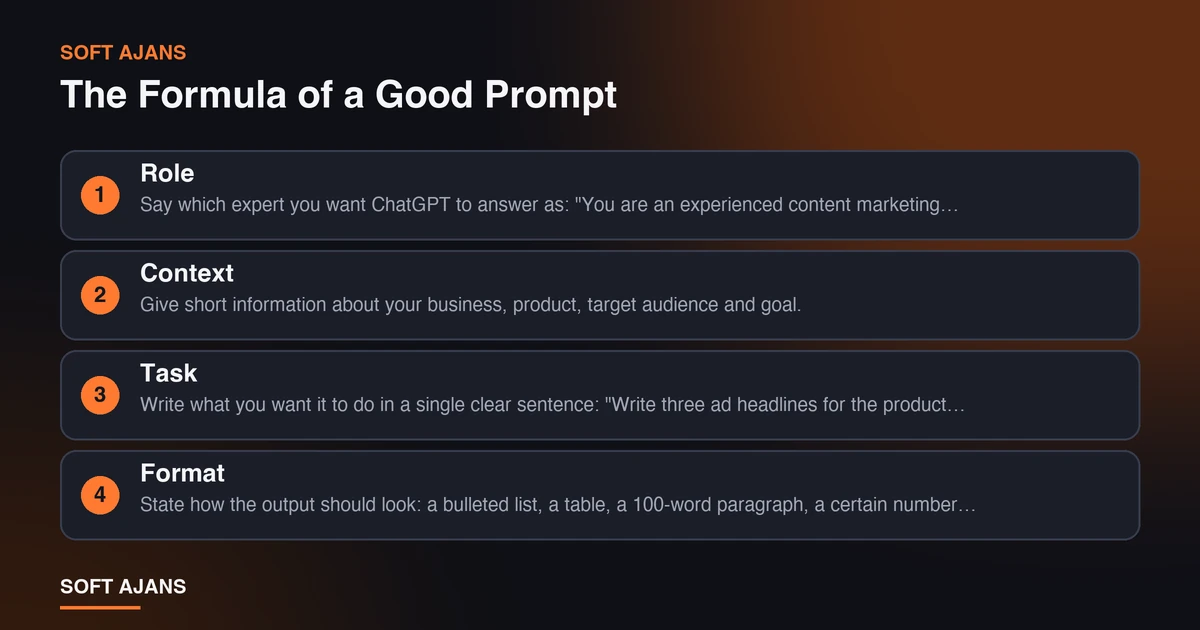
Effective prompts usually consist of five elements. If you keep them in mind you can write your own template on any subject.
1. Role. Say which expert you want ChatGPT to answer as: “You are an experienced content marketing specialist.”
2. Context. Give short information about your business, product, target audience and goal. The clearer the context, the more tailored the output.
3. Task. Write what you want it to do in a single clear sentence: “Write three ad headlines for the product below.”
4. Format. State how the output should look: a bulleted list, a table, a 100-word paragraph, a certain number of options.
5. Constraints. Limits such as tone (formal, friendly), expressions not to be used, length, avoiding exaggeration and not writing unverifiable claims.
A template looks like this: “You are a [role]. [Context]. Your task: [task]. Give the output as [format]. Constraints: [constraints].” The 20 templates below are based on this formula; fill the brackets with your own information.
5 Templates for Blog and Content
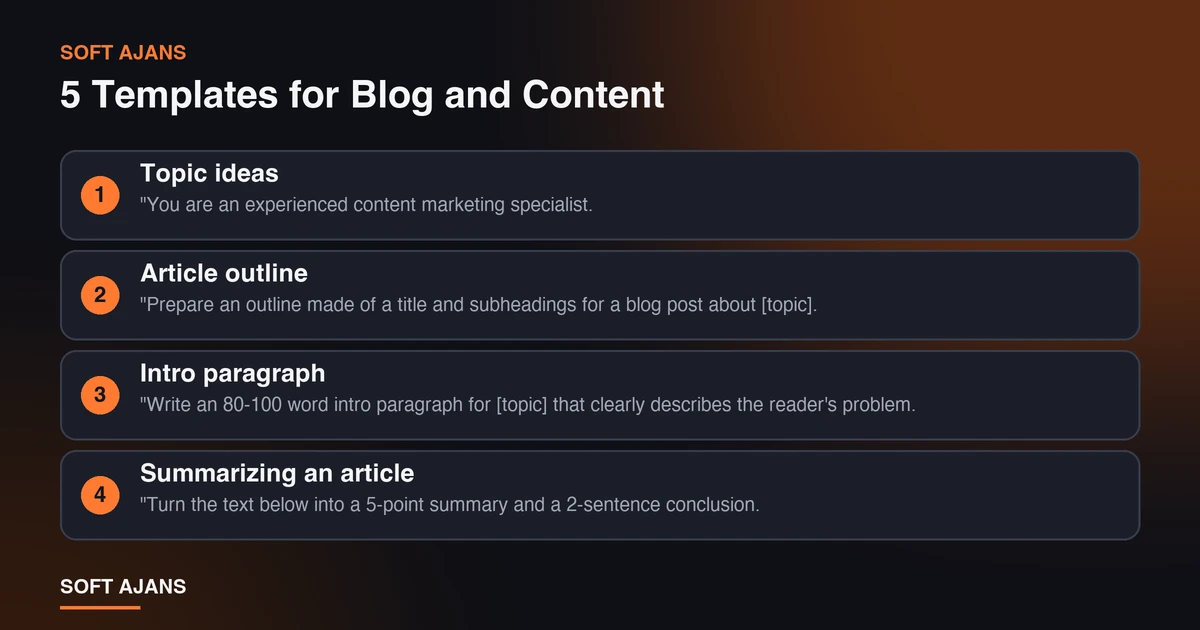
1. Topic ideas. “You are an experienced content marketing specialist. My business: [what it does]. My target audience: [who]. Suggest 15 blog topics this audience might ask about and that could be searched in a search engine. Write a one-sentence search intent for each topic. Give the output as a table.”
2. Article outline. “Prepare an outline made of a title and subheadings for a blog post about [topic]. Reader: [who]. Under each subheading write a 1-2 sentence content note. Do not invent fake statistics; mark information you are not sure of.”
3. Intro paragraph. “Write an 80-100 word intro paragraph for [topic] that clearly describes the reader’s problem. Tone: [plain and friendly]. Do not use exaggerated promises.”
4. Summarizing an article. “Turn the text below into a 5-point summary and a 2-sentence conclusion. Stay faithful to the information in the text, do not add new information. Text: [text]”
5. Improving existing content. “Make the paragraph below clearer and shorter; do not change the meaning and do not add new claims. Text: [text]”
4 Templates for Ad Copy
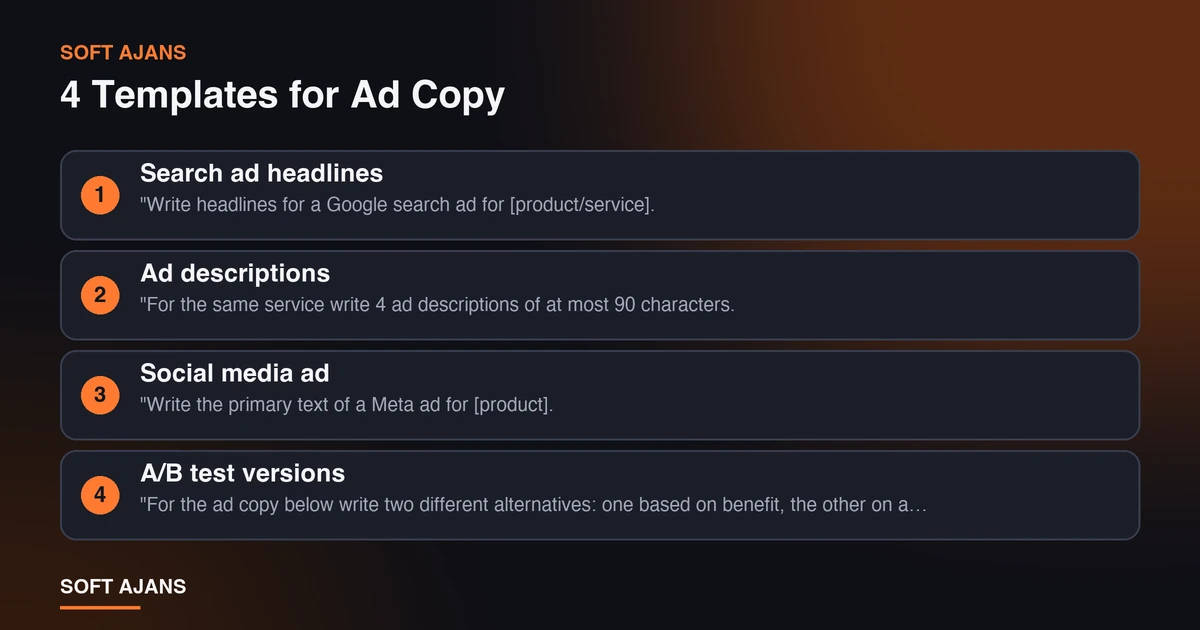
6. Search ad headlines. “Write headlines for a Google search ad for [product/service]. Each headline should be at most 30 characters. They should contain a benefit and an action, and no guarantee or exaggeration. Give 10 options.”
7. Ad descriptions. “For the same service write 4 ad descriptions of at most 90 characters. Each should highlight a different benefit: [benefit 1], [benefit 2], [benefit 3], [benefit 4].”
8. Social media ad. “Write the primary text of a Meta ad for [product]. Target audience: [who]. Use a problem-solution structure and try 3 different tones: informative, friendly, plain. Do not give result promises.”
9. A/B test versions. “For the ad copy below write two different alternatives: one based on benefit, the other on a question. Explain in one sentence why each might work. Text: [text]”
In ad copy, be sure to check the platforms’ policies and your sector’s restrictions (especially health and finance); read the output for compliance with the rules before publishing.
3 Templates for Email
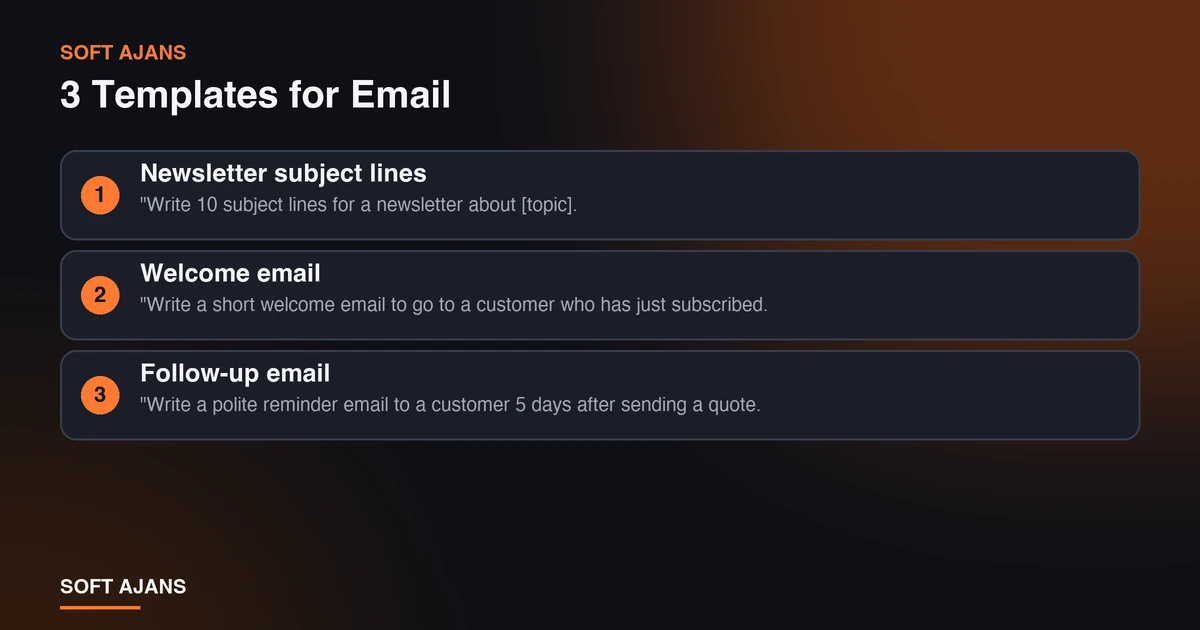
10. Newsletter subject lines. “Write 10 subject lines for a newsletter about [topic]. Each should be at most 50 characters; do not use clickbait and exaggeration.”
11. Welcome email. “Write a short welcome email to go to a customer who has just subscribed. Business: [name, what it does]. Tone: [friendly]. Content: thanks, what to expect, a single call.”
12. Follow-up email. “Write a polite reminder email to a customer 5 days after sending a quote. It should not be pushy, not exceed 80 words and ask a single question.”
3 Templates for Social Media
13. Content calendar ideas. “Prepare a one-month list of Instagram content ideas for [business]. Let there be 3 posts a week; for each idea write the format (image, Reels, story) and a one-sentence description.”
14. Post text. “Write an Instagram caption for the promotion of [product/service]. Give 3 different versions: short (30 words), medium (60 words), storytelling (100 words). Do not add hashtags.”
15. Comment replies. “Write a professional and short reply draft to a customer comment. Comment: [comment]. Do not be defensive, state clearly if an apology is needed, do not ask for personal information.”
5 Templates for SEO and Analysis
16. Title and description suggestion. “Suggest an SEO title (at most 60 characters) and a meta description (at most 155 characters) for the page below. Give 3 options for each. Page summary: [summary]. Target phrase: [phrase]. Do not stuff keywords.”
17. Frequently asked questions. “Write 8 questions customers might ask about [topic] and prepare a 2-sentence, unexaggerated answer draft for each. The answers will not be published without verification; state where you are not sure.”
18. Competitor content comparison. “Below is the heading structure of two pages. List which topics are missing and what my page could add. Rely only on the headings given. Page A: [headings]. Page B: [headings].”
19. Keyword grouping. “Group the keyword list below by search intent (information, comparison, purchase) and suggest an example page type for each group. List: [list]”
20. Report commentary. “Write an executive summary from the monthly numbers below: what rose, what fell, what we learned, what to try next month. Do not change the numbers, do not invent causes; mark the unknown as ‘insufficient data’. Numbers: [table]”
Steps for Checking the Output
AI output is a draft. Apply these steps before publishing:
1. Verify the facts. Confirm statistics, dates, rules and figures from a reliable source. The model can produce wrong information that looks real.
2. Adapt to the brand voice. Edit the text to your own style of expression; texts produced with the same prompt can look similar.
3. Strip out exaggeration and guarantees. Remove expressions such as “definitely”, “guaranteed”, “best” if you cannot verify them.
4. Check regulation and policy. Ad copy should comply with platform policies and, in sectors such as health and finance, with regulation.
5. Add originality. Your own experience, examples and customer knowledge make the text original; a generic output is a text your competitors could also produce.
6. Have a human read it. A person should read it from start to finish before publishing; language and tone mistakes are often caught at this step.
Confidential Information and Security Warnings
The most critical rule in marketing prompts is not to write sensitive information into the prompt. Before pasting a customer name, email, phone, contract content, price list, unpublished campaign or internal financial data into an AI tool, check your company’s policy and the tool’s data usage terms.
A safe method is to replace real data with fictional or anonymous examples. For example, instead of a real customer review, give a general description such as “a customer is complaining about late delivery”. To prepare an internal usage rule you can look at the 10-point draft in our article on an AI usage policy for businesses.
How Do You Improve Your Prompts?
The first answer is often not the final answer. If you did not like the output, instead of rewriting, ask for corrections in the conversation: “Write it shorter”, “Use a less formal tone”, “Give an example for the third item”, “Remove this phrase”. Working iteratively gets results faster than searching for a perfect prompt in one go.
Save the prompts that work somewhere. Building a shared prompt library with your team (role, context and constraints fixed, topic variable) provides both consistency and speed. Also add a note to each prompt on “when to use it” and “what to watch”. For a wide selection of AI tools see our article on free AI tools for businesses and for the general frame our article on AI marketing.
Common Mistakes
- Writing a prompt that is too general. A request without context gives a generic and unusable answer.
- Publishing the output without verifying. Wrong or invented information damages your trust.
- Pasting confidential information. Writing customer and company data into a prompt is risky.
- Leaving all content to AI. Without original experience and voice the content becomes ordinary.
- Never changing the same prompt. Update the context and constraints for each task.
- Forgetting platform rules. Ad copy can violate policies.
- Having competitor site texts copied. It is problematic both ethically and for copyright.
- Confusing the result with a guarantee. A good prompt gives a quality draft; it does not guarantee that it will bring sales or rankings.
What Does Soft Ajans Do in AI?
In our AI consulting service we determine which of your business tasks AI tools can be used for and prepare a safe usage rule and a prompt library together. We also handle checking the outputs, adapting them to the brand voice and the data security framework as part of the work.
We do not give a guarantee of a certain result; we share in writing what will be used how and what will stay under human control. You can ask for a free preliminary analysis to see your situation.
Frequently Asked Questions
What is a prompt?
The command or request you give to an AI tool. The clearer the role, context, task, format and constraints, the more useful the output.
Is it safe to write marketing copy with ChatGPT?
It is useful for producing drafts; however, verifying facts, adapting to your brand and checking platform rules is your responsibility. Do not write confidential or personal data into the prompt.
Is using a ready-made prompt enough?
It is a starting point. You need to add your own context, target audience and brand voice and improve it iteratively.
Does the same prompt give everyone the same result?
No. Output can change with context, the model and time. So check the result in every use.
Does AI-produced content harm SEO?
Low-quality, unverified and mass-produced content can cause problems. Content that has passed human review and includes original information and experience is not a problem. What matters is that the content benefits the user.
Can I paste customer data into an AI tool?
Do not paste it without looking at your company policy and the tool’s data terms. The safe method is to replace real data with anonymous or fictional examples.