Reading a digital agency quote for a clinic that wants to receive patients from abroad is harder than reading an ordinary agency quote. A quote does not only say “SEO”, “ads” and “social media”; it also hides questions specific to health tourism: which country, which language, which treatment, which ad rule and who will reply when a request arrives. If the quote has no answer to these, you do not know what you will receive, however attractive the figure is.
In this article we explain 10 points to check when reading a digital marketing quote for health tourism, questions to ask the agency and common warning signs. This article is not legal or medical advice; the promotion of health services is limited by regulation and compliance is the responsibility of the clinic. If you want to see the search journey of a patient candidate and the multilingual plan in detail, see our article on how to find international patients in health tourism; here our subject is evaluating the quote.
Why Should a Health Tourism Quote Be Read Differently?
The customer of an ordinary local business lives in the same city, speaks the same language and asks by phone. A patient candidate from abroad first researches in their own language, compares several clinics, looks at the doctor’s profile and the reviews, often makes first contact on WhatsApp and may wait for weeks before deciding. The decision process is long and trust is decisive at every step.
For this reason three things need to be clear in a health tourism quote. The first is the target: in which countries and languages, for which treatments will the work be done? The second is the rule: Google and Meta apply restrictions to health ads and wording is limited; how will the agency manage this? The third is measurement: when a request arrives, how will you see which country, which treatment and which channel it came from?
If these three are missing from the quote, the agency is probably offering a general digital marketing package under a health tourism label. A general package does not have to be bad; but it stays incomplete because it does not cover the work health tourism needs.
What Should Be Clear on Your Own Side First?
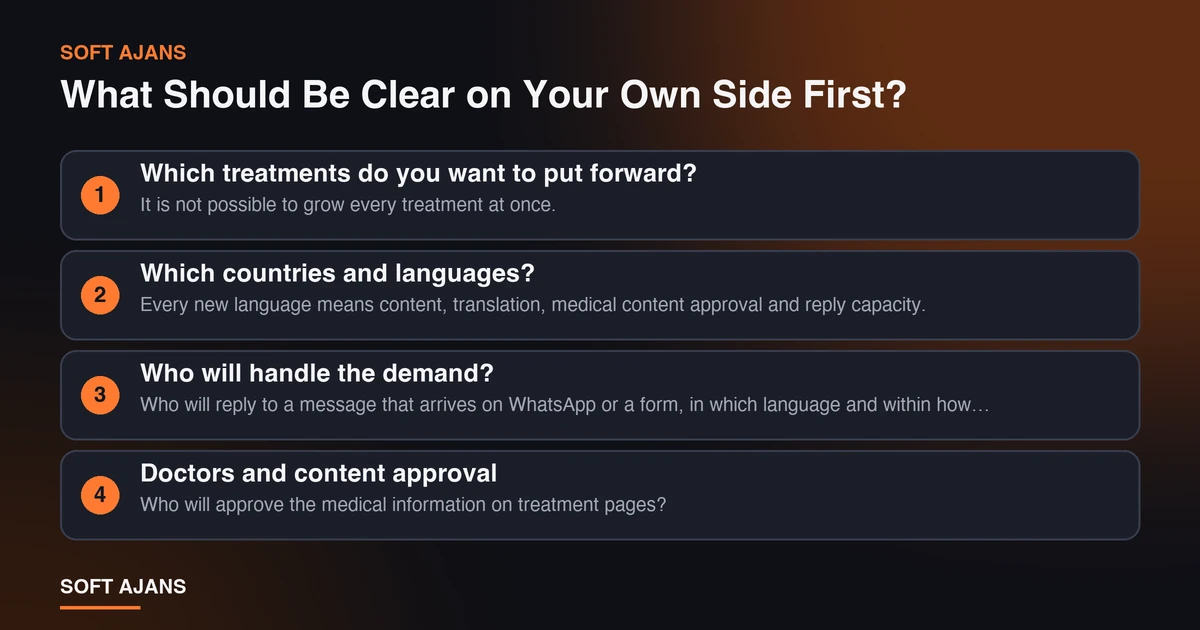
A few things you know before asking for a quote raise the quality of the quotes noticeably:
Which treatments do you want to put forward? It is not possible to grow every treatment at once. Choosing two or three priority treatments makes the content and ad plan clear.
Which countries and languages? Every new language means content, translation, medical content approval and reply capacity. Think in advance about how many languages you can really communicate with patients in.
Who will handle the demand? Who will reply to a message that arrives on WhatsApp or a form, in which language and within how many hours? If a request arrives and goes unanswered, even the best ad is wasted.
Doctors and content approval. Who will approve the medical information on treatment pages? Which information and photos can be used for doctor profiles?
Existing site and data. In which languages does your site have pages, is measurement set up, is there past ad or search data?
When the answers to these five headings turn into a short brief, both the information you give the agency and the quotes become comparable.
10 Points to Look for in a Quote
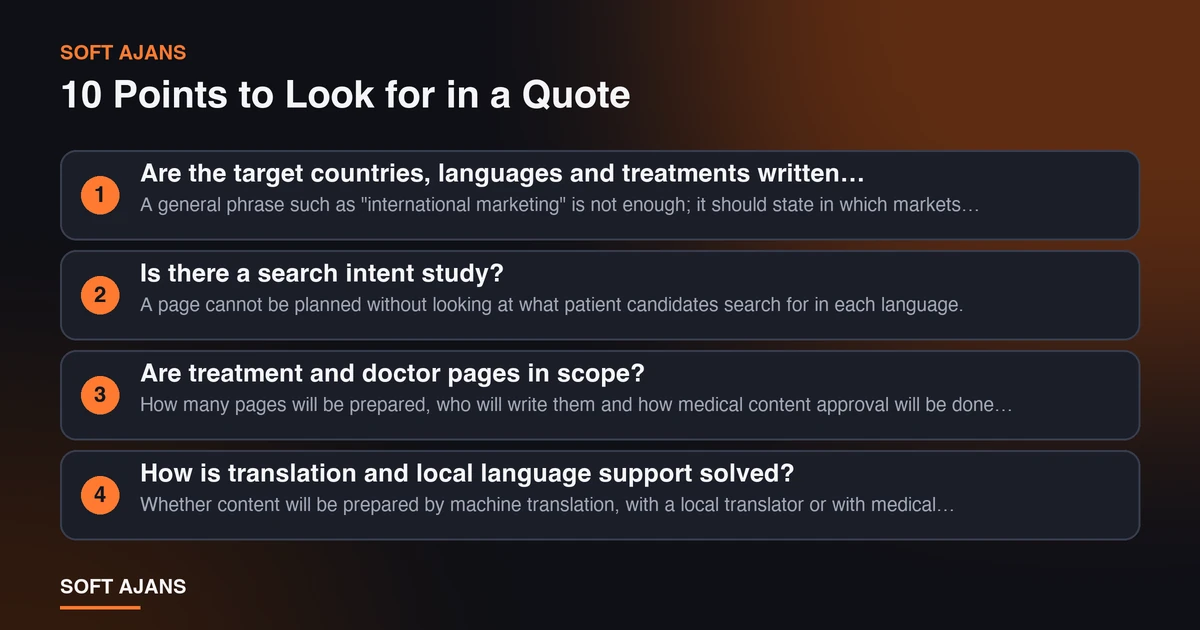
The list below contains 10 points you can tick while reading a health tourism quote. Not all of them need to be “yes”; but every point that is “no” or “not stated” should be asked of the agency.
- Are the target countries, languages and treatments written down? A general phrase such as “international marketing” is not enough; it should state in which markets, with which languages and for which treatments the work will be done.
- Is there a search intent study? A page cannot be planned without looking at what patient candidates search for in each language. The quote should cover this research.
- Are treatment and doctor pages in scope? How many pages will be prepared, who will write them and how medical content approval will be done should be stated.
- How is translation and local language support solved? Whether content will be prepared by machine translation, with a local translator or with medical approval should be written. This item is usually priced separately.
- How are ad rules managed? The agency’s approach to platform restrictions and wording limits in health ads should be explained; it should be stated that result promises and before/after visuals are avoided.
- Is the request flow planned? How WhatsApp, form and phone touchpoints will be tracked and how reply time will be measured should be written.
- Is the measurement and report scope clear? Whether the report is split by country and treatment and how often it is given should be stated.
- Is the ad budget written separately from the service fee? The fee paid to the agency and the ad spend paid to Google and Meta are two separate items and should appear separately in the quote.
- Is the guarantee language honest? A promise of a certain number of patients, a ranking or revenue is a warning sign. In health this is risky both ethically and in terms of regulation.
- Are there ownership and exit terms? Who owns the site, the ad account, the analytics account and the content, and how access is handed over when the contract ends, should be written.
You can also send this list to the agency as a question form. The clarity of the answers shows whether the agency really knows health tourism.
Intermediary or Direct Patient?
In health tourism a patient candidate is reached in two ways: directly as a clinic or through an intermediary agency or platform. The two models need different marketing approaches.
In the direct patient model the clinic’s own site, its own language pages and its own communication channels come first; the clinic builds the trust. This path starts slower but brand and data build up with you. In the intermediary model the patient candidate usually comes from the intermediary’s platform; the agency’s job is more about improving the profile and messages on the platform.
When reading a quote, look at which model the agency assumes. A plan prepared for direct patients may not fit a clinic that works with an intermediary; the reverse is also true. Tell the agency clearly from the start which model you work with.
What Should the Quote Say About Health Ads?
Google and Meta apply targeting and wording restrictions to health and medical ads; in Turkiye too the promotion of health services is limited by regulation. The details of these rules can change over time, so the agency and the clinic’s legal adviser should check the current rule together.
What to look for in the quote is not a recital of the rules but a description of an approach: by which principles will ad texts be written, how will result promises and comparative wording be avoided, within which limits will targeting be set, and what will be done about a rejected ad? An agency that cannot answer this clearly is leaving the risk of your account being restricted to you.
For wording limits on the social media side, see our article on social media management in the healthcare sector; the same sensitivity applies to ad texts.
What to Look for in Treatment and Doctor Pages
In health tourism, trust comes largely from page content. The quote should state how treatment pages will be prepared, how doctor information will be presented and which sources will be used. A good treatment page explains the process, preparation, recovery and frequently asked questions without exaggeration and avoids promises such as “guaranteed result” or “painless”.
On doctor pages, education, experience and area of expertise should be verifiable. We explained the elements that build trust in health content in detail in our article on how to achieve E-E-A-T on health websites. If the quote gives no place at all to these elements (author information, medical approval, update date), the content may be aimed only at stuffing keywords.
Multilingual Structure: Technical Items
A multilingual site is not only translated pages. Each language needs its own address structure, tags that tell the search engine how the language versions relate, a language switcher and correct redirection. If these are set up wrongly, pages may be shown in the wrong country or compete with each other.
Check whether these technical items (address structure, hreflang, language switcher, page speed) are in scope in the quote. For a detailed checklist you can use our multilingual website hreflang checklist; it was prepared for e-export but the technical principle is the same.
Why Are WhatsApp and Reply Speed Part of the Quote?
A patient candidate usually writes on WhatsApp after clicking an ad or a page. If the reply is late, they may have written to another clinic the same day. For this reason a good quote does not only promise “more clicks”; it also covers measuring WhatsApp clicks, form submissions and phone calls as conversions and making reply time visible.
Here the responsibility of the agency and yours separates: the agency brings and measures the demand; the clinic’s team gives the reply. Writing this boundary clearly in the quote reduces later arguments of “the request came but did not convert”.
How Should Price Items Be Read?
In a health tourism quote the price usually consists of these items: search and content work, treatment and doctor pages, translation and local language support, multilingual technical structure, ad management, measurement and reporting. Each of them grows with the number of target countries and languages.
Comparing two quotes by the total figure is misleading; one may be prepared for two languages and the other for five. Have the items written one by one, ask for variable items such as translation and local approval to be shown separately and read the ad budget apart from the service fee. We explain our pricing approach on our how pricing works page.
Common Mistakes
- Trying to grow all treatments at once. If priorities are not set, the budget is scattered.
- Increasing the number of languages faster than reply capacity. Every new language that cannot be answered is a lost opportunity.
- Setting up ads without looking at regulation and platform rules. A rejected ad and a restricted account cost serious time.
- Believing a promise of patient numbers. No agency can guarantee a certain number of patients.
- Leaving translation only to a machine. A wrong expression in medical content damages trust.
- Not planning the request flow. Replying late to an incoming message wastes the ad spend.
- Not setting up measurement by country and treatment. If it is not visible which market works, the budget cannot be distributed correctly.
- Not asking about account ownership. If ad and analytics accounts are opened in the agency’s name, data may be lost when you leave.
What Does Soft Ajans Do in Health Tourism?
In our health tourism digital marketing service we determine what patient candidates search for by treatment, country and language, prepare treatment and doctor pages without exaggeration, set up ads according to the platforms’ health rules and report WhatsApp, form and phone requests by country and treatment.
We have no published case study aimed at international patients; our two published health cases are the organic search results of doctors’ sites. We do not give patient number or ranking guarantees and we say from the start that compliance with regulation is the clinic’s responsibility. To see your situation you can ask for a free preliminary analysis.
Frequently Asked Questions
What is the most important criterion when choosing an agency for health tourism?
There is no single criterion, but three points are the most critical: target countries, languages and treatments being written down, the approach to ad rules being clear and measurement being done by country and treatment. If these are missing from the quote you may be facing a general package.
Can an agency guarantee the number of patients?
No. A patient’s decision depends on many things from price to the doctor, from reviews to reply speed. A promise of a certain number of patients or revenue is a warning sign both ethically and in terms of regulation.
How many languages should I start with?
Starting with at most two or three languages that you can answer and that really have demand for your target treatment is usually healthier. Every new language requires content, translation, approval and reply capacity.
Does the agency do the translation?
It depends on the agency. Some produce content in their own languages, some work with local translators. Medical content approval and translation cost are usually a separate item; they should be written clearly in the quote.
Is the ad budget included in the service fee?
Usually not. The service fee paid to the agency and the ad spend paid to Google and Meta are separate items and should be shown separately in the quote.
Can you work with an agency whose office is in another city?
Often yes, since the work is largely done by video call, WhatsApp and email. What matters is that the process, approval flow and reporting are clear.