For a manufacturer or brand that sells abroad, a website is the digital counterpart of a trade fair stand. A foreign buyer usually finds you once, with a search in their own language from their own country. If what they meet is a Turkish site, a page full of translation mistakes or a structure that does not say which country you serve, they move on to the next result.
In this article we explain how to build a multilingual website for e-export: which language and market to start with, what the URL structure should be, how to set up hreflang tags, which details in the content matter to a foreign buyer and how to collect quote requests. At the end there is a 12-item checklist. While explaining, we also give examples from the topics we met when building our own English section; but let us say at the start that we have no published case study focused on exports: what follows is based on our experience of building and publishing multilingual sites and is not a promise of results.
How Does a Foreign Buyer Evaluate Your Site?
The way a buyer abroad evaluates a supplier is different from the way a domestic buyer does, because the risk is higher: a distant country, a different language, uncertainty about shipping and payment. So the site must answer a few questions quickly and clearly:
- What do you make and for whom? The product page should be written in the terms the buyer uses in their own sector.
- Are you reliable? Company details, photos of production or the facility, documents and references should be visible.
- How do I order? There should be information about minimum order quantity, lead time, payment and delivery terms.
- How do I reach you? There should be a quote form that gets a fast reply, an e-mail and, if possible, a messaging channel.
If most of the site is in Turkish, the foreign buyer cannot find answers to these questions. A multilingual structure is therefore not a “translation job” but a trust and enquiry-flow job. For the general framework of e-export, see what e-export is and how it is done, and if you are considering the marketplace route, see what marketplace integration is. This article focuses on your own site being found by foreign buyers and turning into enquiries.
Language and Country Decision: Which Market First?
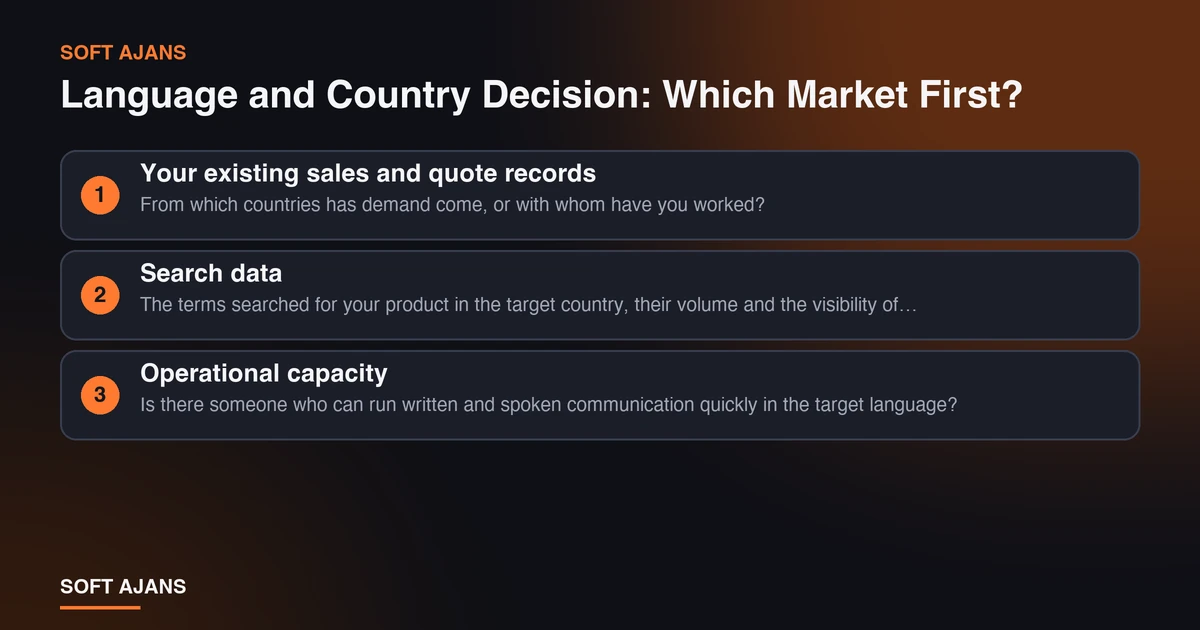
Each language and country needs separate content, measurement and communication; so it is healthier to start with one or two markets and learn. Look at these sources for the choice:
- Your existing sales and quote records: From which countries has demand come, or with whom have you worked? Starting in a market where you already have a relationship is less risky.
- Search data: The terms searched for your product in the target country, their volume and the visibility of competitors. Also look in Search Console at which countries visits to your current site come from.
- Operational capacity: Is there someone who can run written and spoken communication quickly in the target language? Opening a page in a language in which you will not reply can backfire.
Language and country are not the same thing. English is used as a commercial language in many countries; but British, American and Australian spelling, units and habits differ. You can start with a single English version; think about country-specific versions only when that market really grows. For languages such as German, Arabic or Russian, a local translator and technical content approval are needed; this raises both time and cost.
What Is hreflang and How Is It Set Up?
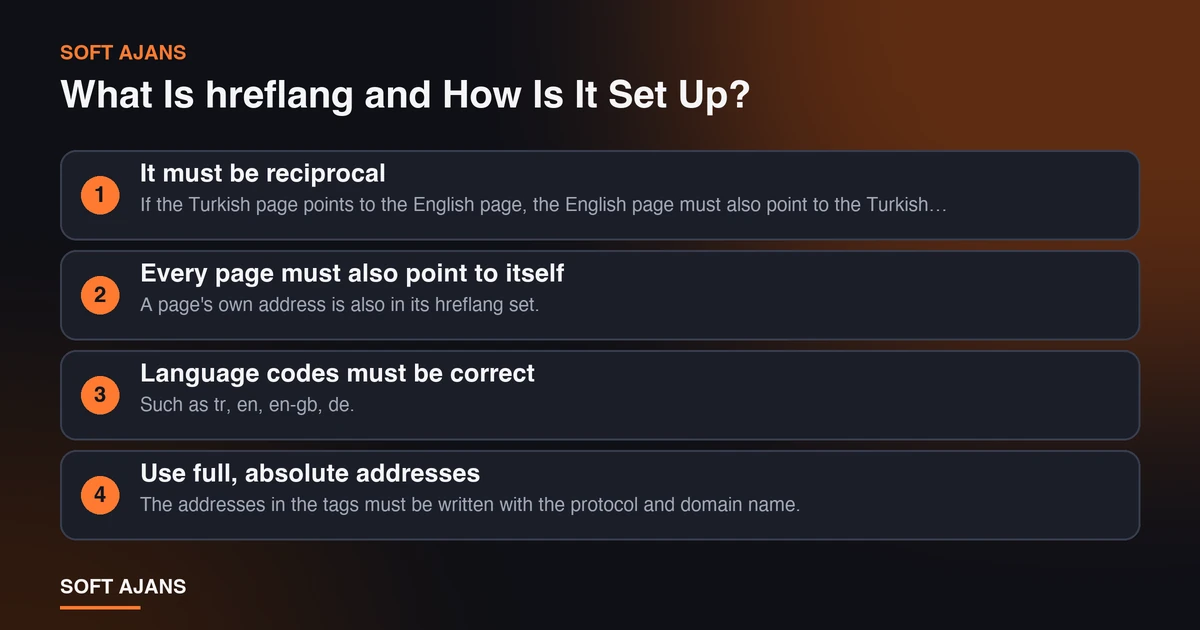
hreflang is a tag that tells the search engine about the different language or country versions of the same content. The aim is to show the English page to someone searching in English and the Turkish page to someone searching in Turkish. If it is not set up correctly, the search engine may think the versions are copies of each other or may show the wrong version.
Most of the rules are simple but need care:
- It must be reciprocal. If the Turkish page points to the English page, the English page must also point to the Turkish page. One-way links may be ignored.
- Every page must also point to itself. A page’s own address is also in its hreflang set.
- Language codes must be correct. Such as
tr,en,en-gb,de. If a country is added, it comes after the language code (en-gb); the order cannot be reversed. - Use full, absolute addresses. The addresses in the tags must be written with the protocol and domain name.
- Define x-default. It shows the default version for users whose language does not match; on most sites it is the main language version.
- It must not conflict with canonical. If a page’s canonical points to another page, hreflang may be ignored; each language version gives its own canonical to itself.
- Add it only to pages that really have a counterpart. Do not write a fake match for a page that has no counterpart.
Writing tags by hand causes mistakes. Our hreflang tag generator produces the <head> tags or the XML sitemap format when you enter the language versions; it runs in the browser and the information you enter is not sent to a server. If you use a sitemap, giving the hreflang information there makes management easier on large sites; for the sitemap topic, see the sitemap article.
URL Structure: Subfolder or Subdomain?
You can separate language versions in three ways: a subfolder (site.com/en/), a subdomain (en.site.com) or a country domain (site.de). Google supports all three; the right choice for you depends on ease of management and your resources.
For small and medium-sized e-export sites a subfolder is often the most practical way: one domain, one hosting, one measurement setup and one accumulation of authority. Country domains send a strong country signal but each is managed like a separate site; each needs separate hosting, maintenance and link work. A subdomain sits between the two.
Whichever structure you choose, be consistent: the page matching between versions must be kept, the language switch button should take the visitor to the counterpart of the same page (to a sensible fallback page if there is none), and if you later change the address of a page, a 301 redirect must not be forgotten.
Content Checklist: Currency, Units, Contact, Documents
Translation is not enough; if the following details are missing from the foreign buyer’s point of view, trust is damaged:
- Price and currency. If you show prices, write the currency clearly (USD, EUR and so on). If you do not show prices, offer the “request a quote” option clearly and state the reply time.
- Units of measure. If the target market does not use the metric system, also show product dimensions in a second unit.
- Phone and time. Write the phone number in international format (with the country code); state working hours with the time zone so the buyer knows when they will get a reply.
- Company details. The company title, address, founding year, tax or trade registry details and contact persons should be visible.
- Documents. Show the certificates, test reports and standards you hold; only real and valid ones. Showing a document you do not have on the site carries both reputation and legal risk.
- Commercial terms. Write a summary for minimum order quantity, typical lead time, payment methods and delivery terms (for example international delivery terms such as EXW and FOB); you can set the details in the quote.
- Real images. Photos of the production line, warehouse, product details and team give more trust than stock images.
- Legal pages. The privacy and cookie notice should suit the expectations of the target market; get expert advice for the texts.
Translation Quality and Local Language
Automatic translation produces a good draft but should not be published on its own. If technical terms are translated wrongly, the buyer loses trust; product names, material names and standard names should be written with the equivalents used in the sector. It is recommended that someone who knows the sector reviews the translation, and then a short glossary of terms is prepared and used consistently on all pages.
Translating a text word for word is also often not the best way. A foreign buyer’s question can differ from a Turkish buyer’s question: which documents do you have, where do you ship, what is the minimum order. Rebuilding the content around those questions and removing unnecessary local details creates more value than translation. We followed this path in our own English section too: while keeping the structure and headings, we shortened and localized the texts.
Quote Form, Catalog and B2B Enquiry Flow
The purpose of a multilingual site is to receive a quote request. So design the enquiry flow around the foreign buyer’s habits:
- Quote form (RFQ). Keep it short and clear: name, company, e-mail, country and delivery place, product and estimated quantity, a short message. A very long form is abandoned halfway.
- Catalog download. Offering an English product catalog as a PDF makes it easy for the buyer to show you in their internal meeting. For catalog preparation see how to prepare a product catalog.
- Messaging and LinkedIn. Some B2B buyers start contact on LinkedIn or a messaging app; make these channels visible and set your reply time.
- Automatic acknowledgement. A short confirmation e-mail that tells the buyer the reply time when the form is submitted builds trust.
- Source and country measurement. Measure from which country, which page and which channel a quote form came; you direct the budget accordingly.
On the advertising side, country- and language-targeted campaigns are the way to reach buyers in the target market directly; you can find the details in advertising abroad and in our Google Ads management service. For ads to work efficiently, the site structure must be ready first.
Lessons From Our Own English Section
When building the English section of our site (service pages, corporate pages and more than 400 blog posts) we made several decisions, and what we learned from them also applies to e-export sites:
Keeping the matches in one place. The English counterpart of each Turkish page is kept in a record file; the language switch button and the hreflang tags are produced from this record. Hand-written tags become inconsistent over time; producing them from a single source reduces errors.
Reciprocal hreflang on every page. The Turkish and English versions point to each other, with Turkish as the default version. Before launch we automatically checked that the pairs were reciprocal.
Making a scope decision. You do not have to translate every page. We did not translate the province and district pages into English, because they mean nothing to a foreign buyer; the free tools and downloadable templates stayed in Turkish, and links to these pages from English pages deliberately go to the Turkish address. Not writing a fake match for a page that is not translated protects quality and accuracy.
English posts linking to English posts. If a visitor has chosen a language, you need to keep them in that language. So links in English posts go to English pages wherever a counterpart exists.
A separate sitemap and clear robots information. The English section has its own sitemap; because search bots read only the root robots.txt file, both sitemaps were listed there.
We do not guarantee what the result will be; but this structure keeps a multilingual site orderly, auditable and scalable. You can look at our English section to see the result.
A 12-Item hreflang and Content Checklist
- I chose the starting language and market using data.
- The URL structure of the language versions (subfolder, subdomain or country domain) is clear and consistent.
- Every page has a counterpart; I did not write hreflang for a page without one.
- The hreflang tags are reciprocal and each page also points to itself.
- Language and country codes are written correctly; x-default is defined.
- Each version’s canonical points to itself.
- The language switch button goes to the counterpart of the same page.
- The translation was reviewed by someone who knows the sector; terms are consistent.
- Currency, units, phone and time zone suit the target market.
- Company details, documents and a summary of commercial terms are visible.
- The quote form is short; catalog download and reply time are stated.
- Measurement of the quote form by country, page and source is set up.
What Does Soft Ajans Do in E-Export?
In our e-export and international digital marketing service we research what buyers search for in the target country, set up the English site and catalog structure in line with the multilingual technical infrastructure (hreflang, URL structure), manage country- and language-targeted Google Ads campaigns and measure B2B touchpoints (quote form, catalog download). Our own team produces the English content; for languages such as German, Arabic or Russian a local translator and technical approval are needed, and we can plan and manage this. We do not offer marketplace store management, grant applications or customs and logistics consulting.
A similar logic applies in the health sector; for clinics looking for patients from abroad, see how to find international patients in health tourism. To see the current state of your site, you can request a free pre-analysis.
Frequently Asked Questions
Is hreflang mandatory for a multilingual site?
It is not mandatory, but if you offer the same content in several languages it helps the search engine a great deal to show the right version to the right user. Without hreflang, versions can be seen as copies of each other and the wrong language can appear in results.
Should I choose a subfolder or a country domain?
For small and medium-sized sites a subfolder is usually the most practical method: one domain, one management and one authority. A country domain sends a strong country signal, but each is managed like a separate site and requires resources.
Can I publish the site with automatic translation?
You can use it as a draft, but someone who knows the sector should review it before publishing. A wrong translation of technical terms damages the buyer’s trust, and low-quality translation can also be a disadvantage in search results.
Should I show the price on the site?
It depends on your product and your market. For standard products, showing a starting price makes screening easier; for project-specific products, a “request a quote” approach is more suitable. Whichever you choose, write the currency and your reply time clearly.
Which pages should I translate?
First the pages the buyer looks at when deciding: the home page, product and service pages, about, documents, contact and the quote form. Translating locally focused pages (such as province and district pages) is mostly unnecessary.
What should be ready before advertising abroad?
An English landing page, a working quote form, a measurement setup and someone to reply. An ad run when the site is not ready wastes budget because it cannot collect the demand.