In health tourism, a prospective patient does long research before choosing a clinic. They search in their own language for where, with which doctor, in how long and under what conditions they can be treated; they read the reviews, look into the doctor’s background and look for a channel where they can ask their question. If the clinic is not visible on this journey, however good it is, the prospective patient never sees it.
In this article we explain what path a clinic looking for patients from abroad can follow digitally: how a prospective patient does research, which language and market to start with, how treatment and doctor pages should be built, what the multilingual technical structure should be like, and how the communication flow and measurement should be planned. The article describes a marketing method; it is not medical or legal advice. The promotion of healthcare services in Turkey is limited by regulation, and compliance is the responsibility of the clinic and its legal adviser.
How Does an International Patient Research?
The decision process of a prospective patient from abroad mostly follows this order. First they do a general search in their own language: the name of the treatment, the country or city, and sometimes the price. Then they compare the clinic sites, doctor profiles and reviews that come up. Then they ask a question through a contact channel (mostly WhatsApp, a form or e-mail). If the answer is not fast, clear and reassuring, they move to another clinic.
The digital counterpart of this journey is four points:
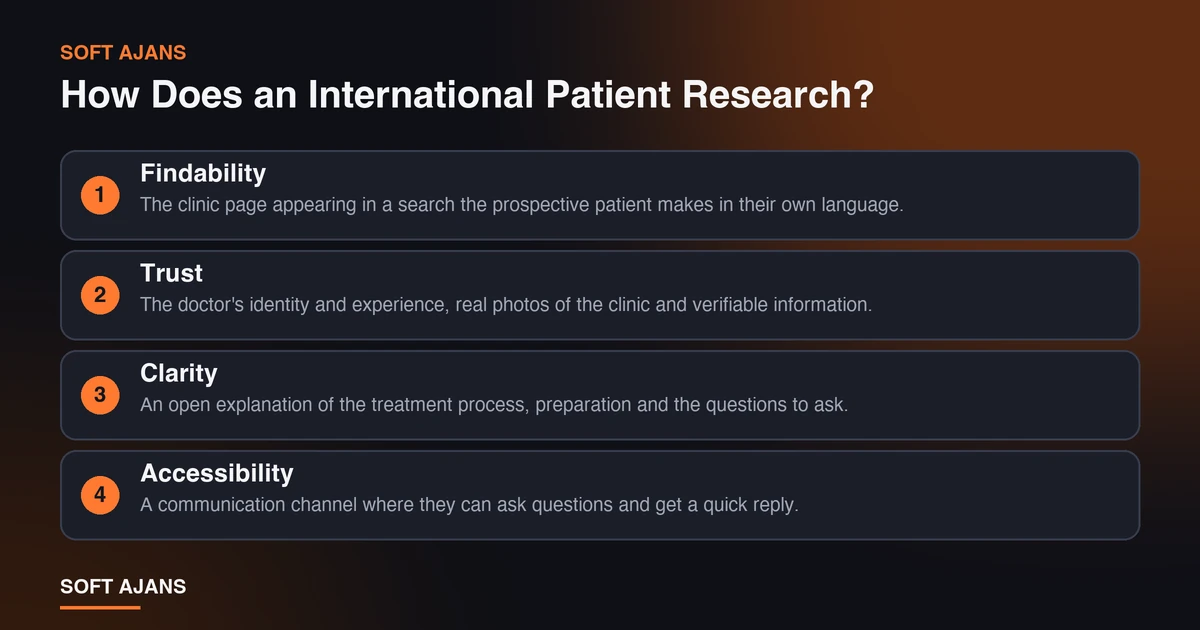
- Findability: The clinic page appearing in a search the prospective patient makes in their own language.
- Trust: The doctor’s identity and experience, real photos of the clinic and verifiable information.
- Clarity: An open explanation of the treatment process, preparation and the questions to ask.
- Accessibility: A communication channel where they can ask questions and get a quick reply.
If one of the four points is weak, the others are not enough. That is why, before saying “let’s run ads”, you need to look at which one is missing.
We described what a prospective patient searches for on Google and how that turns into a clinic’s visibility, through domestic patient behavior, in how to find doctors and clinics on Google; for an international patient the logic is the same, with the dimension of language and country added.
Which Languages and Markets Should You Start With?
Each language and country needs a separate content and measurement plan; opening to many languages at once therefore spreads resources. The healthier approach is to start with one or two languages and markets and learn.
Look at three data sources for the choice:
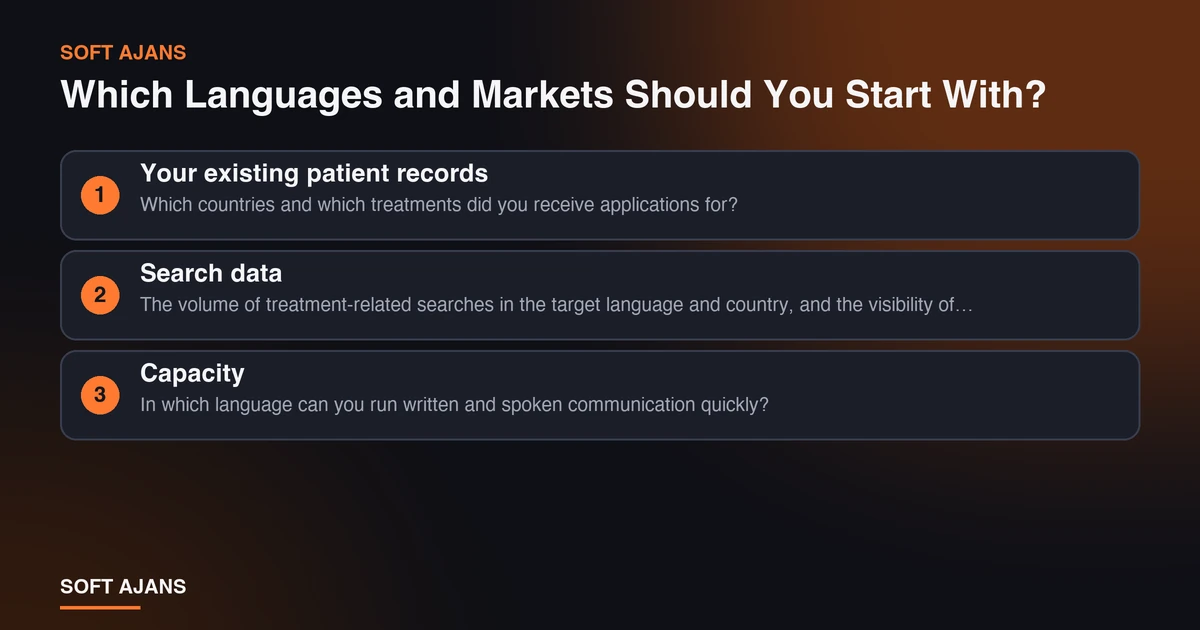
- Your existing patient records: Which countries and which treatments did you receive applications for? A market that has worked in the past is less risky than a new one.
- Search data: The volume of treatment-related searches in the target language and country, and the visibility of competitors. Keyword tools and Search Console give direction.
- Capacity: In which language can you run written and spoken communication quickly? Opening an Arabic page requires having someone who will reply in Arabic.
There is a practical truth in the language decision: English is a common starting language in many markets, and starting with a single language lowers the cost. For other languages (Arabic, Russian, German and so on) a local translator and medical content approval are needed; this raises both cost and time. We produce Turkish and English content with our own team; for other languages we can plan and manage the translation and medical approval process, and we write the scope and cost separately in the quote.
How Should Treatment, Doctor and Clinic Pages Be Built?
Content quality on health sites sets a higher bar than in other sectors. Google evaluates this area more carefully as topics that “could affect the user’s health and life”, so trust signals come to the fore. We described the content principles in how to establish E-E-A-T on health websites.
A treatment page should answer these questions:
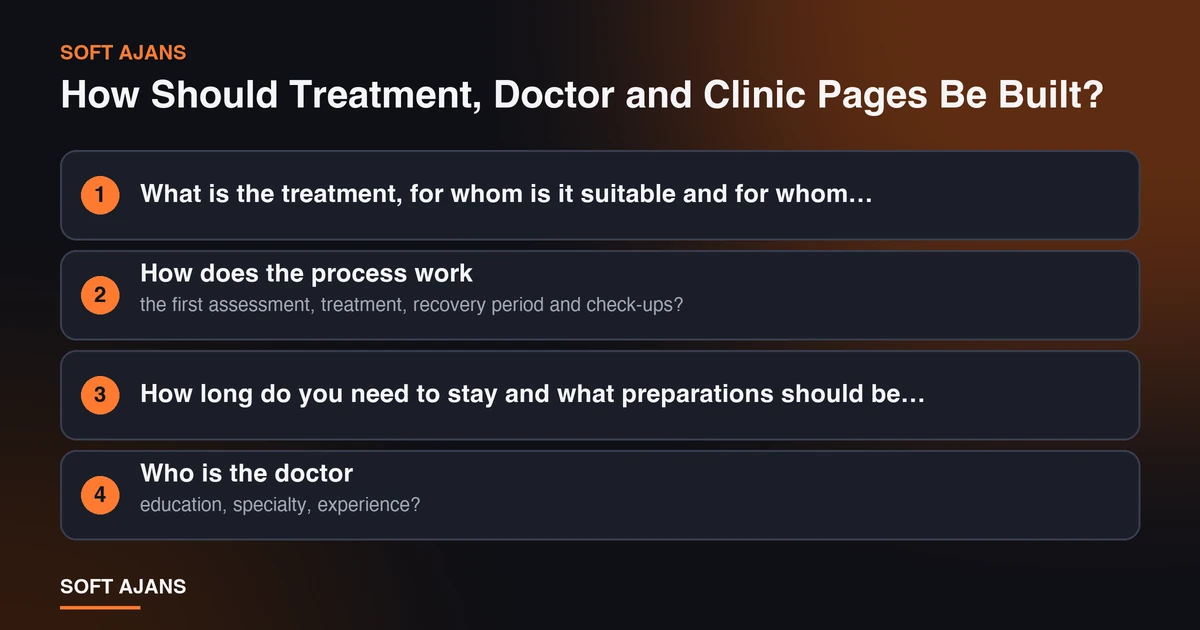
- What is the treatment, for whom is it suitable and for whom is it not?
- How does the process work: the first assessment, treatment, recovery period and check-ups?
- How long do you need to stay and what preparations should be made?
- Who is the doctor: education, specialty, experience?
- How is follow-up after the patient leaves done?
- What are the frequently asked questions?
When writing, avoid exaggeration and promises of definite results. Expressions like “the best”, “guaranteed result” and “painless” can violate both platform policies and regulation, and they reduce the prospective patient’s trust. Patient photos and before/after images are also a risky area both legally and for platforms; we do not recommend this type of content.
Doctor pages carry a value of their own: a real photo, education and experience, memberships, publications and a short introduction. The prospective patient thinks they will be in contact not with you but with the doctor. The clinic page should also include photos of real equipment and facilities, and accreditations and documents (only real and valid ones).
Multilingual Technical Structure: hreflang, URLs and Language Selector

Even if the content is ready, if the technical structure has not been set up for multiple languages, the search engine cannot show the right page to the right user. Pay attention to three things:
hreflang between language versions. The Turkish and English versions of the same page must point to each other with hreflang tags; that way the English version appears for a user who searches in English. The tags must be reciprocal and each page must also point to itself. To produce the tags quickly we have our hreflang tag generator; for a detailed checklist see a multilingual website for e-export.
A consistent URL structure. Having language versions in a separate and orderly structure such as /en/ shows the version clearly to both the user and the search engine. There should be a counterpart for every page between language versions; for a page without a counterpart, the language switch button should not fall back to the home page.
A visible language selector. The visitor should be able to change the version themselves and the choice should be remembered. If you redirect automatically by browser language, take care not to lock search engine bots and users into the wrong version.
To see whether the technical structure is healthy, you can run your site through the checks in our technical SEO service.
WhatsApp and Fast Reply: The Enquiry Flow
In health tourism, prospective patients mostly reach out through WhatsApp and a form. The contact channel is a conversion point and it needs to be designed:
- A visible WhatsApp link that opens with one tap. The link can open with a ready message: “Hello, I would like to get information about [treatment].”
- A reply-time target. The prospective patient talks to several clinics at the same time. In which hours and in which language replies are given should be written on the site; an automatic welcome message can be used for messages outside office hours.
- The content of the first reply. Prepare a standard reply template: introduce yourself, ask for the information needed (treatment, history, documents), explain the process and write the next step clearly. Do not give medical advice on matters that need a doctor’s assessment.
- Protection of personal data. Health data is special-category personal data; decide in advance which information will be taken through which channel and how it will be stored.
Message reply time is a value that can be measured and improved. When you move to an agency, also clarify who holds the communication channels; for account ownership the article who owns your digital accounts will be useful.
Advertising: Platform Rules and Regulation
Google and Meta apply targeting and wording restrictions to ads with health and medical content. For some treatment types and sensitive categories, running ads may be limited or closed; the rules vary by country and over time. In Turkey, too, the promotion of healthcare services is limited by regulation.
In practice these principles work: avoid promises of results and comparative superiority claims in ad copy, do not use patient photos or before/after content, set up targeting within the limits the platform allows, and clean search terms regularly. Submit ad copy to the clinic and, if needed, to a legal adviser for approval. We described how ad management runs in our Google Ads management service.
Ads do not replace search visibility; the two complement each other. Prospective patients also look at organic results and reviews before clicking an ad; so raising the ad budget when the content and trust layer are not ready is inefficient.
Measurement: Reporting by Country and Treatment
In health tourism the question “how many people came” is not enough; you need to know from which country, for which treatment and through which channel they came. A measurement plan should include:
- Events such as WhatsApp click, form submission, phone and e-mail click.
- Country and language breakdown: from which market do visits and enquiries come?
- Treatment page breakdown: which pages generate enquiries?
- Source breakdown: organic search, ads, map, direct.
- The quality of the enquiry: how many messages turned into a real first assessment? You keep this data on the clinic side and it is added to the report.
In the report it becomes possible to redistribute the budget based on this data: weight goes to the countries and treatments that work, and no resources are allocated to those that do not. For the measurement setup, the methods in call tracking are useful.
A 10-Item Starter Checklist
- I chose the one or two languages and markets I will start with, using data.
- I have a separate page with verifiable information for each main treatment.
- Doctor pages have a real photo and education and experience information.
- The site has no promises of results, patient photos or before/after content.
- Language versions are linked reciprocally with hreflang.
- The language selector is visible and every page has a counterpart.
- The WhatsApp link opens with a ready message; the reply-time target is clear.
- The first reply template and the personal data flow are ready.
- Ad copy has been approved by the clinic and, if needed, a legal adviser.
- Measurement is set up by country, treatment and source.
Honest Limits
We want to state openly what we can and cannot do in this area. We do not have a published case study focused on patients from abroad; our two published health cases are the organic search results of doctors’ sites (cardiology and orthopedics). The method in this article is based on our experience in multilingual SEO, policy-compliant advertising and measurement; we do not give a guarantee of results. Compliance with regulation is the responsibility of the clinic; we do not provide legal advice.
What Does Soft Ajans Do in Health Tourism?
In our health tourism digital marketing service we determine what prospective patients search for, for which treatment, country and language; write treatment and doctor pages clearly and without exaggeration; set up Google and Meta ads according to the platforms’ health rules; and report the WhatsApp, form and phone touchpoints by country and treatment. For the local visibility of clinic and doctor sites, you can also look at our doctor and clinic SEO service.
To compare the search visibility of your site with a competitor’s, you can request a free pre-analysis.
Frequently Asked Questions
Which language makes sense to start with in health tourism?
Decide according to your existing patient records and search data. English is a common starting point in many markets and lowers the cost; but if the language of your real target market is different, prioritizing it may be more right. It is efficient to start with one or two languages and learn.
Is translation enough for a multilingual site?
Not on its own. You need content written around the prospective patient’s real questions, medically verified and suited to the local language. Automatic translation can be used only as a draft; it should be reviewed by a person before publishing.
What should I watch for in health ads?
Google and Meta apply restrictions to health-related ads; in Turkey, too, the promotion of healthcare services is limited by regulation. Avoid promises of results, patient photos and before/after content, and have the texts checked by your legal adviser.
Why do international patients prefer WhatsApp?
Because it is a fast, familiar and easy channel. What is critical is to reply to messages quickly and consistently and to decide in advance how personal data will be processed. To measure communication, clicks and reply times should be tracked.
Is social media useful for health tourism?
It can help with trust and promotion, but regulation and platform rules are stricter for health content. The content plan should be made according to these rules. For the general framework of the sector, see social media management in the healthcare sector.
How soon will I see results?
It would not be right to give a guarantee. Ads produce data quickly, while search visibility builds up over months. Multilingual content takes time to be indexed and to build trust; in the first months the measurement setup and learning come first.