For a hotel or a boutique accommodation business, bookings come through two doors: booking platforms (OTAs) and the business’s own site. Platforms provide visibility but take a commission on every booking and leave the relationship with the customer in the platform’s hands. Direct booking reduces commission, lets you communicate directly with the guest and lets you set prices and conditions yourself.
Increasing direct bookings does not happen with a single move; search visibility, the map and reviews, the speed and trust of the booking page, ads and measurement must work together. In this article we explain it with an eight-step plan. The plan does not promise a guaranteed result; it shows what each step is for, how to measure it and what to watch out for.
Step 1: Calculate the Value of a Direct Booking
First put the goal into numbers. The commission rate of booking platforms varies by contract; planning without knowing the rate in your own contract is not possible. A simple calculation is this: subtract the net revenue of a one-night stay on the platform from the net revenue of the same stay booked directly. The difference is the unit gain of a direct booking.
Then think about how much it is worth spending to obtain that gain. If you spend an ad budget, content production and site development to bring a guest to the site, their total should be less than the platform commission; otherwise the direct channel is expensive. Do this calculation separately for each season: in high season occupancy is already high and the contribution of platforms is evaluated differently; in low season direct booking can be a bigger opportunity.
Also see direct booking not only as “revenue” but as a relationship: for a guest who books directly you hold the e-mail or phone, and on the second stay they can call you directly. This value is hard to measure but it affects strategy. After setting the goal, move on to the steps below.
Step 2: Build Pages by Location and Type of Accommodation
A prospective guest usually searches for a hotel not by its name but by location and type of accommodation: “Sapanca bungalow”, “Cappadocia cave hotel”, “Bodrum boutique hotel”. To appear in these searches your site should not consist only of a home page and a room list; it should have pages that answer each main query.
A sample structure could be:
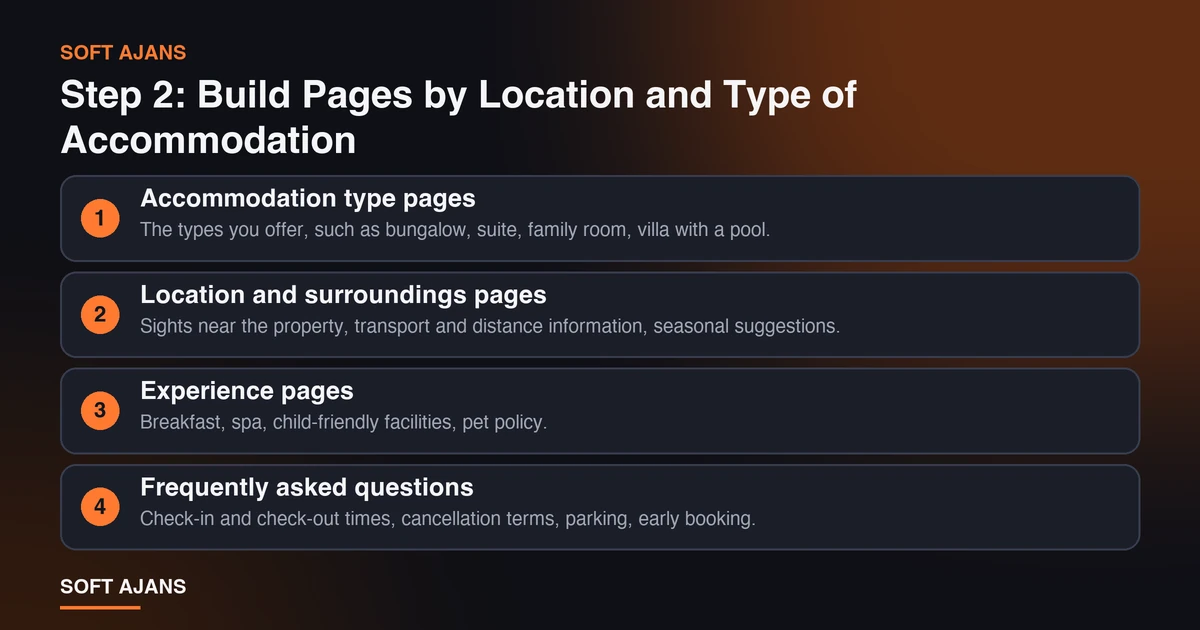
- Accommodation type pages: The types you offer, such as bungalow, suite, family room, villa with a pool.
- Location and surroundings pages: Sights near the property, transport and distance information, seasonal suggestions.
- Experience pages: Breakfast, spa, child-friendly facilities, pet policy.
- Frequently asked questions: Check-in and check-out times, cancellation terms, parking, early booking.
Each page should answer a single intent, contain real photos and concrete information, and offer a clear link to the booking page. Inflated texts that say “the best hotel” everywhere win neither the guest nor the search engine. When building the page plan, you can use the logic in pages a corporate website needs for the general structure of a corporate site.
Step 3: Fill In Your Google Business Profile Completely
Map results are among the most visible places in accommodation searches. The prospective guest finds the hotel on the map, looks at the photos and reviews, then moves to the site or the booking link. So a complete and up-to-date business profile is a precondition of direct booking.
Check these in the profile:
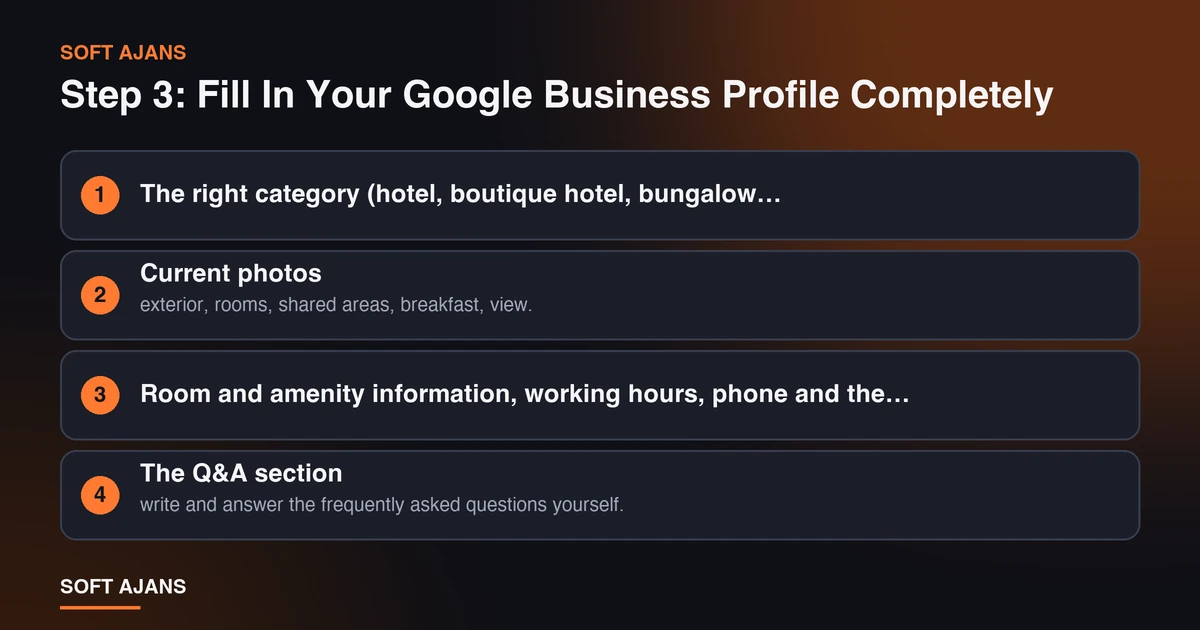
- The right category (hotel, boutique hotel, bungalow, guesthouse and so on) and additional categories.
- Current photos: exterior, rooms, shared areas, breakfast, view. Old and inconsistent photos lose trust.
- Room and amenity information, working hours, phone and the booking link: make sure the link goes directly to the booking page.
- The Q&A section: write and answer the frequently asked questions yourself.
- Posts and announcements: season openings, campaigns, events.
For a detailed checklist of profile optimization see the Google Business Profile optimization checklist, and if there is no profile, see what is a Google Business Profile for setup. This step is also the foundation of the work in our local SEO service, which increases local visibility.
Step 4: Manage and Reply to Reviews
In accommodation, reviews sit in the middle of the decision process. The prospective guest looks at reviews while comparing prices; a stream of reviews that builds trust makes it easier to book directly. Two methods work together: collecting new reviews and replying to incoming ones.
When collecting reviews, selecting only happy guests or giving a discount in return can violate platform rules; the right way is to inform the guest politely at check-out or after the stay, without any conditions. We described these methods in how to get more Google reviews and the 30-day review plan.
When replying, write a short personal thank-you to positive reviews, and a calm, solution-oriented public answer to negative ones. Acknowledge the problem the guest experienced, say what you did, and move the detail to the phone or e-mail. Replies are written not only for the person who wrote the review but for every potential guest who reads it. The article how to reply to Google reviews contains examples.
Step 5: Make the Booking Page Fast and Trustworthy
The loss in direct booking usually happens at the last point: the guest arrives at the site but the booking page is slow, the price is unclear or it is hard to complete on a phone. At this point, look at these:
- Clear price and terms: What the nightly price includes, cancellation terms and extra charges should be written openly. Surprise fees send the guest back to the platform.
- Trust at a glance: Current reviews, payment security information, business details and a contact number should be close to the booking step.
- A short flow: Date selection, room selection, information entry and payment steps should be completed with as few clicks as possible.
- Alternative contact: For a guest who does not want to book online, a phone and WhatsApp link should be visible.
You may not need to change your existing booking system; most of the time the problem lies in the setup of the page and measurement rather than the system. Before deciding whether a system change is needed, measure the speed and usability of the page.
Step 6: Do Not Lose on Mobile and Speed
In tourism, a large share of searches are made from a phone; the prospective guest opens the hotel on the road, while making holiday plans or while browsing another site. If the page opens slowly or a button does not work on mobile, the loss happens silently. So try the booking path from start to finish on a phone yourself.
For speeding up, image size, number of fonts and unnecessary scripts are the first places to look. We gathered practical fixes in nine items in speeding up your website; what to look at on a phone is listed in how to test a mobile-friendly website. Because hotel sites usually use large photos, image optimization gives the biggest gain here.
Step 7: Plan Ads by Season and Occupancy
Ads speed up direct booking, but if badly planned they burn the budget. Two basic types of campaign work in accommodation:
Brand and location searches. Running ads on brand searches, so that a rival platform’s ad does not appear when a guest searches for your hotel’s name, protects direct booking. Its cost is usually low and its conversion high. For location-based searches (“Sapanca bungalow”) competition is higher and the budget should be planned more carefully.
Season and occupancy plan. Adjust the ad budget by season: it makes sense to raise the budget in periods of low occupancy and reduce or stop it in fully booked periods. Targeting, ad copy and the price message should also change by season.
Ads make sense when you measure the clicks arriving at the booking page as conversions; without measurement you cannot know which campaign works. We described how an ad account is managed in our Google Ads management service.
Step 8: Measure and Read the Results by Separating the Season Effect
To know that you have increased direct bookings you need to set up measurement. The basic events to track: arrival at the booking page, starting a booking, form submission, phone click and WhatsApp click. For each of them the source (organic search, map, ad, direct) should appear separately. To see where phone calls come from, you can look at call tracking.
The biggest misreading in tourism is attributing the season effect. Comparing June with March and saying “it rose 80 percent” means loading the natural effect of the summer season onto the work. The right comparison is made with the previous period and also with the same season in the previous year. Your report should contain both comparisons; if the difference also appears in the second, the effect of the work is more reliable.
What Did We Learn From the Sapanca Case?
Our published tourism case is based on the organic search results of a site focused on Sapanca hotels. According to Search Console data, the site’s organic clicks in the last three months rose from about 5.19 thousand to 9.9 thousand compared with the previous three months; that is an increase of about 1.9 times. In the case study we also wrote a warning openly: in tourism demand is seasonal, and the two periods may have fallen under different seasonal conditions. That is why we do not attribute the increase only to the work.
This case reminds us of two things. First, work on search visibility (page structure, content, business profile) can increase clicks, but conversion to bookings is a separate measurement. Second, interpreting the result without separating it from the season effect is misleading. You can read the details in the Sapanca hotels case study.
An 8-Item Checklist
- I calculated the platform commission and the unit gain of a direct booking.
- I have separate pages with real content for accommodation type and location.
- My Google Business Profile is complete; the booking link goes directly to the page.
- I have a routine for collecting new reviews and replying to every review.
- The booking page has a clear price, cancellation terms and contact details.
- The booking path opens fast on a phone and works from start to finish.
- There are ads for brand searches; the budget is planned by season.
- Booking, phone and WhatsApp events are measured with their source; the report separates the season effect.
Common Mistakes
- Trying to solve it with ads alone. If the booking page is slow or untrustworthy, ads waste your money.
- Leaving the booking link on a platform. If the booking button in the profile still goes to a platform, you give the direct channel no chance.
- Price inconsistency. Showing a higher price on the site than on the platform sends the guest to the platform; the direct channel should have an advantage (flexible cancellation, breakfast, early check-in and the like).
- Not investing in photos. Old or low-quality photos damage trust both on the site and in the profile.
- Not seeing the season effect. Comparing only consecutive periods in reports leads to the wrong conclusion.
What Does Soft Ajans Do for Accommodation Businesses?
In our digital marketing service for hotels and tourism businesses, page structure by location and accommodation-type searches, the Google Business Profile and reviews, direct booking ads and reporting that separates the season effect run together. We do not change your existing booking system; we set up measurement according to that system. We do not give a guarantee of results; we set the goal together and measure demand coming from direct bookings.
For the general framework specific to the sector, see digital marketing for hotels and accommodation businesses, and to see the current state of your site, you can look at the free pre-analysis.
Frequently Asked Questions
In how many months do direct bookings increase?
It would not be right to give an exact time. Steps like ads on brand searches show an effect quickly, while steps like search visibility and reviews accumulate over months. Because the season effect can confuse the result, the evaluation should be made with at least one season of data.
Does it make sense to leave booking platforms completely?
Not for most businesses. Platforms are one way to reach new guests. The aim is not to leave platforms but to reduce dependence on commission by increasing the share of direct bookings.
How much budget should a small boutique hotel have?
The budget depends on the size of the property, the season and the competition; there is no fixed figure. First calculate the unit gain of a direct booking, then set an acceptable customer acquisition cost based on that gain.
Do I need to set up a separate system to take bookings from the site?
If your existing booking system can be connected to the site, you may not need to. What matters is that the system opens fast on the site, works on a phone and can be measured. Examine the limits of the current system before deciding on a change.
What is price parity and do I have to comply?
Some platform contracts may restrict offering a lower price on other channels than on the platform. It varies by contract; check your own contract and ask your legal adviser if necessary.
Do reviews really affect bookings on the site?
Reviews are an important part of the decision process in accommodation. A prospective guest looks at reviews both on the platform and on Google. Current and answered reviews increase confidence in booking directly.