It is not possible to give a single answer to “how much does an e-commerce site cost?”, because very different jobs lie under the same words. On one side there is a store that gets a set number of products ready for sale, with payment and shipping connected; on the other side a trading system with a dealer panel, marketplace integration and custom reporting. The two do not have the same price, the same scope or the same management afterwards.
In this article we open up the items that determine e-commerce website prices one by one: how the choice of platform affects cost, what changes with product and design scope, and which costs do not come with the site but must be in your budget. At the end there is a framework for calculating the first-year total cost and ten questions you can ask when comparing quotes. Our aim is not to give you a figure; it is to help you ask “what does this price cover?” when a quote arrives.
The Three Layers of the Price Question: Setup, Running and Selling
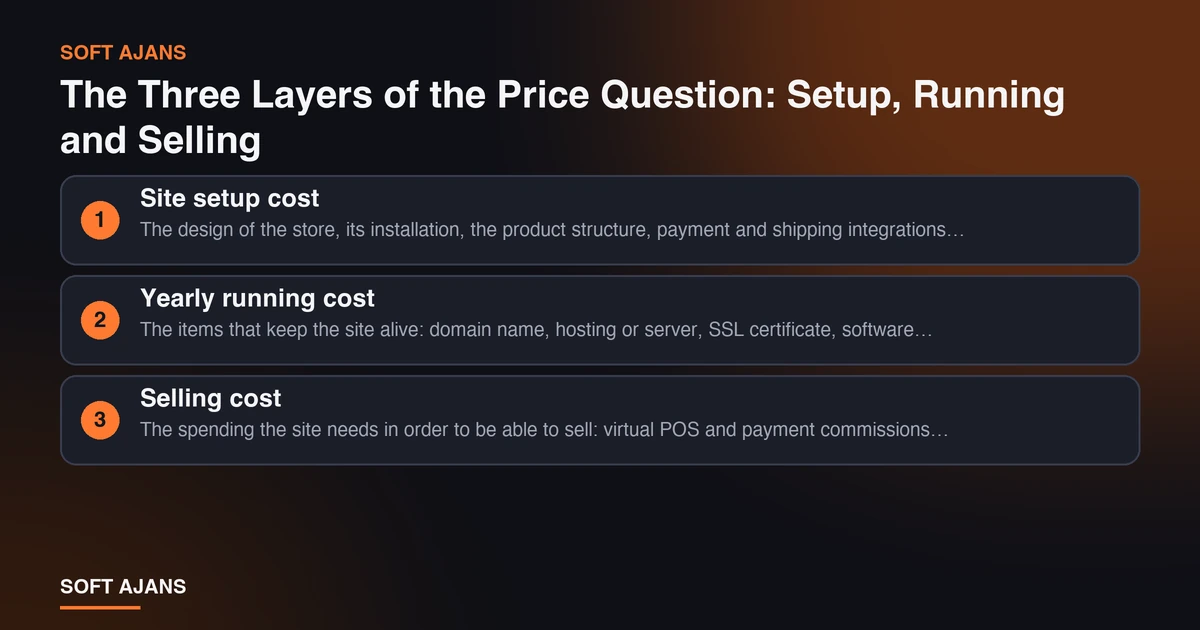
To read e-commerce cost correctly, split the price into three layers:
1. Site setup cost. The design of the store, its installation, the product structure, payment and shipping integrations and going live. The main figure you see in a quote is usually this, and it is mostly one-off.
2. Yearly running cost. The items that keep the site alive: domain name, hosting or server, SSL certificate, software licenses and plugins, maintenance and security updates. Some of these renew every year; the first-year price and the second-year price can differ.
3. Selling cost. The spending the site needs in order to be able to sell: virtual POS and payment commissions, shipping agreements, marketplace commission and integration fees, ad budget, product photography and content production. These may not be in the quote of the firm that builds the site, but they must be in your budget.
Most businesses look only at the first layer and then meet the other two later. A healthy budget plans all three together. We covered the starting budget in general in how to set up an e-commerce site and the capital needed in the capital needed to start e-commerce.
Choosing the Platform: Ready-Made Solution, Package Site and Custom Software
The decision that affects the price most is the platform. There are three approaches, and each has a different cost structure.
Ready-made e-commerce solutions (rented platforms). Solutions used with a monthly or yearly subscription, quick to set up and maintained by the platform. The starting cost is low; but payment and customization limits, subscription and commission items determine the total cost in the long run. Control over data and design may be limited.
Package e-commerce sites. Stores where the agency adapts a ready-made platform to your brand, with the product and payment structure set up. The price is given for a fixed scope; customization changes with the package level. Setup is quick and cost is predictable.
Custom software. Systems developed from scratch or largely custom to your business model: a dealer panel, multiple warehouses, ERP integration, custom pricing rules. It is the most flexible option and the most expensive; the development, testing and maintenance load is also larger.
What decides which suits you is the business model more than the budget: how many products do you sell, are your customers individual or corporate, which systems need integration? We examined the platform criteria in which criteria should businesses evaluate together when choosing an e-commerce platform and the types of software in what e-commerce software is.
Items That Set the Price: Products, Design, Integration
Even on the same platform, the price of two stores can differ. The items that change the price are these:
- Number of products and categories. Data entry, category structure and the search experience of a hundred-product store and a ten-thousand-product store are not the same job. Having product information (code, name, description, price, stock, image) ready in an orderly table for bulk import lowers the cost.
- Design scope. Adapting the brand on a ready structure and designing the product card, category page and payment page completely custom carry different workloads.
- Payment methods. Credit card, bank transfer, cash on delivery and installment options need a virtual POS integration. Applications to a bank or payment institution are run on your side and affect the schedule.
- Shipping integrations. Shipping companies and the automatic transfer of labels and tracking numbers enlarge the integration scope.
- Customer groups. If there are separate prices, dealer discounts or order rules for individual and corporate customers, B2B features are needed. We described this in how to set up a B2B e-commerce site.
- Third-party integrations. Accounting or ERP, e-invoicing, marketplaces and stock systems each mean a separate integration job.
- SEO and measurement setup. Structuring product and category pages for search engines, product schema, analytics and conversion tracking may be in scope; if they are not, they must be planned separately. The article e-commerce SEO is useful on this.
- Content work. Who will write the product descriptions, will product photos be shot, will images be edited?
- Admin panel and training. Is panel training in scope so that you can manage products, stock, orders and campaigns yourself?
- Migration. Moving product, customer and order history from an existing store to the new system is a separate job; the scope cannot be clear until the structure of the old system is examined.
Mark how many of these ten are “yes” in your project. As the number of yeses grows, the price stops fitting a package and a project-specific quote is needed.
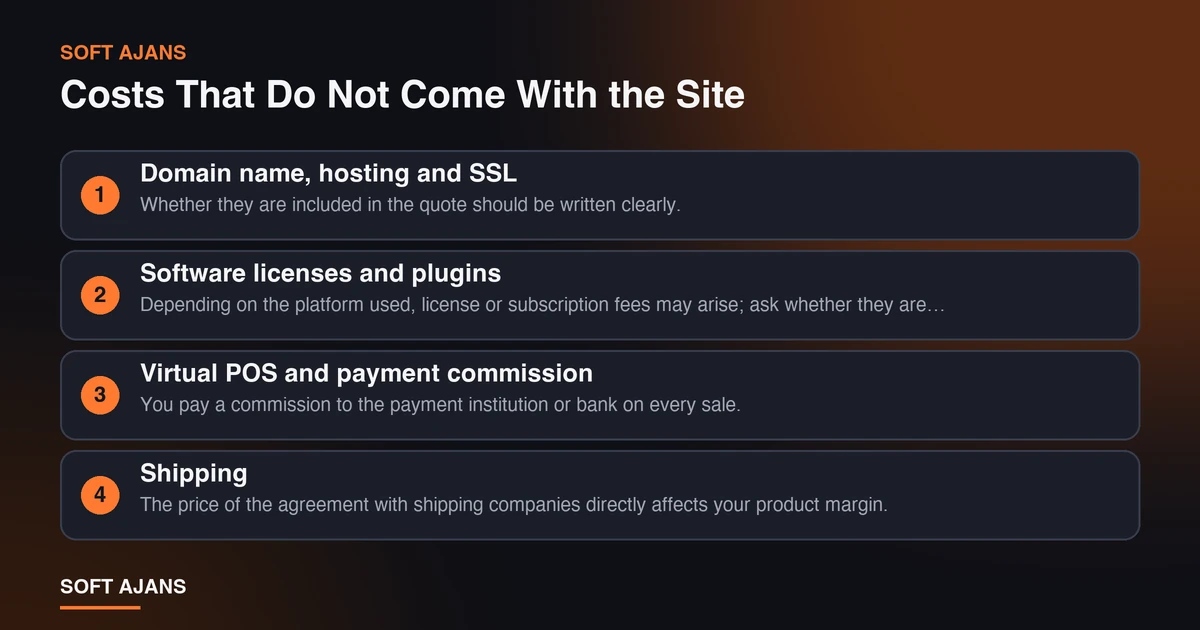
Costs That Do Not Come With the Site
Things you do not usually see in a quote but must write into your budget:
- Domain name, hosting and SSL. Whether they are included in the quote should be written clearly. They renew yearly; note the renewal dates.
- Software licenses and plugins. Depending on the platform used, license or subscription fees may arise; ask whether they are continuing or one-off.
- Virtual POS and payment commission. You pay a commission to the payment institution or bank on every sale. Rates vary by agreement; foresee the monthly cost by multiplying with your sales volume.
- Shipping. The price of the agreement with shipping companies directly affects your product margin.
- Marketplace commission and integration fee. If you will also sell on marketplaces, commission and the integration provider’s fee are added. To work out profit on the marketplace side, our marketplace profit calculator and profit margin calculator run in your browser.
- Ad budget. The site setup fee and the Google Ads or Meta ad budget are separate items; you need to set aside a budget to bring in visitors in the first months.
- Photos and content. Professional product photography directly affects conversion in most stores.
- Maintenance and security. A monthly or yearly maintenance item is needed for updates, backups and responding to possible problems. For the scope of maintenance see the website maintenance checklist.
- Accounting and legal requirements. Expert support may be needed for e-invoicing, legal information pages and obligations arising from e-commerce regulation.
The aim of this list is not to frighten but to build the budget realistically. Asking the agency building the site “which of these are included in the quote?” eliminates surprises from the start.
Our Packages and Their Scope in October 2026
On our e-commerce packages page three packages are written. As of October 2026 the packages are:
- Starter Package (22,000 TL, one-off): A ready-to-sell e-commerce site (limited number of products), payment and shipping integration, mobile-friendly design and basic SEO groundwork.
- Professional Package (38,000 TL, one-off): In addition to everything in the Starter Package, unlimited products and categories, campaign and discount management and an advanced SEO-friendly structure.
- Corporate Package (60,000 TL, one-off): In addition to everything in the Professional Package, marketplace integrations, custom design and advanced reporting, priority support and maintenance.
Prices are kept up to date on the page; read the above breakdown as a dated summary. The ad budget is not included in the package fee. Whether domain name, hosting, server and license costs are included in the package is clearly written in the quote; if you already have a domain name and hosting account, they can be used after technical suitability is checked. For requests outside the packages (a dealer system, custom integrations, a very high number of products) a project-specific quote is prepared.
In deciding which package suits you, your number of products, sales model, integration needs and growth target are decisive; if you are starting to sell, the Starter Package is often enough, and if you have a high number of products or a dealer system, a more comprehensive structure is needed.
How Is the First-Year Total Cost Calculated?
To compare quotes, look not only at the setup price but at the first-year total. A simple calculation table is built like this:
- Setup: The one-off site fee in the quote.
- Yearly fixed items: Domain name, hosting or server, SSL, licenses and plugins, a maintenance package.
- Monthly variables × 12: Payment commissions (monthly sales volume × commission rate), shipping cost differences, marketplace commissions and integration fees.
- Ad budget: The monthly budget you plan for the first 3-6 months.
- Content: Photos, product descriptions and extra design work.
When you fill in these five items separately for two quotes, you see whether the “cheap” looking quote turns out expensive through yearly fixed items or extra integration fees. A very low setup price with a high monthly subscription, or the opposite, can reach a similar total in the first year; the real difference appears in the second and third years. That is why you should calculate the three-year total as well. For a ready table you can use the agency quote comparison table, and for the general method how to compare web design quotes.
10 Questions to Ask When Comparing Quotes
- Which platform does the quote use and in whose name is the license?
- How many products and categories are included, and how is more priced?
- Is the design a ready structure or custom?
- Which payment and shipping integrations are included, and who runs the virtual POS application?
- If marketplace, ERP or accounting integration is needed, is it in scope?
- Are the domain name, hosting, SSL and licenses included, and what is the yearly renewal fee?
- Are product entry and data import included?
- What does the SEO and measurement setup include?
- What is the admin panel training and the post-launch support period?
- Who will hold the code, data and admin access after launch?
Get the answers in writing and have them added to the quote. For the timeline, you can use the framework in how long does it take to build a website; in e-commerce, third-party steps such as the virtual POS application can extend the schedule.
Ways to Manage Cost Without Lowering the Price
It is possible to manage cost without giving up quality:
- Split the scope into two phases. Go live in the first phase with the most important products and features needed for sales; leave B2B, marketplaces and advanced reporting to the next phase.
- Bring the product data ready. An orderly product table reduces the cost of data import considerably.
- Use your existing domain name and hosting if you have them. They can be reused after technical suitability is checked.
- Prioritize photography. Having the best-selling products professionally photographed and renewing the rest gradually balances the budget.
- Grow advertising by measuring. Starting with a small budget and seeing which products and channels work is better than spending a large budget blindly.
- Fix yearly costs in the contract. Have the renewal price written in the quote.
For the side of increasing sales see ways to increase sales in e-commerce, and for abandoned carts see 7 ways to reduce abandoned carts.
Common Mistakes
- Looking only at the setup price. If yearly running and selling costs are not taken into account, the budget goes off quickly.
- Choosing the platform by price. A platform that does not fit your business model becomes expensive later, even if it is set up cheaply.
- Not preparing product data. Scattered product information enlarges both time and cost.
- Leaving payment and shipping processes to the end. A virtual POS application and a shipping agreement can take weeks; they should be started in parallel with the site.
- Not clarifying ownership. The domain name, data and code access should be with you.
- Neglecting mobile. Most shopping is done on a phone; the payment flow should be tried from start to finish on a phone. For testing you can use the list in how to test a mobile-friendly website.
What Does Soft Ajans Do in E-Commerce Projects?
In our e-commerce packages, the product and category structure, a mobile-friendly interface, cart and payment infrastructure, order management, basic SEO settings, analytics setup and admin panel training are included according to package level. If a dealer system and special price rules are needed, our e-commerce and B2B service comes into play, and for the search visibility of product and category pages our e-commerce SEO service. For the general scope of a website you can look at our web design service.
You can contact us to clarify the scope of your project together and split the price into items; if you want to see the current state of your site, you can request a free pre-analysis.
Frequently Asked Questions
What does the price of an e-commerce site depend on?
It depends on the platform choice, the number of products and categories, design scope, payment and shipping integrations, customer groups (individual or dealer), third-party integrations and content work. For requests outside standard packages, a project-specific quote is prepared.
Should I choose a ready package or custom software?
It depends on your business model. If you will start selling with limited products and a standard payment-shipping flow is enough, a package site is often suitable and economical. If you have needs such as a dealer panel, special pricing rules or ERP integration, custom development may be needed.
Is the ad budget included in the package price?
No. Site setup and the ad budget to be used on platforms such as Google Ads or Meta are separate items. Ad management can optionally be added to the service scope separately.
Are the domain name and hosting included in the price?
It varies by quote; whether they are included should be written. If you have an existing domain name and hosting account, they can be used after technical suitability is checked. We recommend asking about yearly renewal fees up front.
How long does it take to prepare an e-commerce site?
Standard projects are usually completed within a few weeks; a high number of products, B2B features or extensive integrations extend the time. Third-party steps such as the virtual POS application can affect the schedule.
What costs continue after my site goes live?
Domain name, hosting, SSL and license renewals, maintenance and security updates, payment and marketplace commissions, shipping and ad budget are continuing costs. Add them to the first-year total cost table.