
The honest answer to “how long until the website is finished?” is “it depends on the scope and on how prepared you are”. But that answer helps nobody. If you have a launch date, a trade fair or a campaign calendar, you need an estimated range and you need to know what moves it.
In this article we explain typical time ranges for a corporate showcase site and for an e-commerce site, the stages of a website project, a sample four-week plan and the most common causes of delay. The ranges we give are approximate; the exact schedule always changes with the scope and should be written in the quote.
The Short Answer: Time Ranges by Project Type

The general framework we use on our service pages and in answers to customers is this: a standard corporate website is usually ready to go live in two to four weeks, and a comprehensive e-commerce site in four to eight weeks. These figures apply to projects where the content (copy, logo, images) arrives on time and approvals are given quickly.
Looking at project types in more detail (ranges other than the first two lines are general estimates):
- A one-page showcase or landing page: A few days to two weeks. The scope is small and there are few decisions.
- A small corporate site (5-8 pages): Two to four weeks. This is the most common type of project.
- A multi-page corporate site with a blog: Four to six weeks. The number of pages and the volume of content set the duration.
- An e-commerce site: Four to eight weeks. Product import, payment and shipping integrations and a testing phase are added.
- Projects that need custom software: If there is member login, a dealer panel, a multilingual structure or a custom integration, the duration can exceed these ranges and is planned separately.
These ranges are calendar days; they are not the number of days the agency works on your project without a break. The difference is mostly waiting time for approvals and content.
Factors That Lengthen and Shorten the Timeline
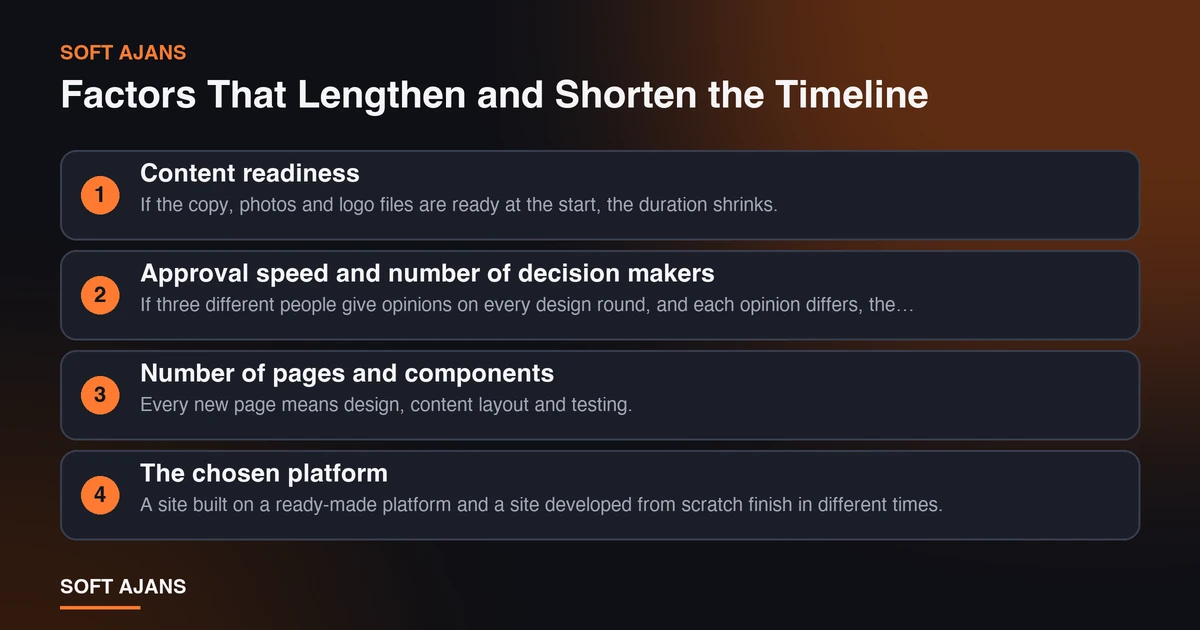
Two projects with the same scope can finish in times that differ by a factor of two. What makes the difference is rarely technical difficulty. Look at these:
Content readiness. If the copy, photos and logo files are ready at the start, the duration shrinks. You can use the list in 10 things to prepare before you order a website for this.
Approval speed and number of decision makers. If three different people give opinions on every design round, and each opinion differs, the project stretches. Appointing one authorized person and sending feedback in one batch is the most effective way to shorten it.
Number of pages and components. Every new page means design, content layout and testing. Components such as a product catalog, a map, a calendar, a form or a calculator add development.
The chosen platform. A site built on a ready-made platform and a site developed from scratch finish in different times. We compared which suits you in WordPress, custom code or a ready-made site.
The state of the existing site. If you are moving from an old site, content migration and a redirect plan need extra time. The article how to avoid SEO loss during a website migration covers the details.
Website Timeline Stage by Stage

A website project goes through similar stages at every agency. On our own service page we describe the process in nine items; for scheduling purposes it is easier to group them into four big steps:
1. Needs analysis and structure. The project goals, user groups, page needs and technical requirements are determined. The main menu and page hierarchy are planned. The duration of this step depends largely on how fast you answer; clarifying the goal and the page list at the first meeting saves time here.
2. Design and approval. The basic layout of the pages is prepared as a wireframe, then colors, typography and components in line with the brand identity are designed. The look on phone, tablet and desktop is considered together. We do not move on to development without your approval, so approval speed determines the duration of this step.
3. Development and content layout. The approved design is turned into a manageable, performance-focused build. Copy, images, forms and contact details are placed on the relevant pages; basic SEO settings and speed adjustments are made, and measurement is set up.
4. Testing and launch. Device and browser tests are run, forms are tried and links are checked. When everything is fine, the site goes live. Small fixes can appear in the first days after launch; plan a short monitoring period for this.
A Sample 4-Week Plan: A Small Corporate Site

The plan below is a sample schedule for a corporate site of 6-8 pages. It is not a commitment; it is a scheme prepared to show how the steps lean on each other:
- Week 1: Clarifying the goal and page structure, listing content and image needs, delivery of copy and logo files, home page draft.
- Week 2: Presenting the home page and inner page designs, one round of feedback, approval of the design.
- Week 3: Developing the pages, placing the content, setting up forms and measurement, basic SEO and speed settings.
- Week 4: Device and browser tests, fixes, final approval and launch.
The two most critical points in this plan are the content delivery at the end of the first week and the design approval at the end of the second week. If either slips by a week, the launch date slips by about a week. In other words, what sets the schedule is mostly not the agency’s working speed but the timing of these two decisions.
Timeline for E-Commerce and Custom Software Sites
An e-commerce site adds three work items to a corporate site: setting up the product and category structure, payment and shipping integrations, and testing the order flow from end to end. If there are hundreds of products, bulk data import and preparing the photos also take time.
What saves the most time is preparing the product data in an orderly table (name, category, price, stock, description, image name). If the product data is scattered, the agency first cleans it, which makes the scope larger than expected. The virtual POS application for the payment infrastructure, on the other hand, runs on your side and can take days, sometimes weeks; the order test cannot be completed before that application is done. That is why starting the application in the first week of the project is a good habit.
If you want to look at the topic in detail, the article how to set up an e-commerce website goes step by step; if you need rules such as a dealer panel and special pricing, see how to set up a B2B e-commerce site. For our package options, there is the e-commerce packages page.
7 Typical Causes of Delay
These are the causes of delay we see again and again in projects:
- Content that does not arrive: Copy and images come “by the end of the week” but arrive two weeks later.
- Scope creep: “Let’s add this too” decisions while the design is in progress. Each addition looks small; the total is large.
- Too many decision makers: Partners, managers and family members each giving their own opinion.
- Access that cannot be found: The password of the domain, hosting or Google account is lost.
- Third-party dependencies: Information that must come from other companies, such as a virtual POS, shipping or corporate e-mail.
- Late feedback: Ten days of silence after a presentation, then a request for extensive changes.
- Legal texts that are not finished before launch: Waiting for the legal adviser at the last minute for the privacy policy, cookie notice and company details.
None of these items involves how fast the agency writes code. What governs the duration is the flow of information.
What Can You Do to Shorten the Timeline?
Asking the agency to “work faster” to compress the schedule rarely works. These things do:
- Prepare the content and image package before the project starts; tell the agency the gaps as a list at the first meeting.
- Appoint one authorized person and collect feedback in a single message.
- Lock the page list; write new ideas on a “second phase” list.
- Split the launch into two stages: go live first with the most important pages, and add the blog and secondary pages afterwards.
- Start external dependencies such as the virtual POS, e-mail and domain on day one.
- Write approval days into the calendar: “design approval by this date at the latest”.
The first two of these measures are the habits that shorten the timeline the most. Also plan the work after launch from the start; the article website maintenance and a monthly checklist describes the routine after launch.
How Should the Timeline Be Written in the Quote?
A vague sentence like “delivered in 2-3 weeks” is not enough. In a good quote the duration comes with this information: the start date (which condition triggers the start?), the order of the stages, the deliverables expected from you and their dates, the time allowed for approval, the number of revision rounds and the launch date. How it is handled if the duration is extended by your delay should also be in writing.
Also look at the relation between the timeline and the payment plan. If payments are tied to stages (contract, design approval, launch), the schedule and the payments support each other. To compare quotes item by item, use the list in how to compare web design quotes.
How Does the Process Work at Soft Ajans?
In our web design service the process starts with a needs analysis, moves forward with your design approval and ends with going live. The exact schedule is written in the quote, because the duration changes with the scope, the number of pages and whether the content is ready. Before the project starts we list what comes from you and what comes from us; this minimizes surprises in the schedule.
To see the state of your current site and learn where to start the project, you can request a free pre-analysis. For those who are curious about the general framework, the guide how to build a website also explains the whole process.
Frequently Asked Questions
Can a website be built in a week?
A very small showcase or landing page can go live within a week; for that the content must be ready and decisions quick. A week is not realistic for a multi-page corporate site; if quality control and testing are skipped, the problems appear after launch.
Does the agency set the launch date or do I?
Both together. You give a target date, and the agency says whether it is possible given the scope and the state of the content. If it is not, either the scope is narrowed, the date is postponed or a two-stage launch is planned.
Does the timeline extend if I ask for changes after design approval?
Small fixes usually do not affect the timeline. Big requests that change the page structure or components are more costly and time-consuming once development has started. That is why it is important to gather changes before the design approval.
Why does an e-commerce site take longer than a corporate site?
Because there are extra items such as the product and category structure, payment and shipping integrations and testing the order flow. Steps involving a third party, such as the payment infrastructure application, can also extend the timeline.
How many days should the site be monitored after launch?
In the first two weeks, forms, measurements, mobile view and search engine crawling should be followed closely. Small fixes are normal in this period. In the following months, monthly maintenance checks are enough.
Will there be downtime when moving from the old site to the new one?
Not if it is planned properly. The new site is prepared in a separate environment, tested and launched when it is ready. If the address structure changes, redirecting the old addresses to the new ones should be activated on the same day.