We would love to answer “how much does catalog design cost?” with a single figure, but it is not possible. Two catalogs with the same number of pages can differ by a factor of two in design fee, because the price is set not only by the page count but by the number of products, the density of the content, the state of the images, the number of revisions and the scope of delivery. On top of that, the printing cost is a separate item from the design fee and the two are often confused.
In this article we open up the items that determine catalog design prices one by one, list what a quote should contain and explain how to compare the quotes you receive. The aim is not to give you a figure but to let you answer the question “what does this price cover?” We described how to prepare a catalog in how to prepare a product catalog; here the subject is cost.
The Basic Factors That Set a Catalog Price

Eight items affect a catalog design fee. Each should be asked about separately in the quote:
- Number of pages. The design process of an eight-page showcase catalog and a hundred-page product catalog is not the same. As the page count grows, not only design but checking, correction and file preparation grow too.
- Originality of the design. A standard design that proceeds from a ready-made layout and a design built specially for the brand, with custom page layouts and a visual language, carry different workloads.
- Number of products and information per product. As information such as product code, description, price, dimensions, technical specifications and compatibility tables increases, layout gets harder. The number of products that fit on one page also affects the price.
- Photo and image editing. Cleaning product photos, background cutting, color correction and resizing are a separate job. Will the agency shoot the photos or will you supply them, and are the images print quality?
- Technical drawings and diagrams. Dimension drawings, assembly diagrams, tables and icons bring extra design work.
- Copy work. Who will write the product descriptions? Correcting text from you and writing it from scratch are different items.
- Number of revisions. How many revisions are included in the quote? What is the scope of a revision (a text correction or changing the page structure)?
- Scope of delivery. Will a print-ready file, a digital PDF, source files or a multilingual version be delivered?
When you ask an agency about each of these eight items, you see where the price difference comes from. Most of the time a low quote has left out one or two items; that means an extra charge later.
Why Should the Design Fee and the Printing Cost Be Read Separately?
The phrase “catalog price” mixes two different things: designing the catalog and printing it. The design fee is a job fee paid once; the printing cost changes with quantity, paper, size, cover type and binding method and is paid again with every print run.
It is important to see this distinction clearly in the quote. If an agency offers only the design, you need to get the printing cost from a printer yourself; if the agency also manages printing, design and printing should appear on separate lines in the quote. Otherwise you cannot compare two quotes: one may include design and printing while the other includes only design.
Before printing, clarify these: how many copies will be printed, which size and paper, the cover type, binding and extra finishes (varnish, embossing and the like). These choices also affect how the design file is prepared; bleed, color mode and resolution are set according to the print. You can find the print-readiness checks in our product catalog article.
Why Can a Price per Page Be Misleading?
“How much per page?” is a natural question; but multiplying the catalog price only by the page count is misleading. There are three reasons:
Page density differs. A page that shows a single product with a large photo and a page that presents twelve products with tables and dimensions on the same page do not take the same effort. The first is simple in layout terms; the second demands attention and care.
The first pages are expensive, the repeating pages get cheaper. In a catalog, setting up the page layout and designing the cover, the inner page template and the product block is most of the workload. Once the template is settled, applying the same layout to a hundred pages is relatively quick. That is why the price per page can fall as the page count grows.
Hidden work does not fit per page. Photo editing, data transfer (for example moving a product table from Excel into the catalog file), multilingual versions and revisions do not grow in proportion to the page count.
The practical conclusion: if a price per page is given, ask what scope it is for. The safer approach is to get a written quote on the total scope of the project and have the price split into items.
What a Quote Should Contain, Item by Item
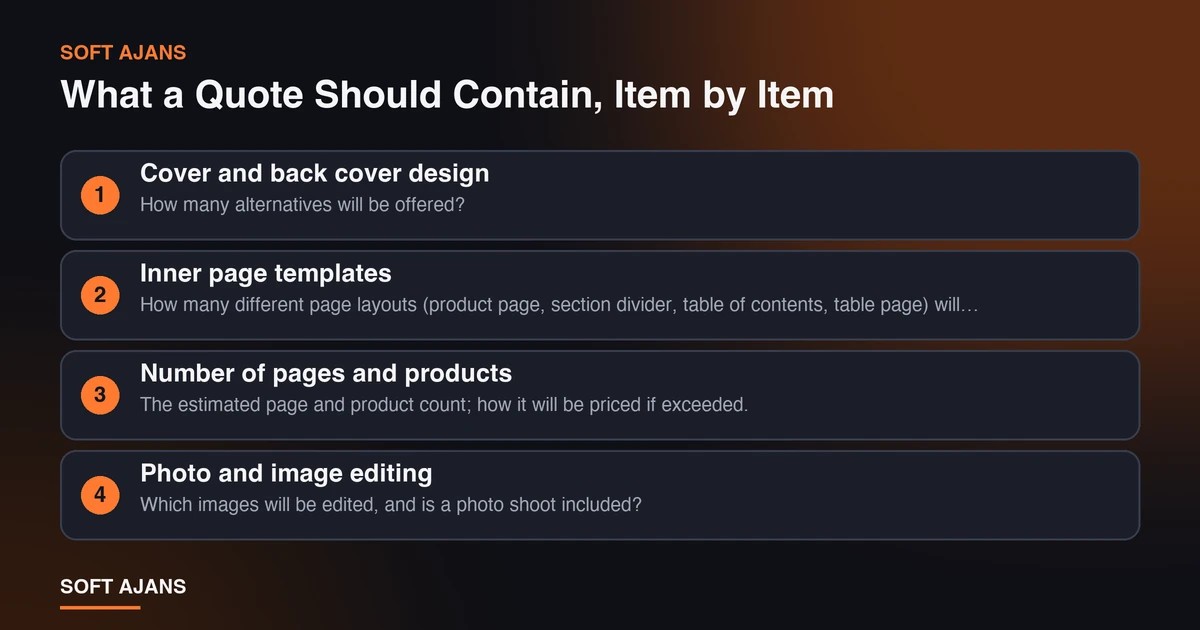
A good catalog quote should have these written separately:
- Cover and back cover design. How many alternatives will be offered?
- Inner page templates. How many different page layouts (product page, section divider, table of contents, table page) will be designed?
- Number of pages and products. The estimated page and product count; how it will be priced if exceeded.
- Photo and image editing. Which images will be edited, and is a photo shoot included? A shoot is planned separately from the standard design service; for shoot needs you can look at our production services.
- Copy work. Is writing or correction of text included?
- Multilingual versions. Who will supply the translated texts? Is page adaptation priced separately for each language?
- Revisions. How many rounds are included and what is their scope?
- Delivery formats. A print-ready PDF, a digital (optimized) PDF, source files? Whether the source file will be handed over to you should be written in the agreement.
- Printing. Included or separate? If separate, how will a quote be obtained?
- Duration and payment plan. Stages, approval points, delivery date.
You can use this list for other quotes too. We described the general logic of comparing quotes in how to compare web design quotes and bringing three agency quotes to the same base; for a ready table you can download the agency quote comparison table.
Example: Three Different Catalogs, Three Different Scopes
To make clear why the price changes, consider three fictional scenarios. The scenarios contain no figures; they only show the difference in scope:
Scenario 1: A short showcase catalog. Eight pages, a few product groups, ready photos, a standard layout. The cover and the inner page template are designed one by one, and because the page count is low the process is short. Revisions mostly consist of text and image placement corrections.
Scenario 2: A mid-sized product catalog. Forty pages, hundreds of product codes, a dimension table, a photo for each product. Here the product block layout, data transfer and photo editing gain weight. Custom page layouts and a visual concept are needed; revisions take longer.
Scenario 3: A multilingual catalog of over a hundred pages. Technical drawings, multilingual texts, delivery in both print and digital form. Page adaptation for language versions, differences in text length and the checking process increase the workload; in this scenario the scope must be written, item by item.
In all three scenarios the “page count” is a common measure, but what sets the cost is the work inside each. That is why, at the first meeting, tell the agency how your catalog looks in terms of these items.
Our Packages on the Service Page in October 2026
On our catalog design service page there are three packages with their scope. As of October 2026 the packages are:
- Starter Package (4,500 TL, one-off): A showcase catalog of up to eight pages, a standard page layout, delivery of a print-ready file and one revision.
- Professional Package (8,500 TL, one-off): In addition to the Starter Package, a multi-page product catalog, a custom page layout and visual concept, with two revisions.
- Corporate Package (14,000 TL, one-off): In addition to everything in the Professional Package, copy support for product descriptions, delivery in digital and print formats and unlimited revisions.
Prices are kept up to date on the page; the above is a dated summary. A photo shoot and printing are not included in the standard service and are planned separately. For projects outside the packages (a multilingual version, a very high page count, custom data transfer) we define the scope together and write it item by item in the quote. In the Corporate Package revisions are unlimited; in that case, to protect the schedule we recommend collecting feedback in a single message and setting approval dates in writing.
For comparison you can find the general framework of service prices on the digital agency prices page.
Right Ways to Reduce the Cost
Instead of lowering the price at the expense of quality, manage the scope wisely:
- Bring the content ready. Preparing product information in an orderly Excel table (code, name, description, dimensions, price, image name) removes the data-cleaning work.
- Supply photos in print quality. Photos with sufficient resolution and a consistent background reduce editing time.
- Keep page templates limited. Five or six well-designed templates are both more consistent and more economical than giving every page a different layout.
- Do revisions in batches. Instead of sending every small correction in a separate message, give all feedback in a single list in one round.
- Split the scope into two phases. It is possible to make the first print run with the best-selling products and leave the remaining products for the next run.
- Derive the digital and printed versions from the same file. A catalog designed from the start with two formats in mind avoids the cost of re-layout later.
In a digital catalog, images inflate the file size. To make the PDF easy to share by e-mail and WhatsApp you can reduce the size of the images; for individual images, our free image compression tool runs in your browser.
Information to Prepare Before Asking for a Quote
If you give the agency the following information, the quote comes faster and more accurately:
- The purpose and reader of the catalog (dealer, end customer, trade fair, tender).
- The estimated number of pages and products.
- What you already have ready: logo, product photos, copy, product table.
- If there is an old catalog, a copy or photo of it; is it a renewal or a design from scratch?
- Delivery formats: print, digital or both.
- The number of languages and the state of the translated texts.
- The expected delivery date (a trade fair, campaign or print date).
- Is there a brand identity guide? If not, a corporate identity design or logo design need should be handled before the catalog.
Common Mistakes
- Comparing price only by page count. The density and scope of the content are ignored.
- Assuming printing is included in the design quote. If printing is not in the quote, a separate budget is needed.
- Leaving photo needs to the end. Low-quality photos make the catalog look weak however good the design is.
- Not defining the scope of revisions. A “small correction” and “changing the page structure” are not the same thing.
- Skipping the source file question. If you want to update the catalog yourself later, it should be written from the start that the source file will be handed over to you.
- Sending the copy at the last minute. Missing or late copy affects both the schedule and the cost.
What Does Soft Ajans Do in Catalog Design?
In our catalog design service, page layout and design, placing product information in a readable and consistent structure, optional copy support and delivery of a print-ready file are offered together. A PDF optimized for digital use can also be prepared; when translated texts are supplied, different language versions can be made, and an existing catalog can be renewed. Product photo shoots and printing are planned separately.
You can contact us to clarify the scope of your project together and split the price into items; if you want a general assessment of your current catalog or site, you can request a free pre-analysis.
Frequently Asked Questions
Are catalog design prices calculated per page?
Some agencies give a price per page, but this is often misleading, because page density, photo editing, multilingual versions and revisions are not proportional to the page count. It is safer to get a written quote split into items on the total scope.
Is catalog printing included in the design fee?
Usually not. The design fee is a job fee paid once; printing is priced separately by quantity, paper and binding. Whether printing is included should be clearly written in the quote.
How long does catalog design take?
The duration varies with the page count, the amount of products, whether the content is ready and the speed of feedback. If the copy and photos arrive on time, the duration shortens noticeably.
Can I get the source file?
Source file delivery can be made depending on the scope of the agreement. If you want to update the catalog yourself or with another designer in the future, ask for this in writing at the quote stage.
Can I have my existing catalog redesigned?
Yes. The design, page structure and content layout of an old catalog can be renewed. Giving the agency your existing files (or a print sample) lets the scope and the price be set correctly.
Will I pay a separate fee for a digital catalog?
It depends on the scope of delivery. Some packages include delivery in both print and digital formats, while in others a digital PDF is requested separately. Check in the quote which formats are included.