For a manufacturer or brand that wants to sell abroad, digital marketing often starts with the sentence “let’s have an English site made and open ads” and often gets stuck right there. Because a buyer abroad usually finds a supplier with a search in their own language from their own country; to trust, they look for documents, a catalog and clear terms; before asking for a quote they compare with other suppliers. A site that is not ready for every step of this journey makes the ad budget wasted.
In this article we give a plan that splits the first 90 days of digital marketing for e-export into three stages: which market to start with, how to prepare the site and catalog, how to set up search visibility and ads in the target market, and what to measure. The plan is not a result guarantee but a calendar that puts preparation in order. We explained the technical details of a multilingual site (hreflang, URL structure) in a multilingual website for e-export; here the subject is the order and calendar of the work.
Why Do the First 90 Days Matter in E-Export?
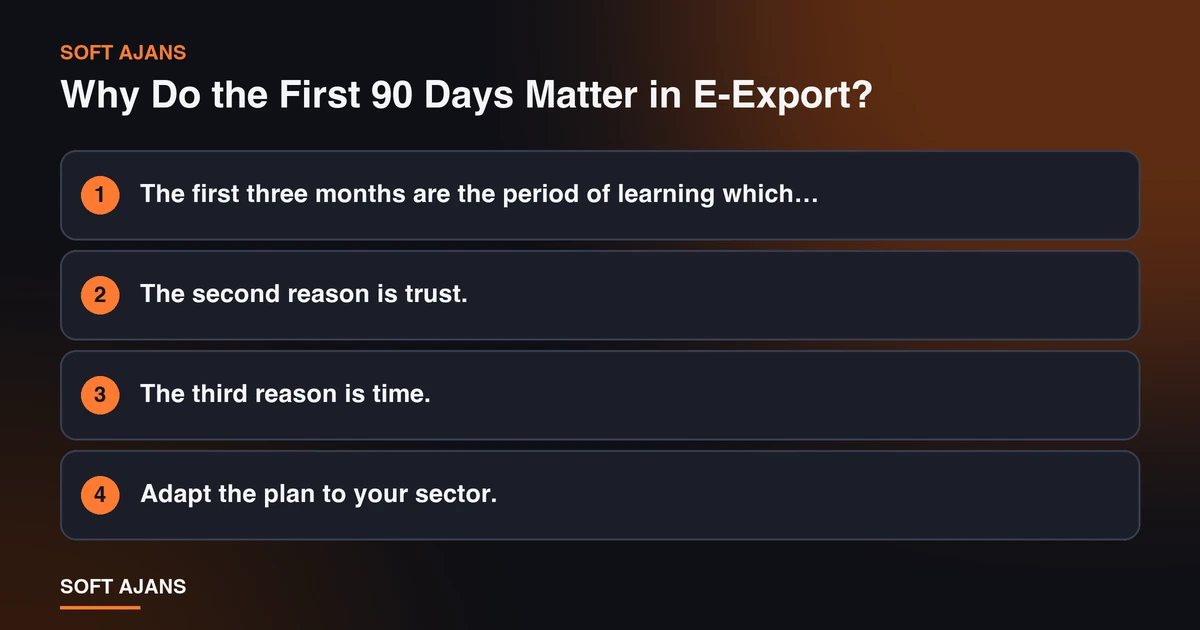
The first three months are the period of learning which market, which language and which message works. Instead of spending a large budget in this period, taking small and measurable steps lets you learn mistakes cheaply. Because each country and language needs separate content, measurement and communication; opening to many markets at once spreads resources.
The second reason is trust. For a buyer abroad the risk is high: a distant country, a different language, uncertainty about shipping and payment. In the first three months, setting up a site that inspires trust, the right documents and a communication channel that replies fast is the foundation of all later work.
The third reason is time. It takes time for a new language version to appear in search results; ads produce data fast but are inefficient if they do not rest on a reliable site. That is why the plan sets up search and advertising together but in the right order.
Adapt the plan to your sector. A manufacturer that is ready and has a catalog can shorten the first stage; a company whose product information is scattered should give more time to the first stage. For general preparation habits, 10 things to prepare before you order a website also shows the way.
Days 1-30: Market, Product and Basic Preparation
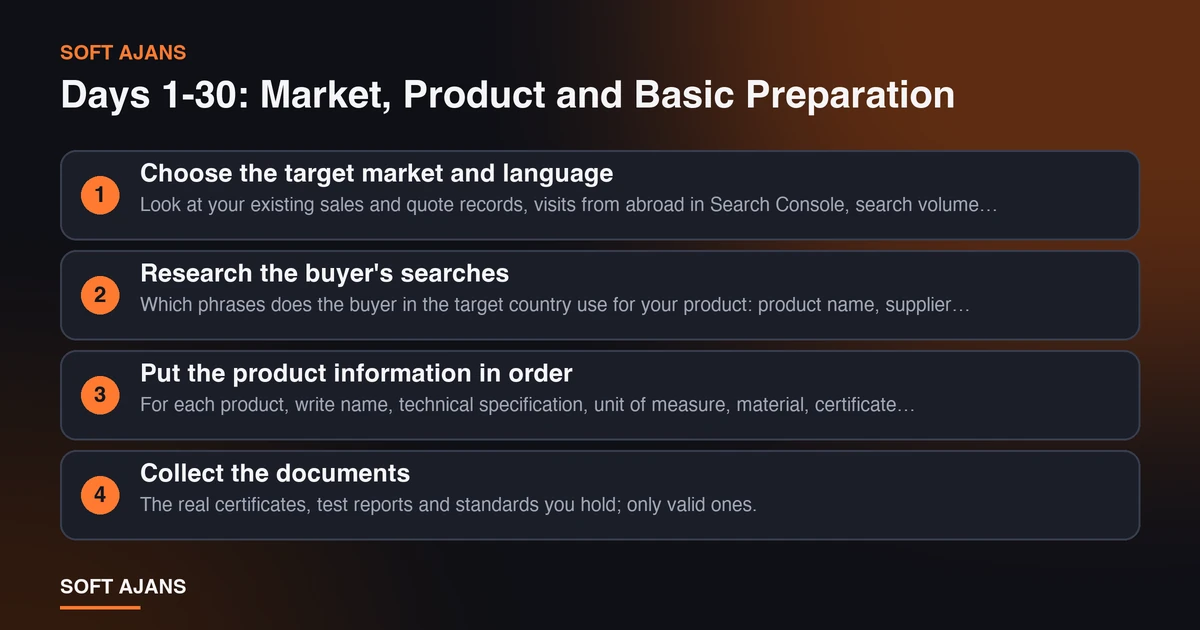
The first month is the month in which you clarify what you will sell to whom, in which language. Accuracy matters, not speed.
Choose the target market and language. Look at your existing sales and quote records, visits from abroad in Search Console, search volume in the target country and your team’s capacity to reply. Start with one or two markets. English is a commercial language in many countries; you can start with a single English version and think about country-specific versions when the market grows.
Research the buyer’s searches. Which phrases does the buyer in the target country use for your product: product name, supplier, manufacturer, wholesale? How do competitors appear? This research determines the site structure and the ad keywords. For details of market selection see international SEO.
Put the product information in order. For each product, write name, technical specification, unit of measure, material, certificate, minimum order quantity and image in a table. Scattered product information lengthens translation and catalog work.
Collect the documents. The real certificates, test reports and standards you hold; only valid ones. Showing a document you do not have carries reputation and legal risk.
Start catalog preparation. An English product catalog makes it easy for the buyer to show you in their internal meeting. For page layout and print preparation see how to prepare a product catalog.
Plan measurement. Write a plan in which quote form, catalog download, e-mail and messaging clicks are measured by country and source.
Days 31-60: Site, Catalog and Technical Groundwork
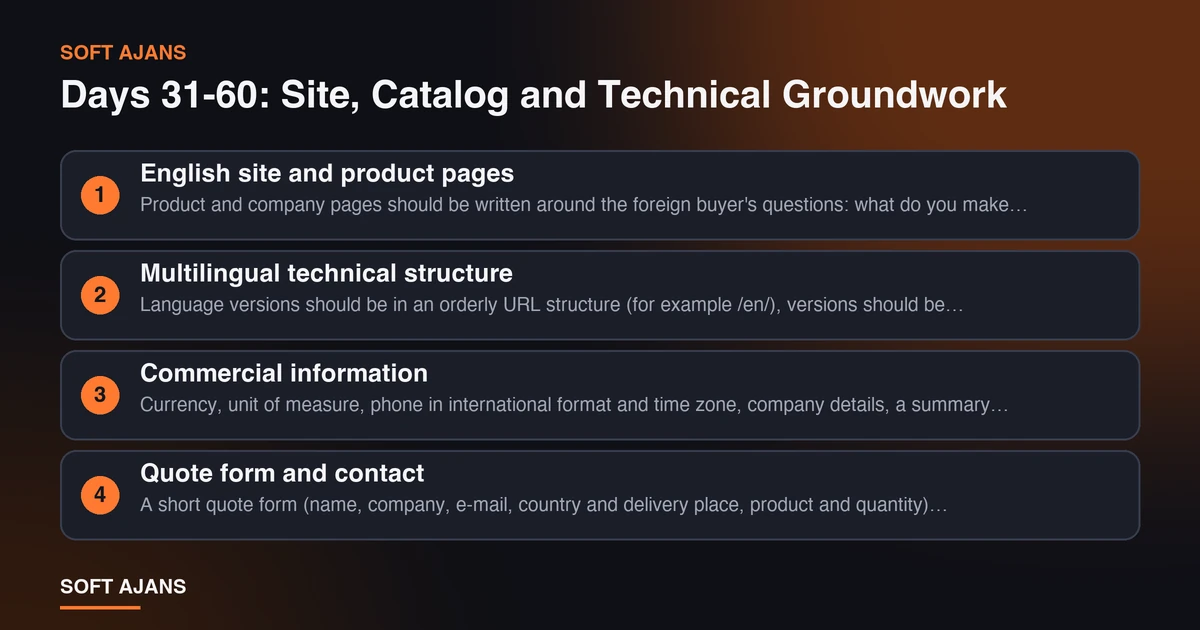
The second month is the month in which the shop window the buyer will see is built.
English site and product pages. Product and company pages should be written around the foreign buyer’s questions: what do you make, which certificates do you hold, where do you ship, what is the minimum order, what is the lead time? Use automatic translation only as a draft; have someone who knows the sector review it and keep terms consistent.
Multilingual technical structure. Language versions should be in an orderly URL structure (for example /en/), versions should be linked to each other with hreflang and every page should have a counterpart. To produce the tags quickly you can use our hreflang tag generator (in Turkish).
Commercial information. Currency, unit of measure, phone in international format and time zone, company details, a summary of commercial terms (payment and delivery terms). If these are missing, trust is damaged.
Quote form and contact. A short quote form (name, company, e-mail, country and delivery place, product and quantity), catalog download and a promise of a fast reply. When the form is submitted, an automatic confirmation message telling the buyer the reply time should go out.
Speed and mobile check. A buyer abroad may enter your site over a distant connection and from a phone; confirm that the site opens fast. The checks in speeding up your website help.
Set up and test measurement. Quote form, catalog download and contact clicks should be recorded by country and source. See that measurement works before ads begin.
Days 61-90: Visibility, Ads and the First Review
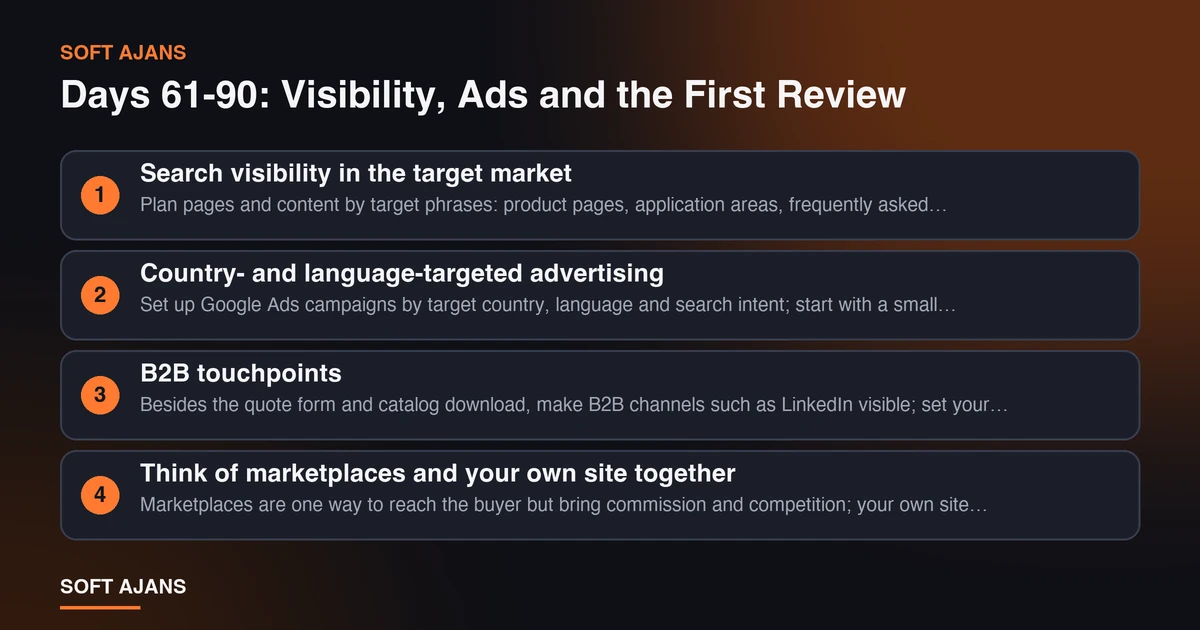
The third month is the month in which the shop window is brought to the buyer and the first data is collected.
Search visibility in the target market. Plan pages and content by target phrases: product pages, application areas, frequently asked questions and guides that answer the questions in the buyer’s decision process. It takes time for new pages to gain visibility; so the content plan continues after three months.
Country- and language-targeted advertising. Set up Google Ads campaigns by target country, language and search intent; start with a small budget and see which phrase and which country brings quotes. We described the logic of country- and language-targeted advertising in advertising abroad. Before opening the ad account, the Google Ads account audit checklist is useful.
B2B touchpoints. Besides the quote form and catalog download, make B2B channels such as LinkedIn visible; set your reply time. Measure the source and quality of incoming requests.
Think of marketplaces and your own site together. Marketplaces are one way to reach the buyer but bring commission and competition; your own site keeps your brand and the customer relationship with you. For the details of the choice see what marketplace integration is and what e-export is.
Do the first review. At the end of day ninety answer these questions: Which country and which phrase brought quotes? Is the cost per quote acceptable? Are the quotes qualified, how many turned into a real meeting? Which page and which channel worked? Which market will you grow in the next three months, and which will you drop?
What Should You Measure in Three Months?
These indicators are enough for results:
- Number of quote requests and their source: Which country, which page, which channel (organic search, ads, direct, LinkedIn)?
- Catalog downloads and contact clicks: Where does the buyer’s interest concentrate?
- Quality of the request: How many quotes came from a real buyer, how many turned into a meeting and a sample or order? You keep this data and it is added to the report.
- Search Console: Impressions, clicks and query trends in the target countries and language.
- Ads: Cost per click and per request by country and language.
- Reply time: The time of the first reply to an incoming request; a buyer abroad corresponds with several suppliers at once.
We described how to measure reply time in how to measure the first response time to incoming requests. An important warning: data from the first three months is small; one or two requests make the percentages look extremely large. When deciding, read the numbers carefully, together with several indicators.
The 12-Point First 90 Days Checklist
- I chose the starting market and language using data; at most two markets.
- I researched the buyer’s searches in the target country.
- Product information is in one orderly table.
- Real certificates and documents are collected; no document I do not have is shown.
- The English catalog is ready or being prepared.
- The English site is live with product and company pages; the translation was reviewed by someone who knows the sector.
- Language versions are linked with hreflang and every page has a counterpart.
- Currency, unit of measure, phone and time zone suit the target market.
- The quote form is short; catalog download and a reply-time promise exist.
- Measurement works by country, page and source and has been tested.
- Country- and language-targeted ads were started with a small budget.
- A review that will decide which market to grow on day ninety is planned.
Common Mistakes
- Opening to many markets at once. Each country needs separate content, measurement and communication; resources are spread.
- Running ads before preparing the site. Clicks that go to a Turkish site or one with translation errors are wasted.
- Publishing automatic translation without checking. A wrong translation of technical terms loses the buyer’s trust.
- Not showing documents and commercial terms. The buyer abroad builds trust first with documents and clear terms.
- Underestimating reply time. A buyer corresponding with several suppliers turns to the one that replies first and gives clear information.
- Setting up measurement afterwards. Without starting data you cannot know which market worked.
- Expecting results in the first weeks. Search visibility takes time; the first three months are a learning period.
What Does Soft Ajans Do in E-Export?
In our e-export and international digital marketing service we research the buyer’s searches in the target country, set up the English site and catalog structure in line with the multilingual technical infrastructure (hreflang, URL structure), manage country- and language-targeted Google Ads campaigns and measure B2B touchpoints (quote form, catalog download). Our own team produces the English content; for languages such as German, Arabic or Russian a local translator and technical approval are needed, and we can plan and manage this.
We have no published case focused on e-export; our published cases are organic search results and we do not guarantee results. We do not offer marketplace store management, grant applications or customs and logistics consulting. To compare the visibility of your site and one competitor you can request a free pre-analysis; we described how the price is formed on the how pricing works page (in Turkish).
Frequently Asked Questions
Which market should I start with in digital marketing for e-export?
Start with one or two markets according to your existing sales and quote records, the search volume in the target country and your capacity to reply. A market where you already have a relationship is often less risky.
Is an English site enough for every country?
For a start, often yes; English is a commercial language in many countries. But spelling, units of measure and habits vary by country. Think about country-specific versions when the market really grows.
Should I run ads in the first three months?
If your site, catalog and measurement are ready, yes, with a small budget; that way you quickly see which country and phrase bring quotes. If the site is not ready, finish the site first; ads sent to an unprepared site are inefficient.
Should I sell on a marketplace or on my own site?
The two do not have to be alternatives. A marketplace reaches the buyer fast but brings commission and competition; your own site keeps the brand and the customer relationship with you. Many manufacturers use both.
When should I evaluate the results?
The ninety-day first review is for learning; do not make big decisions with small data. Search visibility and the B2B enquiry flow usually settle over a longer time. To see which market works, look at at least a few months of data.
Is there a result guarantee?
No. Results vary with the product, price, market, competition and the reliability of the site. This plan puts preparation in order; it does not promise results.