“How much budget should I set aside for ads on TikTok?” cannot be answered with a single figure, because the right budget depends on your product, your target audience, competition and above all on what you will measure. But how you plan the budget, whatever the figure, rests on a certain logic: how much goes to testing and how much to scaling, and by which indicator do you stop or continue?
In this article we explain the logic of planning a TikTok ads budget, three fictional scenarios, a week-by-week plan for the first 30 days and the indicators to look at when deciding. We give no real cost or return figures, because on TikTok costs vary over a wide range with the campaign objective, audience, competition and the quality of the video. We explained how to set up a campaign step by step in our guide how to run TikTok ads.
Tie the Budget to the Goal Before the Figure
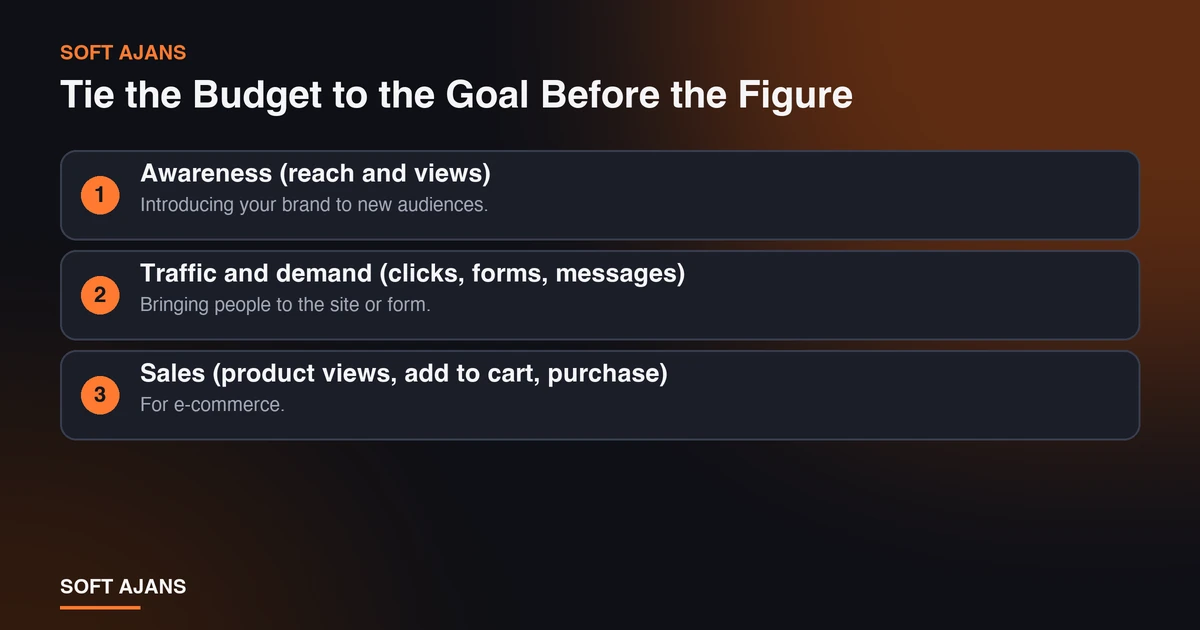
A budget plan starts not from a number but from a goal. On TikTok there are three basic aims, and each needs a different budget logic:
Awareness (reach and views). Introducing your brand to new audiences. The success measure is views, reach and video watch time. Sales are not measured directly; so starting the budget small and looking at the response to the content is enough.
Traffic and demand (clicks, forms, messages). Bringing people to the site or form. The success measure is cost per click and cost per form; your site must be ready to receive this traffic.
Sales (product views, add to cart, purchase). For e-commerce. The success measure is cost per order and return on ad spend; for this, conversion tracking with the TikTok Pixel must be in place.
After setting the goal, ask: “how much profit does one unit of result (a form, an order) bring?” The profit left from an order shows the upper limit you can set aside for ads. For the profit calculation our profit margin calculator (in Turkish) helps.
The Testing Share and the Scaling Share
On TikTok the budget is usually split into two parts:
- Testing share: The budget set aside to try different videos, audiences and messages. Its aim is not to win but to learn.
- Scaling share: The budget invested in the video and audience seen to work in testing. Its aim is to grow the result.
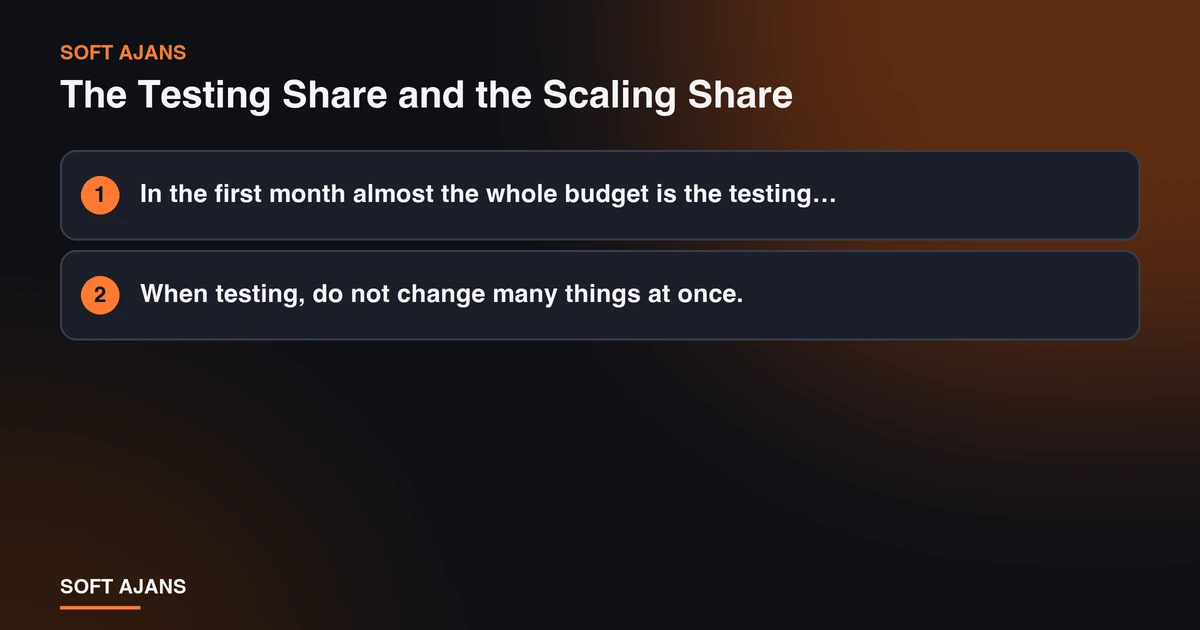
In the first month almost the whole budget is the testing share, because you do not yet know what works. In later months, as what works is found, the scaling share grows. As a practical starting ratio it makes sense to put most of the first month’s budget into tests and a small part into the first signal that works; but the ratio varies by business and is not a fixed rule.
When testing, do not change many things at once. Try different videos on the same audience, or the same video on different audiences; if you change both at once you cannot tell which one worked.
Three Fictional Budget Scenarios
The scenarios below are neither a forecast nor a promise; they are prepared with fictional figures only to show how a budget can be split. Real amounts should be set according to your goal and profit margin.
Scenario 1: A small business trying it for the first time (an example monthly ad budget of 10,000 TL). One campaign, one goal. About half of the budget goes to trying three or four different videos, the rest to the video that gives the best signal. The aim is to find, by the end of this month, an answer to “which message and which audience work?”; not profit.
Scenario 2: An e-commerce store aiming for growth (30,000 TL a month). One test campaign and one scaling campaign. In the test campaign new videos and audiences are tried; in the scaling campaign the previous month’s winning video runs with a higher budget. A small share is set aside for remarketing (people who came to the site and did not buy).
Scenario 3: A multi-product brand that is scaling (60,000 TL a month and above). Several campaigns: awareness, sales and remarketing are managed separately. Regular production of new videos is a significant part of the budget, because ad videos lose their effect over time and must be renewed.
In these scenarios the ad budget is separate from the service fee; the ad budget is paid directly to the TikTok platform. We gave examples of how to split the overall digital marketing budget in digital marketing budget: 3 realistic scenarios.
The Week-by-Week Plan for the First 30 Days
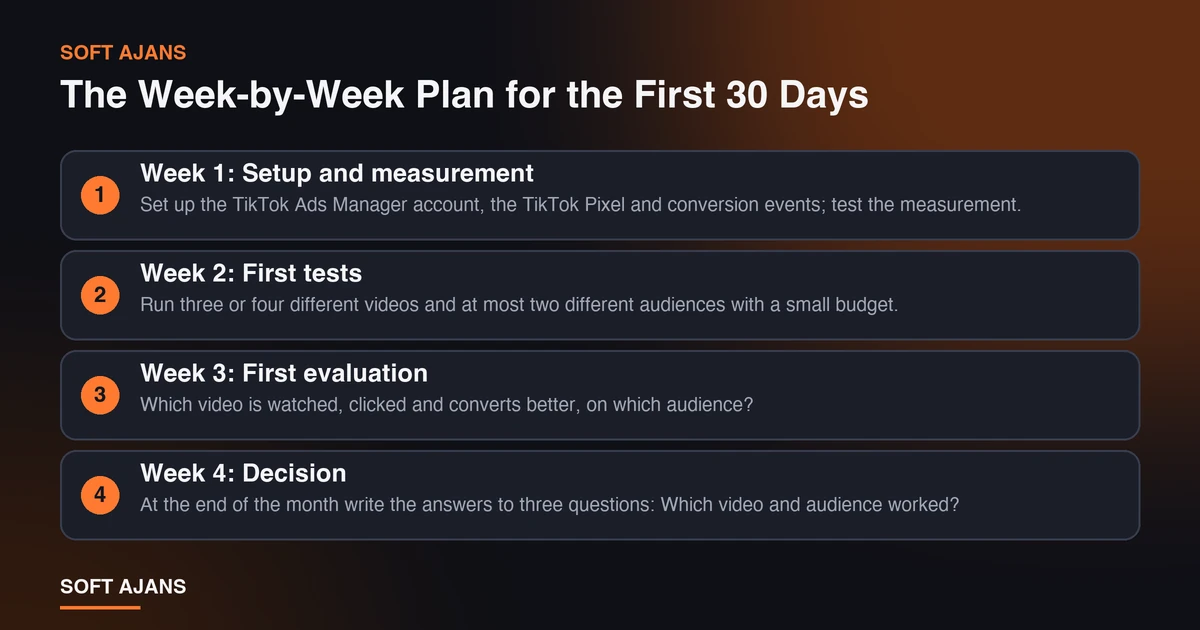
Week 1: Setup and measurement. Set up the TikTok Ads Manager account, the TikTok Pixel and conversion events; test the measurement. Decide on the target audience and the first videos. Only a very small part of the budget is spent this week; the real job is the infrastructure.
Week 2: First tests. Run three or four different videos and at most two different audiences with a small budget. Do not draw conclusions yet; the platform is in its learning phase and changing a campaign right away resets the learning.
Week 3: First evaluation. Which video is watched, clicked and converts better, on which audience? Close the weak ones and shift budget to the strong ones. Leave a small share to try a new video idea.
Week 4: Decision. At the end of the month write the answers to three questions: Which video and audience worked? Is the cost per result (form, order) acceptable against your profit? Should we grow, keep or reduce the budget next month?
Before deciding at the end of the first month that “it does not work”, check the site too: a slow site or an untrustworthy payment page makes even a good ad look like a failure. For speed and mobile checks see speeding up your website and how to test a mobile-friendly website.
Which Indicators Do You Decide By?
There are dozens of indicators in the TikTok panel; a few are enough for a decision:
| Indicator | What it tells you |
|---|---|
| Video watch time and view rate | Does the video hold attention? If weak, change the first seconds and the content. |
| Click-through rate | Do the message and call to action awaken interest? |
| Cost per click | Is traffic expensive? The audience and video can be changed. |
| Conversion rate | Does the site or form receive the visitor well? |
| Cost per conversion | How much does a form or an order cost? Compare it with your profit. |
| Return on ad spend | For the sales goal, the revenue returned for every lira spent. |
To make sure the numbers are reliable, check that conversion tracking is set up correctly. To measure phone, form and WhatsApp requests you can use the methods in call tracking. When deciding, look not at a single indicator but at the story of several together: if views are high but conversion is low, the problem may be not in the video but in the site or the offer.
Rules for Growing and Stopping the Budget
To take emotion out of budget decisions, set written rules in advance:
- Growing: If cost per conversion is below your target and stable for several days, raise the budget gradually. Sudden and large increases can disturb the platform’s learning.
- Keeping the same: If the result is close to the target but fluctuating, keep the budget fixed and try new videos.
- Reducing or stopping: If, despite enough data, cost per conversion exceeds your profit, close the campaign; look first in the video, the audience and the site for the cause.
- Renewing video: When the audience that watches the same video is saturated, performance falls; new video is a continuing item in the budget plan.
You can use these rules for other ad channels too, not only TikTok. To check whether your account and site are ready before advertising, the Google Ads account audit checklist offers a similar logic.
Video Content Is Part of the Budget Too
When planning a TikTok ads budget, most businesses calculate only the amount to be paid to the platform and forget video production. Yet the success of an ad depends largely on the video, and videos lose their effect over time. So set aside a separate item for content production: editing the existing videos to be used, new shoots, short cuts and trials of different first seconds.
A practical approach is to prepare a few new video variations each month: telling the same message with different openings, or with different people and places. Getting many short videos from a single shooting day lowers cost; for planning and shoot preparation, the preparation list in what determines corporate promo film prices is useful. We described the logic of the short-video format in how to make Instagram Reels.
Common Mistakes
- Opening ads without setting up measurement. Without conversion tracking you cannot know which video works.
- Deciding in the first week. Changing the campaign often while the platform is learning resets the learning.
- Testing everything at once. If you change video, audience and message together, it is not clear what worked.
- Not taking the video seriously. On TikTok, advertising depends on content more than on almost any channel; you need platform-specific videos with strong first seconds.
- Not preparing the site. A slow site or one broken on mobile wastes the click.
- Not doing the profit calculation. Growing the budget without comparing what a result costs with your profit margin can lead to a loss.
- Continuing for long with a single video. Creative fatigue lowers performance.
What Does Soft Ajans Do in TikTok Advertising?
In our TikTok ad packages, TikTok Ads account setup, target audience planning, short video ad concepts, conversion tracking through the TikTok Pixel, remarketing, performance optimization and regular reporting run together. Depending on the package scope we edit your existing videos or plan new video ideas and the production process. The ad budget is not included in the service fee; it is paid directly to the TikTok platform.
We do not guarantee sales or results; results vary with the product, price, offer, content, targeting and the website experience. Package options and prices are written on the service page; to see the current state of your account and site you can request a free pre-analysis. For the organic side of the platform see TikTok Explore and what TikTok SEO is, and for the e-commerce side what TikTok Shop is.
Frequently Asked Questions
What is the minimum budget I should set aside for TikTok ads?
It would not be right to give a fixed lower limit, because the budget depends on the goal, the audience and competition. What matters is to start with a budget that collects enough data to learn from, and to compare cost per result with your profit. Also check in Ads Manager the platform’s own minimum budget conditions for the campaign types.
How long until TikTok ads give results?
The first weeks are the platform’s learning period. The first meaningful signals usually appear at the end of the first month; but the time varies with the sector, the video and the budget. So plan the first month as a test month.
Is the ad budget included in the service fee?
No. The ad budget is paid directly to the TikTok platform and is separate from the agency fee. The service fee covers work such as setting up and managing the account, planning videos and reporting.
How often should I change the monthly budget?
Frequent and sudden changes can disturb the platform’s learning. Raise the budget gradually, base your decisions on a few days of data and review once a week.
Are TikTok ads suitable for every business?
They give results more easily for products and services suited to visual storytelling and addressed to a young and dynamic audience; but they may not be the right channel for every business. If your target audience is not on TikTok or you have no product suited to video, starting with other channels may be more efficient.
Is there a sales guarantee?
No. Results vary with the product, price, offer, content, targeting and the website experience. The scenarios in this article are fictional and are neither a forecast nor a promise.