The answer to “how much does a logo cost?” changes a lot from one agency to another, and even between two customers of the same agency. One sells a “logo” for a few thousand liras, another asks for several times that; both use the same word. The difference is usually not in the designer’s talent but in what the quote covers: how many concepts will be presented, how many revisions will be made, which files will be delivered, and whether the design is original or an adaptation of a ready-made template.
In this article we explain the items that determine logo design prices, what a quote should list separately, why file formats matter and how to compare the quotes you receive. The aim is not to give you a figure; it is to let you ask “what does this price cover?” We described the relationship between a logo and a corporate identity in what corporate identity design includes; here the subject is the cost of the logo itself.
Why Is a Logo Price Not a Single Figure?
A logo is far more than drawing a shape. First, what the brand does, whom it speaks to and how it wants to feel are understood; then ideas are developed, concepts are prepared in several directions, the chosen direction is matured with feedback and finally it is turned into files for different areas of use. Each stage is a separate effort and carries a different weight in every project.
To understand the price gap between two logo quotes, ask this question: in how many directions will the designer think for this price, and what will they deliver to you? One quote may cover preparing a single draft and making one correction; another may cover three or four concepts and several revision rounds. The delivered files make a difference too: getting only a small image (PNG) is not the same as getting print-ready vector files together with it.
There is also a matter of expectation. A logo looks like a “product you buy” but is really the result of a process. The clearer the brief and the more orderly the feedback, the shorter and more efficient the process. That is why a good quote writes down not only the price but also the process and what is expected of you.
The 8 Factors That Set the Price
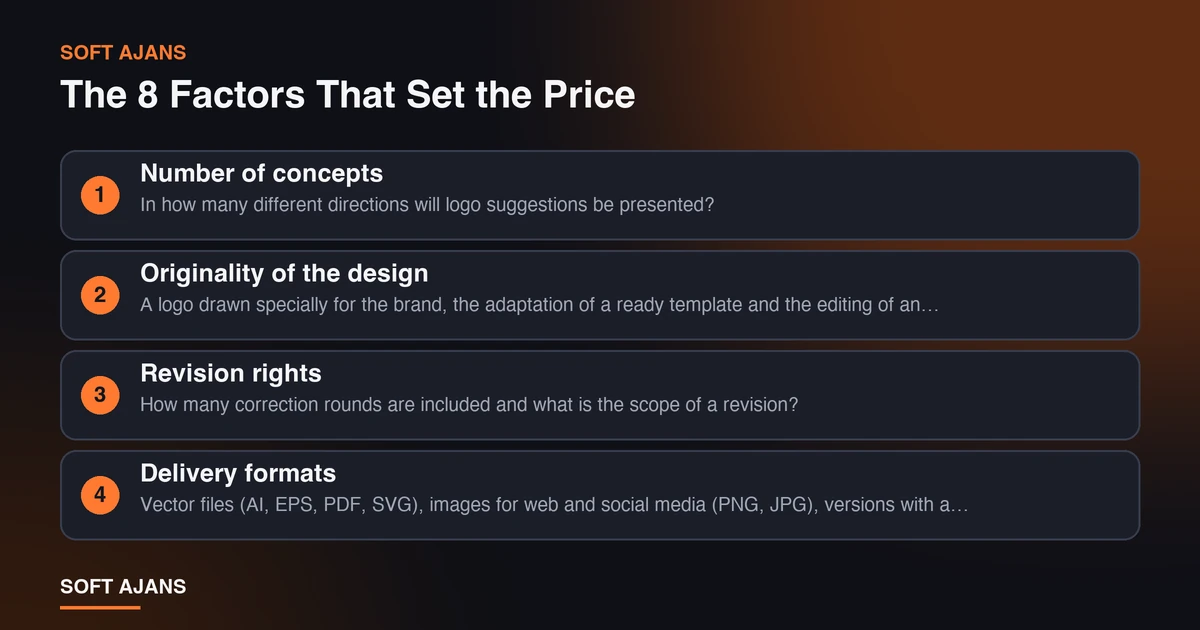
Logo design price is affected most by these eight factors:
- Number of concepts. In how many different directions will logo suggestions be presented? A single direction means a single opinion; several concepts give a choice and a comparison but require more effort.
- Originality of the design. A logo drawn specially for the brand, the adaptation of a ready template and the editing of an image taken from an AI tool are very different jobs. Original design raises price and time, but being unique comes from there.
- Revision rights. How many correction rounds are included and what is the scope of a revision? Changing a color is not the same as changing the direction of the concept from scratch; this difference should be written in the quote.
- Delivery formats. Vector files (AI, EPS, PDF, SVG), images for web and social media (PNG, JPG), versions with a transparent background. Which of them are delivered determines the price and how useful the logo will be in the future.
- Logo variations. Horizontal and vertical layouts, icon only, versions for light and dark backgrounds, single-color (black or white) versions. Each variation means extra work.
- Usage guide. A page or document showing the logo’s color codes, clear space, minimum usage size and uses to avoid. A short guide and a comprehensive one carry different workloads.
- Depth of research and brief. A study that examines the sector, competitors and target audience differs from one based on a quick brief. The first takes more time but is more likely to hit the mark.
- Duration and urgency. If delivery in a very short time is wanted, the designer has to make time away from other work; this can be reflected in the price.
When you ask an agency about each of these eight items one by one, you see where the price difference comes from. Most of the time a low quote has left out one or two items; that means an extra charge or a difference in expectations later.
Items a Quote Should List Separately
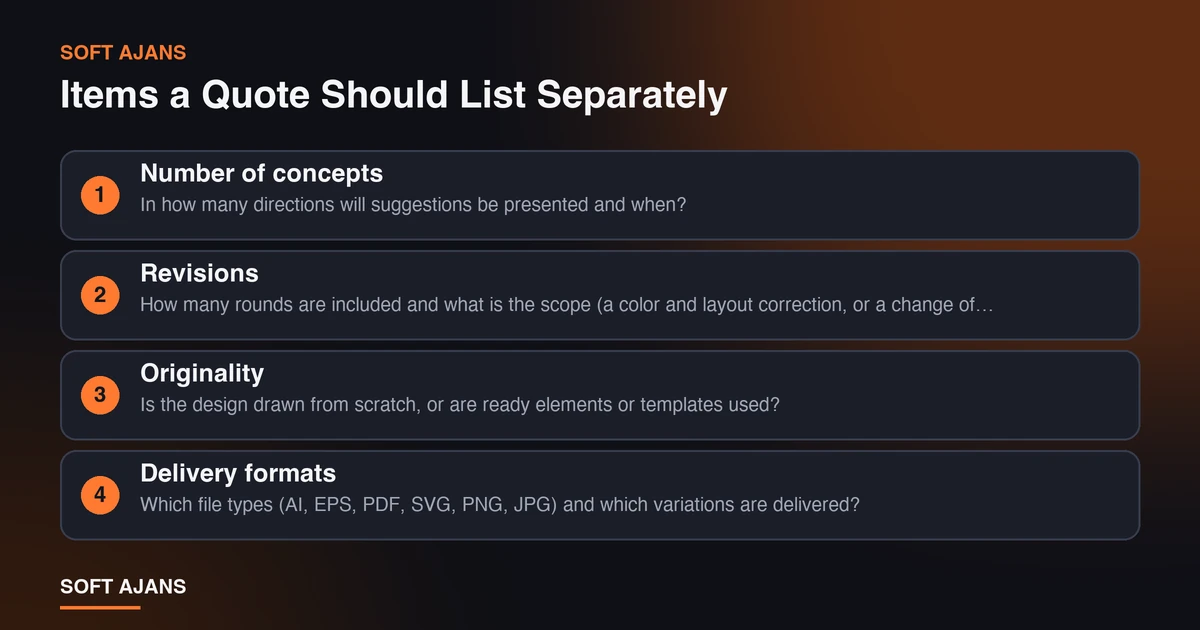
In a good logo quote the following items are written separately and clearly:
- Number of concepts: In how many directions will suggestions be presented and when?
- Revisions: How many rounds are included and what is the scope (a color and layout correction, or a change of direction)?
- Originality: Is the design drawn from scratch, or are ready elements or templates used?
- Delivery formats: Which file types (AI, EPS, PDF, SVG, PNG, JPG) and which variations are delivered?
- Usage guide: Is there one, short or comprehensive?
- Usage rights: Are the rights to the logo transferred to you after payment and delivery? This item must be clearly written in the contract.
- Source files: Is the drawing file itself given to you?
- Duration: The dates of the first concepts and of the final delivery.
- Payment plan: Upfront or in stages?
- Extra services: Are applications such as a business card, letterhead or social media template included in the package or separate?
You can apply this list to other quotes as well. We described the general method in how to compare web design quotes and bringing three agency quotes to the same base; for a ready table you can download the agency quote comparison table.
File Formats: Which One Is for What?
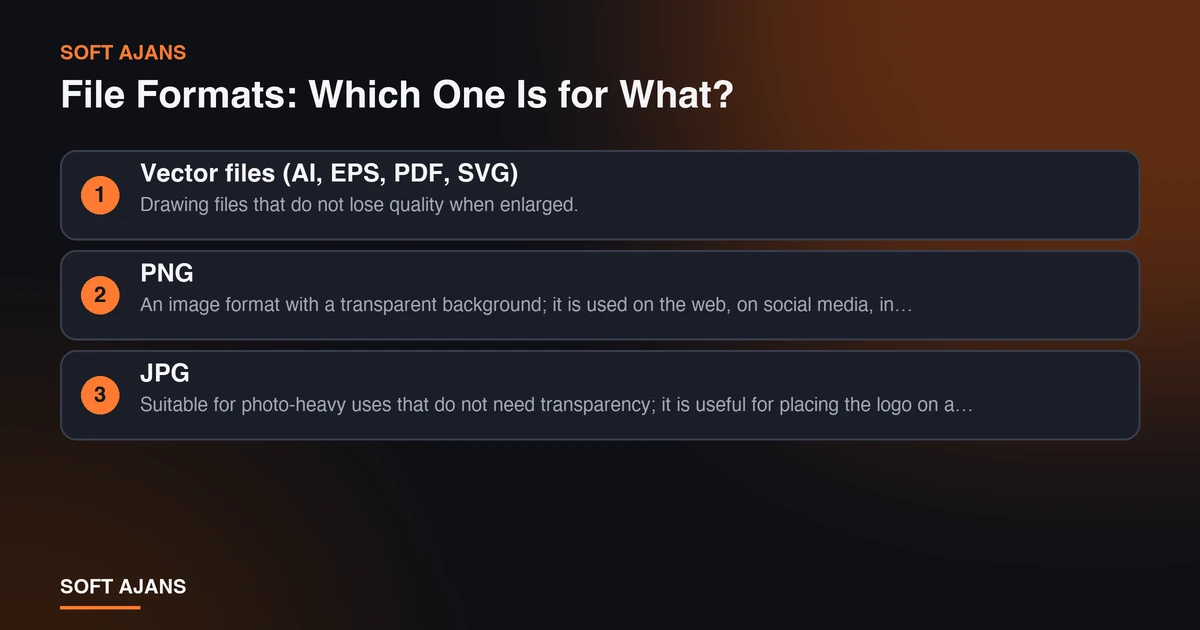
When it comes to logo delivery, the most overlooked subject is the file format. Yet staying with only a small image file seriously limits how you can use the logo in the future.
Vector files (AI, EPS, PDF, SVG). Drawing files that do not lose quality when enlarged. They are needed for uses at any size, such as signage, vehicle wraps, posters and printed business cards; printers generally ask for these. SVG is also used for a sharp look on a website.
PNG. An image format with a transparent background; it is used on the web, on social media, in presentations and in digital documents. Asking for versions in different sizes and for both light and dark backgrounds is a good habit.
JPG. Suitable for photo-heavy uses that do not need transparency; it is useful for placing the logo on a photo background or for quick sharing.
If you receive the logo only as a PNG, you will run into trouble on the day you have a sign or print job made: a low-resolution image gets blurry when enlarged and redrawing is needed. So ask for the quote to state that vector files and which formats will be delivered. To reduce the size of images or change their format for digital use, our image compression tool and image format converter, which run in the browser, will help; your files are not sent to a server.
Ready Templates, AI and Original Design Compared
On the logo market three approaches sit side by side: original design drawn specially for the brand, the adaptation of a ready template or stock element, and the editing of an image produced by an AI tool. The price, time and risks of the three differ.
Original design is built around the brand’s character and aims to be unique. It takes more time and effort, which shows in the price. Adapting a ready template is quick and cheap, but the same template may also be used by other businesses; your brand can lose its distinctiveness. AI outputs look quick and cheap, but they often come without a vector file, are hard to fine-tune, and the question of who holds the rights can be unclear depending on the tool and the legal framework.
Before your budget, decide among these three approaches with this question: is the logo only a temporary need, or a brand asset you will use for years? In a logo that will be used long-term, originality and clear rights are often the most important item. For legal matters such as trademark registration, a search for similar logos and the transfer of rights, we recommend getting support from a trademark attorney or a legal adviser; we do not provide legal advice on this.
Our Packages and Their Scope in October 2026
On our logo design service page three packages are written. As of October 2026 the packages are:
- Starter Package (3,000 TL, one-off): 2 original concepts, 1 revision and basic file formats (PNG, JPG).
- Professional Package (5,500 TL, one-off): 3-4 original concepts, 3 revisions, all usage formats (web, print, social media) and a usage guide.
- Corporate Package (9,000 TL, one-off): Everything in the Professional Package, unlimited revisions, a comprehensive usage guide and preliminary consulting for corporate identity integration.
Prices are kept up to date on the page; the above is a dated summary. Designs are prepared as original work according to the brand’s needs, without using ready templates. The file formats to be delivered (such as AI, EPS, PDF, SVG, PNG and JPG) are set by package; the duration varies with the package and the speed of feedback. In the Corporate Package revisions are unlimited; in that case, to protect the schedule we recommend collecting feedback in a single message and setting approval dates in writing. For the general framework of the packages see digital agency prices, and for our general approach to how a price is formed see how pricing is determined.
A Logo or a Corporate Identity?
A logo is not enough for a brand that appears on several media. If the business card, letterhead, e-mail signature, social media templates and website do not speak the same language, even a beautiful logo leaves a scattered impression. In that case, next to the logo you need an identity system and a guide.
A practical distinction: for a newly founded business that appears on only a single medium (for example only a social media account), a logo package is often enough. If printed documents, web, social media and field materials will be used together, or if more than one person will produce materials, corporate identity design is a more correct investment. We described the difference in the importance of logo and corporate identity design. For how to make color and typeface decisions for the web after the logo, you can find it in how to choose the right color palette and typography for a website.
The Brief to Prepare Before Asking for a Quote
What speeds up the logo process most is a well-prepared brief. Write the following briefly to the designer:
- The name of the business, what it does and whom it serves.
- Where the logo will be used (signage, business card, website, social media, packaging).
- Three adjectives describing the brand personality (reliable, young, friendly, for example).
- Examples of logos you like and dislike, and why.
- If there is an existing logo, and why you want to change it.
- Colors or symbols you do not want to use.
- Your competitors’ logos: how do you want to stand apart from them?
- The person who will give approval, the expected delivery date and the budget range.
As long as these eight items stay unanswered, the number of revisions rises. We also gathered general preparation habits in 10 things to prepare before you order a website; a similar logic applies to a logo.
A 10-Point Logo Quote Checklist
When evaluating a logo quote, check these ten items:
- How many original concepts will be presented?
- Is the design drawn from scratch, or are ready elements or templates used?
- How many revision rounds are included and what is their scope?
- Which file formats are delivered (are vector files included)?
- Which variations are delivered (horizontal, vertical, icon, single color, light-dark backgrounds)?
- Is there a usage guide, and how extensive is it?
- Are usage rights transferred to you after payment and delivery?
- Are source files given to you?
- Are the duration and payment plan tied to stages?
- Are extra applications such as a business card, letterhead or template included or separate?
Get the answers in writing and have them added to the quote. Everything said verbally but not written becomes a subject of argument at delivery.
Common Mistakes
- Deciding only by price. A very low quote may have left out the number of concepts, revisions or the delivery of vector files.
- Not getting vector files. If the logo stays only as a PNG, redrawing is needed at the print and signage stage.
- Not defining the scope of revisions. A “small correction” and “changing the concept from scratch” are not the same thing.
- Not having the rights written down. Who owns the logo and whether it is transferred after payment should be clear in the contract.
- Deciding with too many people. Partners and relatives giving different views at every round lengthens the process and makes the logo “average”.
- Designing by trend. A style that is fashionable today can look dated in a few years; a logo should be long-lived.
- Thinking the logo alone is enough. In a brand that appears on several media, an identity system is needed next to the logo.
What Does Soft Ajans Do in Logo Design?
In our logo design service we prepare original logo drafts that reflect your brand’s character, among which you can choose from several concepts. We develop the concept you like together until it is settled, within the revision rights set. We deliver your logo in file formats suited to areas of use such as web, print and social media, and in the Professional Package we also prepare a usage guide showing the color, spacing and size rules. We do not use ready templates.
If you also need identity parts such as a business card, letterhead, e-mail signature and a brand guide next to your logo, we can discuss our corporate identity design service. The Corporate Package also includes preliminary consulting for corporate identity integration. We do not give a guarantee of result or of taste; we make the process, the scope and the revision rights clear in writing from the start. For applying it on a website see our web design service, and to see the state of your digital assets you can look at the free pre-analysis.
Frequently Asked Questions
What does the price of logo design depend on?
It depends on the number of concepts, the originality of the design, the revision rights, the delivered file formats and variations, the scope of the usage guide and the urgency of the schedule. That is why the scopes of two quotes need to be brought to the same base before you compare them.
How many days does it take to prepare a logo?
The duration varies with the package and the speed of feedback. If the brief is clear, feedback comes in a single list and approval is fast, the process is shorter; in projects where many decision makers give opinions it gets longer. The schedule should be written in the quote.
Which file formats should I ask for with a logo?
You must ask for vector files (AI, EPS, PDF or SVG) and PNG for web and social media. Without vector files you can have problems with signage, posters and print jobs. Also ask for versions with a transparent background and for light and dark backgrounds.
Is it a problem to have a logo made from a ready template or with AI?
It can be used for short-term and low-risk needs; but uncertainties can arise about uniqueness, vector files and usage rights. For a brand asset you will use for many years, original design and clear rights are often safer. For registration and transfer of rights, apply to a trademark attorney or a legal adviser.
What happens when the revision rights run out?
Extra revisions are priced as written in the quote. So learn up front how many rounds are included and how an extra round will be charged. In packages with unlimited revisions too, approval dates should be set in writing to protect the schedule.
Do I also need a corporate identity together with the logo?
If you appear on only a single medium, the logo is often enough. If you will use printed documents, web, social media and field materials together, or if more than one person will produce materials, an identity system and guide protect consistency.