One morning, negative reviews fall on your Google profile one after another. Or a customer shares a problem on social media and the post spreads fast. Or you search your brand name and an old news story comes up on the first page. In these moments the most expensive thing is not the bad news itself but the team not knowing what to do: who will reply, who will approve, which message will be used, whom to notify?
In this article we explain a one-page crisis plan template a business can apply tomorrow: what you should write in advance, which steps are taken in the first 24 hours, how to build the message and what not to do. The article is not legal advice; in cases involving insult, defamation or personal data, the application must be made through a lawyer. We described the general framework in what digital reputation is; here the subject is the written plan to be used in a crisis.
Why Write a Crisis Plan in Advance?
In a crisis, time, information and calm are scarce. If it is not clear who has the authority, a reply is delayed for days, different people say different things and the situation is given more weight than it deserves. A plan resolves this uncertainty in advance: decision authority, tone, time and approval flow are written down; in a crisis it is only applied.
The second reason is correct scaling. Not every negative review is a crisis. The reply needed for a single dissatisfied customer differs from the reply needed for a service outage that affects dozens of people. Part of the plan consists of simple criteria used to separate “normal negative feedback” from “crisis”.
The third reason is consistency. If several people answer through different channels (phone, e-mail, social media, review replies), the messages must not contradict each other. A one-page plan makes everyone use the same framework.
The Five Sections of the Plan
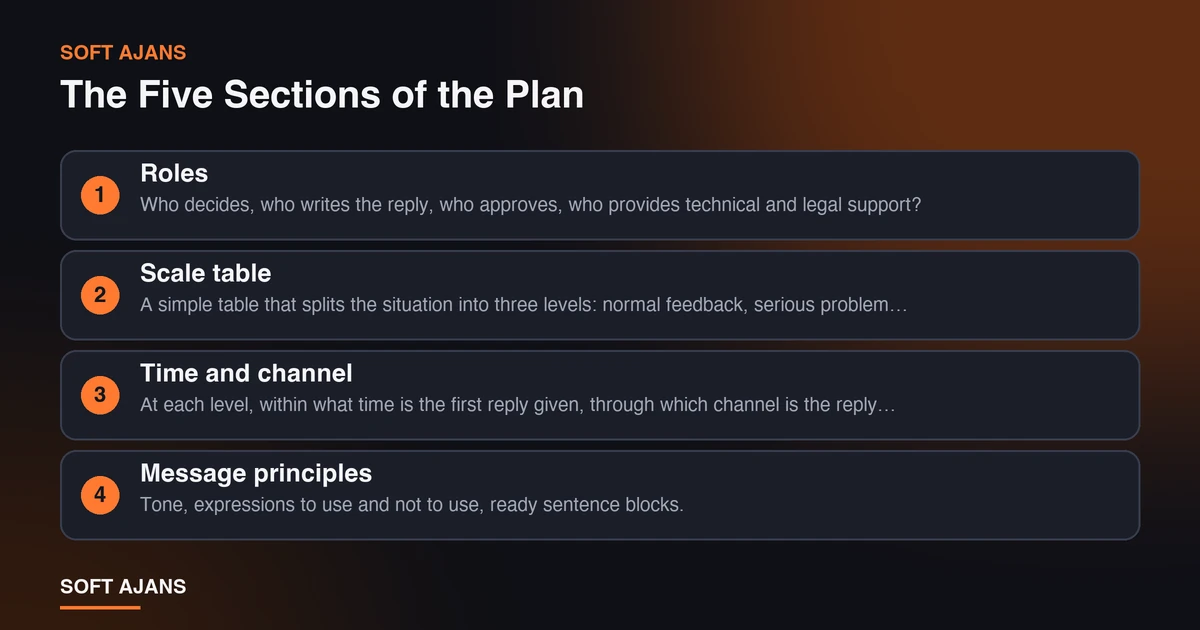
A one-page crisis plan is both short and functional if it has five sections:
1. Roles. Who decides, who writes the reply, who approves, who provides technical and legal support? In a small business these roles can be held by one person; they still need to be written down. Also set a backup for when the person cannot be reached.
2. Scale table. A simple table that splits the situation into three levels: normal feedback, serious problem, crisis. In which case you move to which level should be written with examples.
3. Time and channel. At each level, within what time is the first reply given, through which channel is the reply written, where is the detail moved?
4. Message principles. Tone, expressions to use and not to use, ready sentence blocks.
5. Record and aftermath. The incident record, collecting evidence, informing after resolution and lessons.
Each of these sections is a few lines; together they fit on a single page and sit in a place everyone on the team can reach.
The Scale Table: What Is What?
A three-level table makes you ask the same question each time: “How many people does this affect, how fast is it spreading, how serious is it?” A sample table:
| Level | Example | Reply framework |
|---|---|---|
| Normal feedback | A single negative review, a personal complaint | Normal reply flow: calm, short, general; detail to a private channel |
| Serious problem | Several complaints on the same subject, an error or delay | The manager is informed; a single authorized reply text is prepared; the root cause is investigated |
| Crisis | A fast-spreading post, a service outage, a claim concerning safety or law | The decision maker convenes; the first statement is made quickly; legal support is brought in |
Adapt the limits in the table to your business. For a clinic even a single claim about patient privacy can count as “serious”; for a cafe a single review is “normal”. What matters is that the limit is set in advance, in a calm time.
The First 24 Hours: Step by Step
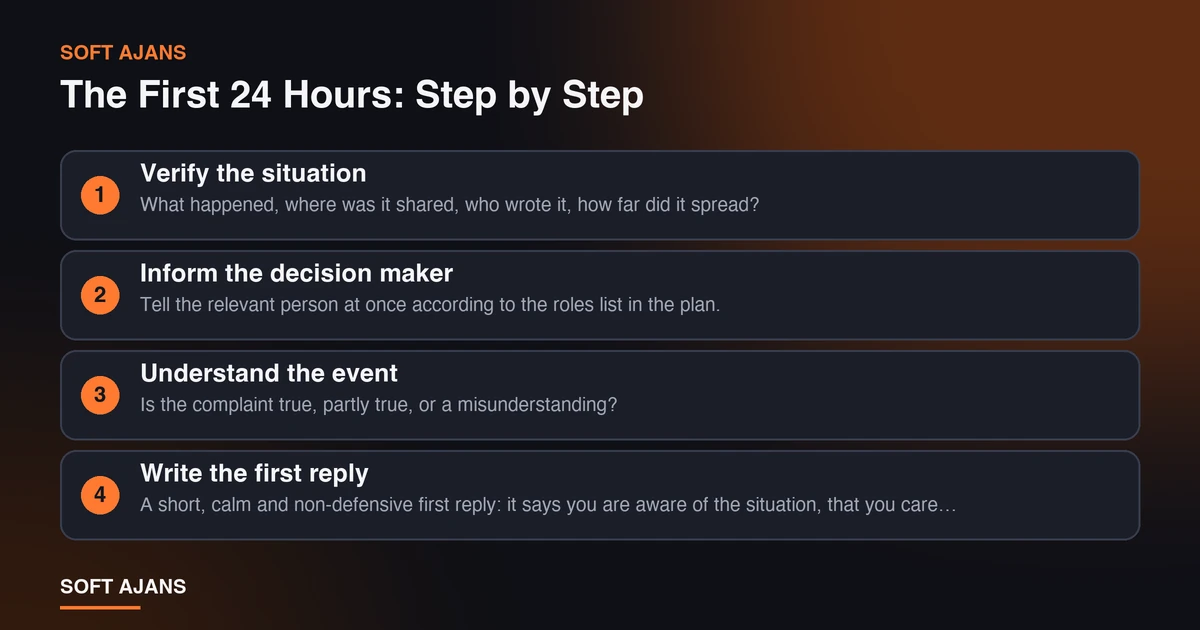
When you move to the crisis level, this order works:
- Verify the situation. What happened, where was it shared, who wrote it, how far did it spread? Record the screenshot, date and link; these are evidence both for your own records and for a possible official application.
- Inform the decision maker. Tell the relevant person at once according to the roles list in the plan.
- Understand the event. Is the complaint true, partly true, or a misunderstanding? Before replying, get information from internal records and the employees concerned.
- Write the first reply. A short, calm and non-defensive first reply: it says you are aware of the situation, that you care and how you will solve the detail. Move the detail to a private channel.
- Reply from a single center. Prevent different people saying different things in different channels; let one person or a small group write the replies.
- Consider the legal or platform route. If a review or content breaks platform rules, use the relevant platform’s notification form with evidence. In cases involving insult, defamation or personal data, consult a lawyer.
- Take a corrective step. If the problem is real, solve it: a refund, a correction, an apology or a process change. A real solution is the best reputation repair.
- Announce the solution. Tell the person who shared the complaint, and if needed the general audience, briefly and clearly what you did.
- Keep monitoring. For a few days monitor new reviews and posts; keep the plan open until the situation settles.
We described Google’s review rules and the limits of the removal process in how to remove Google reviews. An important warning: a business owner cannot have a review deleted themselves; only reviews that break policy can be reported, and the decision belongs to the platform.
Message Principles
How the message is built affects whether a crisis grows or settles. These principles work:
- Be short and calm. Long defenses enlarge the situation.
- Acknowledge the feeling, do not accuse. A sentence like “we are sorry for the problem you experienced” shows respect regardless of whether the problem is real. Verify the event before taking responsibility.
- Be clear. Say what you did and what you will do next.
- Move the detail to a private channel. Do not share personal data or patient and customer information in an open reply.
- Keep the tone. Do not belittle the other side, do not use irony.
- Stay consistent. The same information should be given in different channels about the same event.
- Do not promise; say what you can do. A promise you cannot fulfill creates a second crisis.
For example reply patterns to negative reviews, see how to reply to Google reviews. Add the sentence blocks you prepare to the plan: first reply, invitation to a private channel, solution notice and thanks.
Extra Care in Regulated Fields Such as Health, Finance and Law
In some sectors the reply itself is subject to rules. In health, disclosing patient information can be a privacy violation; writing treatment details when replying to a review causes a problem. In law and finance too there are obligations on customer information and confidentiality. In these sectors prepare the “who may share which information” section of the plan together with a legal adviser. We described the limits of communication in healthcare in social media management in the healthcare sector.
After the Crisis: Record the Lessons
Once the situation settles, do a short review: how did the event start, did the plan work, which step was late, which message was well received? Without closing the root cause (a process error, a communication gap, a product problem), a crisis plan stays a firefighting tool. At the end of the review, update the plan: the roles, the table and the sentence blocks.
After a crisis also look at the brand-name search: if the event has become visible in search results, keeping your own assets (your website, Google profile, social media accounts) current and consistent helps balance the results. A routine of collecting reviews from real and satisfied customers builds this balance over the long term; the 30-day review plan is an example of this. Do not try to balance with fake or purchased reviews; this both violates platform rules and can create a second crisis.
The 12-Point Crisis Plan Checklist
- The people who decide, write the reply and approve are written down; their backups are defined.
- There is a scale table written with examples for normal feedback, serious problem and crisis.
- The first reply time is defined for each level.
- It is clear through which channel and by whom replies will be written.
- Tone and wording principles are written; expressions not to be used are listed.
- Sentence blocks for the first reply, invitation to a private channel and solution notice are ready.
- Which information will not be shared in an open reply (personal data, customer information) is written.
- The evidence-collecting step (screenshot, date, link) is in the plan.
- The platform notification and legal application routes, and who is responsible, are clear.
- Who has authority over corrective steps (refund, apology, process change) is clear.
- There is a post-crisis review and plan update step.
- The plan is kept where the team can reach it and is reviewed at least every six months.
Common Mistakes
- Deciding in the moment when there is no plan. If the role and approval flow are unclear, replies are delayed and contradict.
- Counting every negative review as a crisis. This tires the team and leaves no energy for a real crisis.
- Writing a defensive and long reply. Arguing back and forth enlarges the situation.
- Sharing personal information in an open reply. It causes serious problems especially in health and finance.
- Focusing on deleting or having the review deleted. A review that follows the rules is not removed; solving the problem and giving a professional reply is healthier.
- Trying to balance with fake reviews. It is against platform rules and creates a second risk.
- Not closing the root cause. If the problem repeats, reputation erodes.
- Writing the plan and forgetting it. Roles and tools change; the plan must stay current.
What Does Soft Ajans Do in Online Reputation Management?
In our online reputation management service we monitor reviews on the Google Business Profile and other platforms in one place; we set a tone and time framework for positive, negative and unfair reviews and prepare the replies. We identify what appears on the first page for your brand-name search and strengthen these results with your own pages and profiles and correct content. For reviews and content that break platform policies we use the platforms’ notification forms with evidence; if a legal process is needed we prepare you to work with your lawyer. We put in writing beforehand who does what in a sudden negative development and show the review rating, review volume and the change in the brand search in the monthly report.
We do not buy reviews and do not recommend it; we do not guarantee that a negative piece of content will be removed, as the decision belongs to platforms or judicial authorities. We do not provide legal advice or litigation. To see your situation you can request a free pre-analysis; for how we work, see our transparency commitment (in Turkish).
Frequently Asked Questions
Does a small business need a crisis plan?
Yes, but it can be short. Even in a one-person business, writing down who will reply, in what time and in what tone, and which information will not be shared, prevents big mistakes.
Can I have a negative review deleted?
We cannot guarantee that. A business owner cannot delete a review themselves; only reviews thought to break platform policy can be reported, and the decision belongs to the platform. For a review that follows the rules, a professional reply and balancing with new, real reviews is the healthiest way.
Within what time should the first reply be given in a crisis?
There should be a time written in your plan according to the level. The general principle: the first reply should be fast and short, and the detail should be solved in a private channel. Do not take responsibility before verifying the event.
What should I do if a legal process is needed?
In cases involving insult, defamation or personal data, the application must be made through a lawyer. Collect evidence such as screenshots, dates and links in an orderly way; an agency can collect this evidence and help you coordinate the process but does not provide legal advice.
Can I restore reputation with fake or purchased reviews?
No. This violates platform guidelines and can get your profile restricted. Setting up a process for getting reviews from real customers is slow but a sound method.
How often should I update the plan?
At least every six months, and also after a crisis or after the team, tools or platforms change. Roles, phone numbers and sentence blocks are the first things to go out of date.