GEO, or visibility in AI answers, has become a headline in agency quotes at speed over the last two years. Every agency offers a “GEO package”, but what is inside the packages differs a lot: some are a real audit and content work, some merely give classic SEO a new name. And because how AI answers are chosen is not transparent, promises such as “we guarantee you will appear first” are suspect from the start.
In this article we explain the ten points to look at when reading a GEO consulting quote, the questions to ask the agency and the red flags. The aim is not to explain what GEO is from scratch; we did that in what GEO is. Here the subject is being able to look at a quote and answer “will this work really be done, how will it be measured, what does it promise?”
Why Do GEO Quotes Not Look Alike?
GEO is a new field without an established professional standard yet. The AI experiences of ChatGPT, Gemini, Perplexity, Claude, Copilot and Google work differently and change constantly. None of them announces in advance which source it will show in which answer. As a result every agency builds its own method and quotes do not resemble each other much.
This uncertainty creates two risks. The first is an unclear scope: behind a line that says “GEO optimization” there can be an audit, a rewrite of content, technical arrangements, or merely adding an FAQ to a few pages. The second is vague measurement: if it is not written what will be measured, on which platforms and how often, it is impossible to say “it worked” or “it did not”.
So a good quote writes clearly what GEO includes and what it does not, and states the limits of measurement honestly. To bring quotes to the same base in general you can also use the method in bringing three agency quotes to the same base.
10 Points to Look for in a Quote
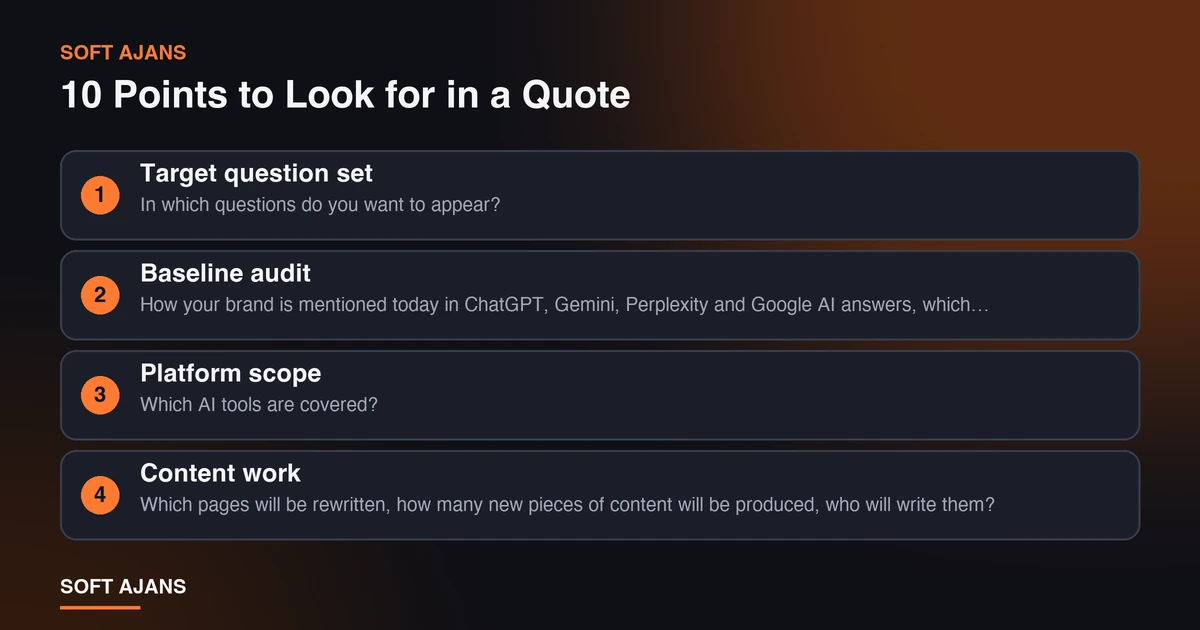
The points below form the skeleton of a GEO quote. Every missing point is a question to ask the agency.
- Target question set. In which questions do you want to appear? A good engagement starts with a question list specific to your business, made up of service-search, comparison, price and “best” type questions. Without a question set there is nothing to measure.
- Baseline audit. How your brand is mentioned today in ChatGPT, Gemini, Perplexity and Google AI answers, which sources are shown and whether the information in the answers is correct should be examined. A comparison with competitors is part of this stage too.
- Platform scope. Which AI tools are covered? An approach that looks for a “trick” for a single platform is fragile; work based on common principles is sturdier.
- Content work. Which pages will be rewritten, how many new pieces of content will be produced, who will write them? Content is expected to answer questions directly, be sourced and carry information specific to the brand. Mass, low-quality content production is risky.
- Technical groundwork. Are crawlability, speed, structured data and the robots.txt and llms.txt arrangements that govern AI bot access written in the quote? For details see what llms.txt is and what bot management is.
- Authority and trust signals. Author profiles, about and contact pages, consistent information on corporate profiles and a plan for natural citation on reliable sources. Methods such as purchased links or fake reviews must not be in scope.
- Measurement method. Which questions will be tested on which platforms and how often? Will Search Console trends, brand searches and conversions be followed together? Are the limits of measurement written openly? We described the method in how to measure AI visibility.
- Reporting. What does the monthly report contain? Are falling or unchanged indicators written too? We listed how to read a report in how to read an agency report.
- Duration and payment plan. Are the stages and durations written? Are the contract term, the exit condition and what will be handed over to you when the work ends clear?
- Guarantee and limits. What does the quote promise about results? An honest quote writes that appearing in AI answers cannot be guaranteed and offers measurable improvements and transparent reporting instead.
Questions to Ask
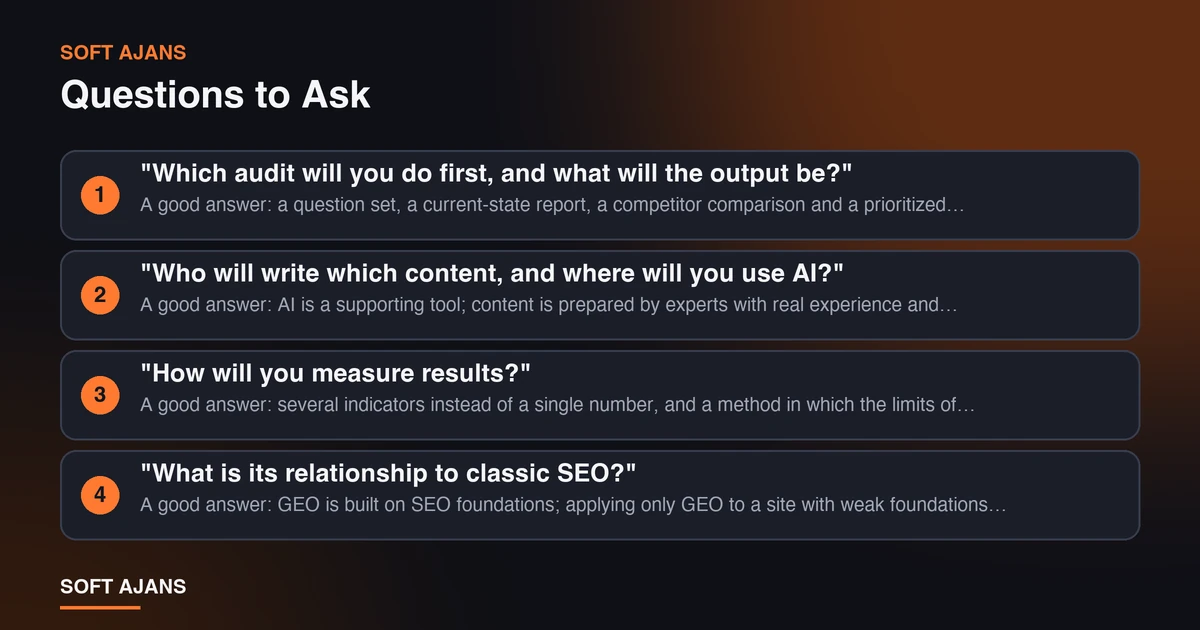
After checking the points, put these questions to the agency:
- “Which audit will you do first, and what will the output be?” A good answer: a question set, a current-state report, a competitor comparison and a prioritized plan.
- “Who will write which content, and where will you use AI?” A good answer: AI is a supporting tool; content is prepared by experts with real experience and verified information.
- “How will you measure results?” A good answer: several indicators instead of a single number, and a method in which the limits of measurement are written openly.
- “What is its relationship to classic SEO?” A good answer: GEO is built on SEO foundations; applying only GEO to a site with weak foundations is inefficient.
- “Who keeps the accounts and data?” A good answer: Search Console, Analytics and other accounts in your name. We described this in who owns your digital accounts.
- “Can you show a similar piece of work?” A good answer: a real example shared with its figures and how it was measured, or, if there is none, saying so honestly.
Red Flags
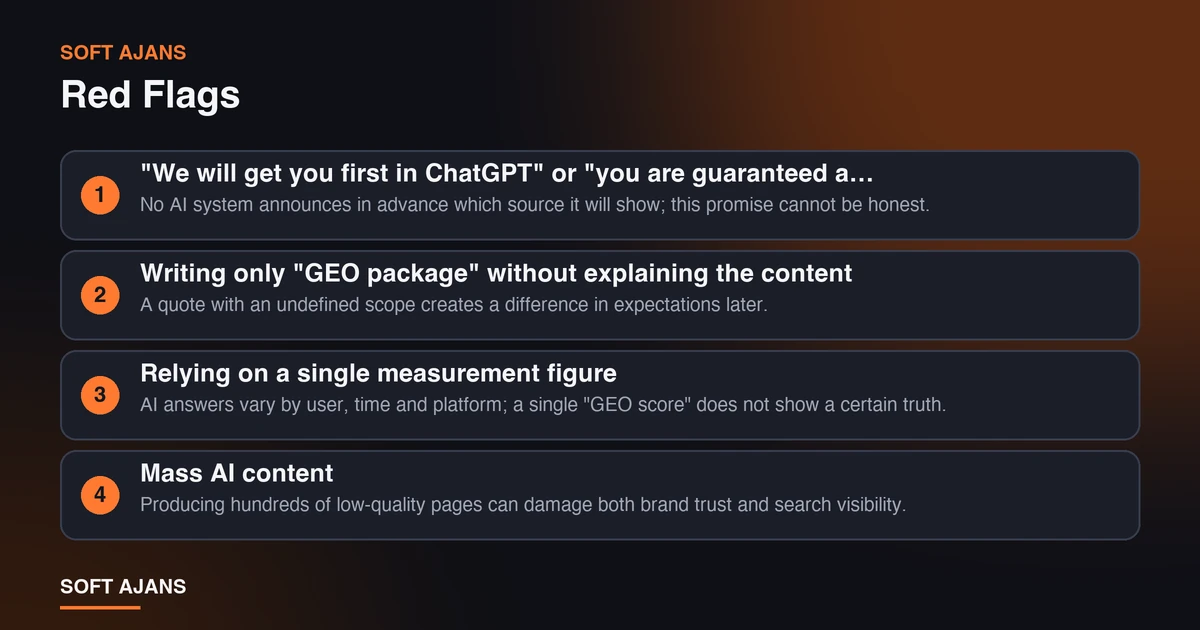
If you see any of the following in a quote, read it once more:
- “We will get you first in ChatGPT” or “you are guaranteed a place in the Google AI summary”. No AI system announces in advance which source it will show; this promise cannot be honest.
- Writing only “GEO package” without explaining the content. A quote with an undefined scope creates a difference in expectations later.
- Relying on a single measurement figure. AI answers vary by user, time and platform; a single “GEO score” does not show a certain truth.
- Mass AI content. Producing hundreds of low-quality pages can damage both brand trust and search visibility.
- Purchased citations, fake reviews or links. Even if it works in the short term it puts your site at risk.
- Declaring classic SEO unnecessary. SEO foundations remain valid; AI systems also largely rely on crawlable, fast and reliable sites.
- A long and locking contract. Long-commitment contracts in a new field need special care.
What Can You Do Yourself Before Starting GEO?
Doing some basic preparation before getting a quote both lets you evaluate quotes better and avoids unnecessary cost:
- Write your question set. List the fifteen or twenty questions your customer asks before finding you.
- Test these questions yourself. Ask them in ChatGPT, Gemini and Perplexity; note whether your brand is mentioned, which sources are shown and whether the information is correct. The eight-question free AI visibility test (in Turkish) is useful as a start.
- Check bot access. See with the bot checker (in Turkish) whether your robots.txt blocks AI bots by mistake.
- Review basic SEO. If crawlability, speed, mobile compatibility and content quality are lacking, those should be fixed first.
- Make your brand information consistent. Name, address, phone, service names and founder information should be the same on the site and on profiles.
To understand why your brand does not appear in AI answers, you can use the seven reasons in why your brand does not appear in ChatGPT as a checklist.
What Does the Price Depend On?
GEO consulting price cannot be given as a fixed figure, because the scope differs in every business. The price is usually set by these factors:
- Size of the site. How many pages will be reviewed, how many rewritten?
- Number of target questions and platforms. The more questions and platforms are tested, the broader the audit and measurement.
- Content need. Is the existing content enough, or is new production needed?
- Technical fix load. How big are the problems with structured data, crawlability and bot access?
- Frequency and duration. A one-off audit or regular monthly work?
- Reporting and meeting needs.
Ask for these items to be written separately in the quote. We described the general factors that affect price, in our own way of working, on the how pricing works page (in Turkish); you can download the quote comparison table as the agency quote comparison table.
Common Mistakes
- Putting GEO in place of SEO. The two do not replace each other; GEO is a layer added on top of SEO foundations.
- Starting without defining the question set. Without target questions there is neither measurement nor a definition of success.
- Tying measurement to a single tool. Tools that track AI answers are not yet standard; they need to be read with several indicators.
- Expecting fast results. The effect of technical fixes is seen earlier, while the effect of content and authority work usually shows over a longer time.
- Not correcting wrong information. If you see old or wrong information about your brand in AI answers, you need to find and fix the problem at the source.
- Believing a guarantee claim. No one can guarantee which source will appear in which answer.
What Does Soft Ajans Do in GEO Consulting?
In our GEO consulting service we first determine the questions that matter for your brand and test them in ChatGPT, Gemini, Perplexity and Google AI answers, and report to what extent your brand and your competitors are mentioned, which sources are shown and how accurate the information in the answers is. Then we carry out a citable content strategy (short answer blocks, question-and-answer structure, topic clusters), technical groundwork and structured data, the robots.txt and llms.txt arrangements that govern AI bot access, and authority and E-E-A-T work.
We do not guarantee appearing in AI answers; since no system announces this in advance, a guarantee cannot be given. We use AI not in place of expertise but as a supporting tool, and we do not produce mass, low-quality content. In measurement we report the regular testing of the defined question set, Search Console trends, brand searches and conversions together. The price is set by the size of the site, the number of target questions and platforms, the content need and the scope of work. For a general view of the field see what AEO is, for using AI inside the business our AI consulting page, and to see your current situation you can request a free pre-analysis.
Frequently Asked Questions
What is the most important point in a GEO consulting quote?
The target question set and the measurement method. If it is not clear which questions are targeted and how they will be measured, it is impossible to tell whether the work succeeded. If these two points are not clear, the quote is incomplete.
Can a result guarantee be given for GEO?
No. No AI system announces in advance which source it will show in which answer. An honest quote offers measurable improvements and transparent reporting; it does not guarantee appearing in a particular position.
Does GEO work replace classic SEO work?
No. AI systems also largely rely on crawlable, fast and reliable sites. SEO foundations remain valid; GEO is a layer added on top of them.
How long until GEO results are seen?
It varies with the current state of the site, sector competition and the scope of the work. The effect of technical fixes is seen earlier, and the effect of content and authority work later. Quotes that promise an exact time should be read carefully.
How is visibility in AI answers measured?
There is no standard, complete method. The regular testing of defined questions on platforms, Search Console trends, brand searches and conversions are followed together. Instead of trusting a single number, you need to read several indicators together.
Does a small business need GEO consulting?
Not always. Writing your question set, testing it yourself on a few platforms, fixing basic SEO and making your brand information consistent is often a sufficient start. Consulting makes sense if your customers look for you in AI answers and your basic groundwork is ready.