As the year-end approaches, most businesses ask “what will we do in SEO next year?” To answer, learning from what actually happened in 2026 is healthier than guessing. This year Google released three core updates (March, May and November 10); AI summaries and AI mode became more and more visible in search results; and some users started asking their questions directly to AI assistants.
In this article we offer a 10-point checklist for preparing for 2027. The list is not a certain forecast of the future but a preparation framework based on the changes of 2026. We deliberately avoid claims such as “this factor will be decisive in 2027”, because search systems change fast and nobody knows next year’s ranking dynamics for sure. The aim of this list is to put you on solid ground whichever way things change.
1. Build a Foundation That Withstands Core Updates
We saw three core updates in 2026. The common message of these updates is that Google keeps re-evaluating the question “which page is the most helpful and reliable?”. Sites that rely on a single trick or short-term tactic are the ones most affected by fluctuations.
In practice this means: pages that answer a real question clearly and completely, visible trust signals (author, source, date, contact) and flawless technical health. We explained how to behave in update periods in our November 2026 core update guide; the short rule: do not panic, wait a week after the update ends and compare with data.
2. Build Data Discipline for Before/After Measurement
The biggest problem in core update periods is not having “before” data. Create a monthly routine: export page and query data from Search Console regularly and write important changes with their dates in a log file. Then when rankings change you can answer “when, which page, why”. For the basic use of the tool, see our Google Search Console guide.
3. Measure the Effect of AI Summaries in Your Own Data
AI summaries in search results can reduce clicks for some queries. The effect on your site varies by sector and query type. Instead of deciding by general claims, track in your own Search Console data a separate list of queries whose impressions are stable but whose clicks have fallen. We covered the topic in detail in our AI Overviews and zero-click post and our AI mode post.
This measurement gives you data for two decisions: for which queries waiting for traffic with information content alone is risky, and where to put more weight on purchase-intent pages.
4. Balance Information Pages and Revenue Pages
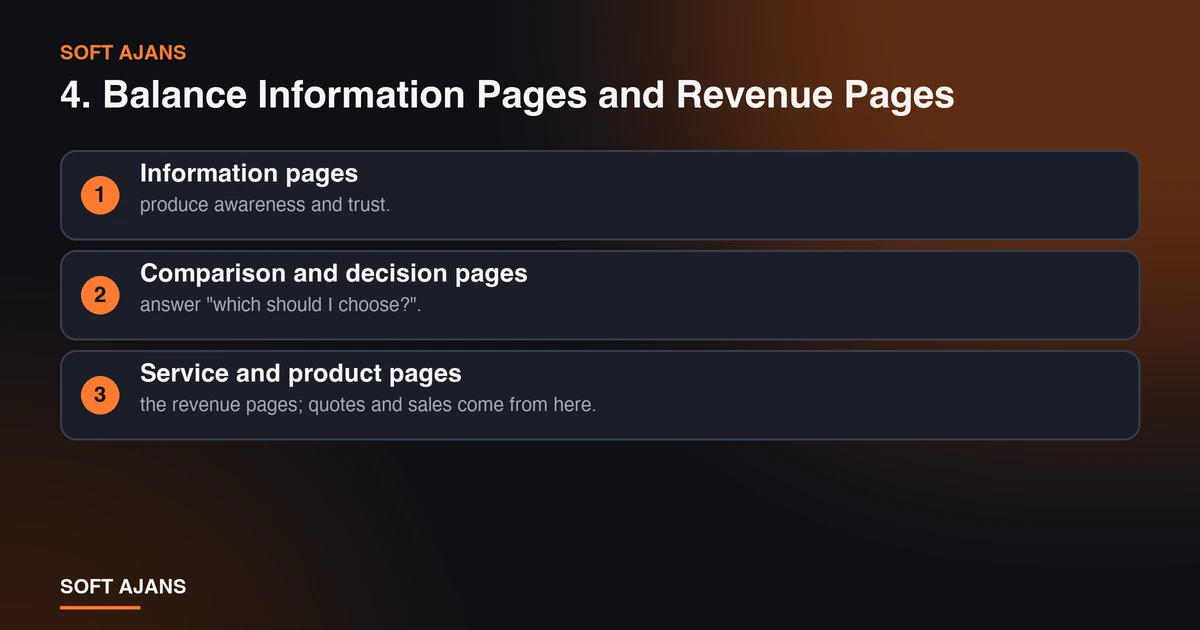
A strategy that relies only on general information content is the strategy most affected by AI summaries. Information content is valuable but should not be the only leg. Think of your content map in three layers:
- Information pages: produce awareness and trust.
- Comparison and decision pages: answer “which should I choose?”.
- Service and product pages: the revenue pages; quotes and sales come from here.
Every information page should have a descriptive link to the related revenue page. To see which content really brings business, track conversion data by page.
5. Treat Visibility in AI Assistants as a Testing Ground
A share of users ask questions to AI assistants instead of search engines. There is no settled method for visibility in this channel; the industry calls it “GEO” or “AEO”. The honest approach is this: producing clear definitions, content that cites sources and structured content is a reasonable preparation that may work in this channel, but there is no guarantee. For the concept and practice, see our GEO guide.
Practical step: determine 10-20 core questions in your sector, ask them to different AI tools once a month and note how your brand is mentioned. This simple record shows whether the channel matters for you.
6. Make Technical Health a Routine
Technical problems quietly lose visibility regardless of core update fluctuation. Set up a quarterly technical check routine:
- Index coverage and crawl errors
- Sitemap freshness
- Redirect chains and broken links
- Canonical and noindex settings
- Page speed and mobile experience
For details you can use our technical SEO guide and our Core Web Vitals guide.
7. Refresh Old Content on a Plan
Some of the content published during the year loses its freshness. Updating old content as well as producing new content can contribute to visibility. Twice a year, review pages that get traffic and should get more; refresh dates, examples, screenshots and links. For the method, see our content refresh guide.
8. Keep Local SEO and Profile Information Current
For businesses with a physical location, Google Business Profile is an asset to be managed all year. Opening hours, services, photos, review replies and updates remain basic preparation in 2027 too. We described the practical steps for the holiday season in our Google Business Profile holiday guide; for general profile optimization see our checklist.
9. Plan the Campaign Calendar in Advance
Special days and campaign periods repeat every year. Use permanent addresses for campaign pages and prepare the calendar at the start of the year. You can find our preparation suggestions for Black Friday and New Year in the Black Friday 2026 SEO guide and our New Year and January campaign post. For the general calendar, see the 2027 digital marketing calendar.
10. Clarify Reporting and Goals
At the start of the year make “what do we expect from SEO?” concrete. Set the goal not as traffic but as a business result: number of quote forms, phone calls, sales. Rankings and traffic are intermediate indicators. To see what a monthly report should contain, look at our sample report.
A Simple Plan for the First Quarter of 2027
| Period | Focus |
|---|---|
| January | Technical check, Search Console data archive, clarifying goals |
| February | Refreshing old content that gets traffic, strengthening revenue pages |
| March | AI assistant visibility record and query analysis; core update tracking |
| All year | Monthly report, campaign calendar, local profile routine |
How Should You Use This List?
Not every item has the same priority for every business. For a small local business, item 8 (local profile) and item 6 (technical health) may come first; for an e-commerce site focused on campaigns, items 9 and 4 stand out; for a blog that gets traffic with information content, items 3 and 5 may be more critical.
Ask yourself three questions to prioritize:
- How close is this item to our business result? Items closest to quotes and sales come first.
- How much is missing in our current state? Invest in the biggest gap, not in the area where you are already good.
- How much effort does it take? Finish low-effort items quickly; plan the big ones.
What Not to Do
Building strategy on forecasts. Many posts that say “this will happen in 2027” are speculation. Trust your own data and Google’s official statements.
Trying every trend at once. Concentrate your resources on one or two priority areas.
Changing without measuring. Record the date and expected effect of every change; otherwise you cannot know what worked.
Trying shortcuts. Purchased links, mass-produced automatic content and fake reviews create risk in the long term even if they bring short-term gain.
Trusting offers that promise guarantees. Offers guaranteeing ranking, traffic or sales are generally not realistic.
What Should You Measure at the End of Each Quarter?
At the end of every quarter look for answers to five simple questions. How did organic clicks and impressions change compared with the previous quarter? Which pages gained traffic and which lost? How many conversions (forms, calls, sales) came from the organic source? Did the technical audit show new errors? How was your brand mentioned in the AI assistant record?
These five answers set the priority of the next quarter. Collect the results in a short document and place it side by side with the previous quarter; a trend is read not from a single measurement but from successive ones. If the data shows a clear decline, first understand the cause; do not go straight to big changes.
Where to Start With a Small Budget?
If your budget is limited, follow this order: first the technical foundation (index, speed, mobile), then strengthening the three pages that bring the most business, then a few quality pieces of content that support these pages. Instead of broad and shallow content production, a small number of deep and regularly updated pages is more efficient for most businesses. For local businesses, managing Google Business Profile regularly is one of the most effective things you can do at almost no cost.
A Short Note: Stay Current
The information in this article is valid as of November 2026. The end date of the core update, the scope of AI search features and Google’s interface may change over time. Before deciding, check Google’s Search Status Dashboard and official documentation. We will update this post when there is an important change, so that it remains a living checklist you can consult all year.
Do not try to apply all the items at once. Even completing only the first three items in January lays the foundation of a disciplined SEO process for the whole year. After that you can proceed by adding one item each month; what matters is progressing regularly and measuring the effect of each step.
How Soft Ajans Helps With Your 2027 Plan
In our SEO consulting service we do annual planning, technical crawling, content prioritization and monthly reporting. We do not guarantee rankings; we report what we measure. For an approach specific to your city, see our city-specific SEO pages, and to review your site quickly see our SEO checklist.
Frequently Asked Questions
Will SEO still work in 2027?
Search behavior is changing but people’s need to look for information and products continues. In whichever channel, the value of helpful, reliable and technically sound content is not decreasing. No certain forecast of the future can be made; that is why measurement and flexibility matter.
Will AI summaries end organic traffic?
We cannot say for sure. A decline in clicks is observed for some query types, but the effect varies by sector and query. The healthiest approach is to measure the effect in your own Search Console data and put more weight on revenue pages.
What should I do to appear in AI assistants?
There is no certain method. Producing clear definitions, content that cites sources and structured content is a reasonable preparation. Record regularly how your brand is mentioned in these tools and be cautious about offers promising guaranteed results.
Should I produce new content or update old content?
Balance both. Refreshing old pages that get traffic and have potential often gives quick gains; new content widens your coverage. Set the priority by data.
Where should I put my SEO budget?
First technical health and revenue pages, then content that supports these pages. The distribution varies by sector and your current state; seeing your site’s status with a free preliminary analysis makes deciding easier.
Will core updates be this frequent every year?
We do not know. Three core updates were released in 2026; it would not be right to guess the frequency in 2027. Building a resilient foundation and a measurement discipline works regardless of update frequency.