“A hundred backlinks cheap,” “ranking-guaranteed package,” “first page in a week.” Most offers that sell backlink packages come with promises like these, and most of them don’t work; some even harm the site. On the other hand, a site that earns no links at all will struggle to gain authority. So is buying backlinks safe?
The short answer: it is not risk-free, but if you know where the risk comes from, it can be managed. In this guide we explain Google’s stance on the subject, the real source of the risk and 9 questions to ask when evaluating a backlink package. For the basics first, see what is a backlink.
What Does “Buying Backlinks” Mean?
The phrase covers three different things, and the risk is not the same in each:
- Paid placement (sponsored content): Paying a site publisher to run an article that mentions you or your brand. The link sits inside that article.
- Link networks and automated packages: Bulk links from many sites run by a single owner, or from pages generated by software.
- Digital PR and partnership work: Editorial-based link earning through news, interviews, trade publications, partnerships and events. Here the fee usually pays for the work, not for the placement.
Asking which of these a company actually does is the first step of the whole evaluation.
What Does Google Say About This?
Google’s spam policies define buying or selling links to influence rankings as a violation. Google recommends that paid or exchanged links be marked with rel="sponsored" or rel="nofollow". Marked links may not count as a ranking signal, but they can still bring brand visibility and direct visitor traffic. When unnatural link patterns are detected, Google can ignore those links; in serious cases it can apply a manual action.
So ask two questions openly: By what method will the links be earned, and how will they be marked? Is your goal a ranking signal, or brand visibility and traffic? No company can say “zero risk of a Google penalty”; stay away from any company that does.
Where the Risk Comes From: Patterns, Not Numbers
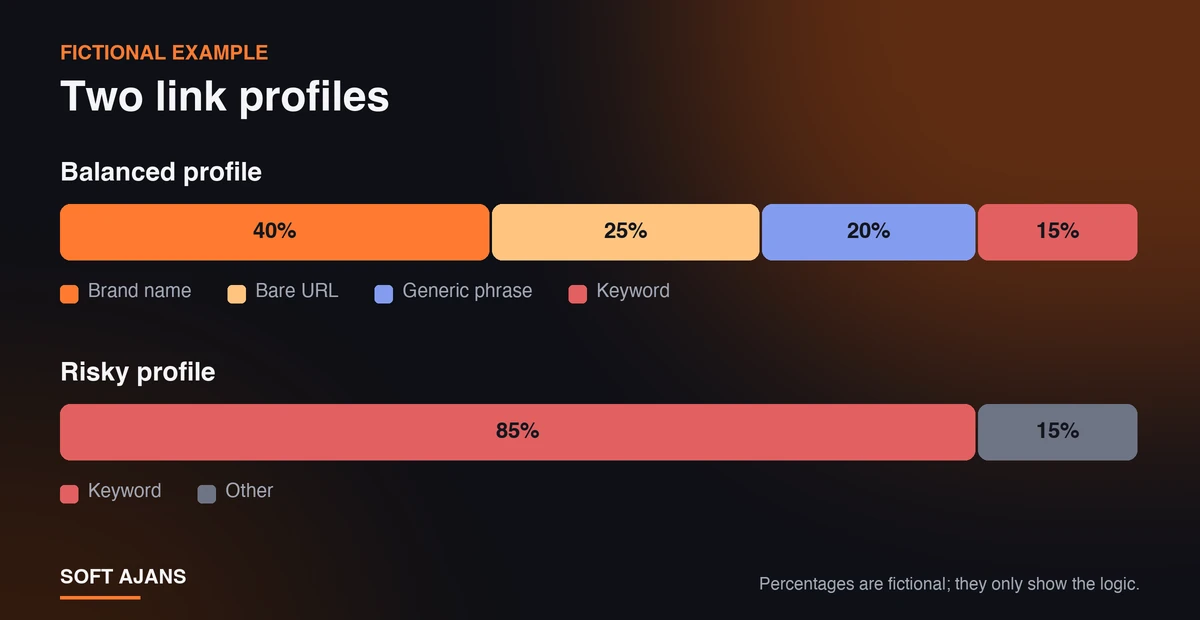
A single link rarely causes trouble; the trouble is the pattern. Hundreds of links with the same keyword, bulk links from unrelated sites, a sudden burst in the number of links and repeated placements from the same source create an unnatural profile. The two examples in the image are fictional, but they show the logic: in a natural profile most links use the brand name, the bare URL and generic phrases, and keyword anchors are a minority. In a risky profile almost every link is the same commercial keyword. For details, see what is anchor text.
What Does a Valuable Backlink Look Like?
A valuable link is one that means something to a real reader inside a page. The publishing site is relevant to your sector, produces content regularly and has a real audience. The link appears inside an original, on-topic article and adds something for the reader. The page wasn’t created just to host links. A link that meets all of these criteria is safer than many low-quality links, even if you have fewer of them.
9 Checks When Choosing a Backlink Package
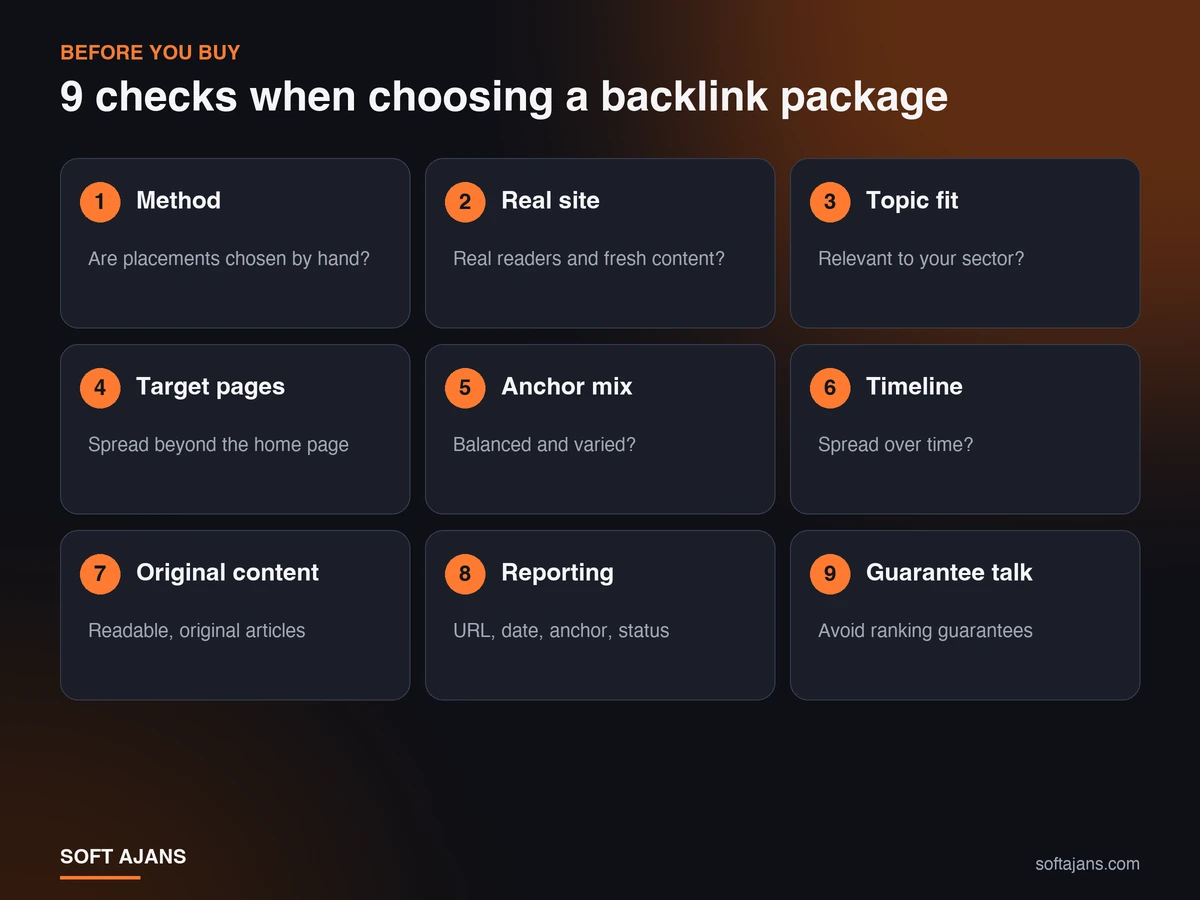
- Method: Are placements chosen by hand, or generated automatically? Can you see the sites in advance?
- Real site: Does the publishing site have fresh content, real readers and organic visibility, or does it exist only to sell links?
- Topic fit: Are the site and the article relevant to your sector?
- Target pages: Do all links go to the home page, or are they spread to service, category and blog pages?
- Anchor text mix: Are brand, URL, generic phrase and keyword anchors balanced?
- Timeline: Are links earned over time, or all at once?
- Original content: Are the published articles original and readable?
- Reporting: Are the placement URL, target page, anchor text, date and link status reported?
- Guarantee talk: Do they promise a “ranking guarantee” or “first page guarantee”? If so, don’t trust them; backlinks alone don’t decide rankings.
Along with these, also ask: What happens if the link is removed? Is the placement permanent, or for a set period? These points should be in the contract.
Red Flags and Good Signs
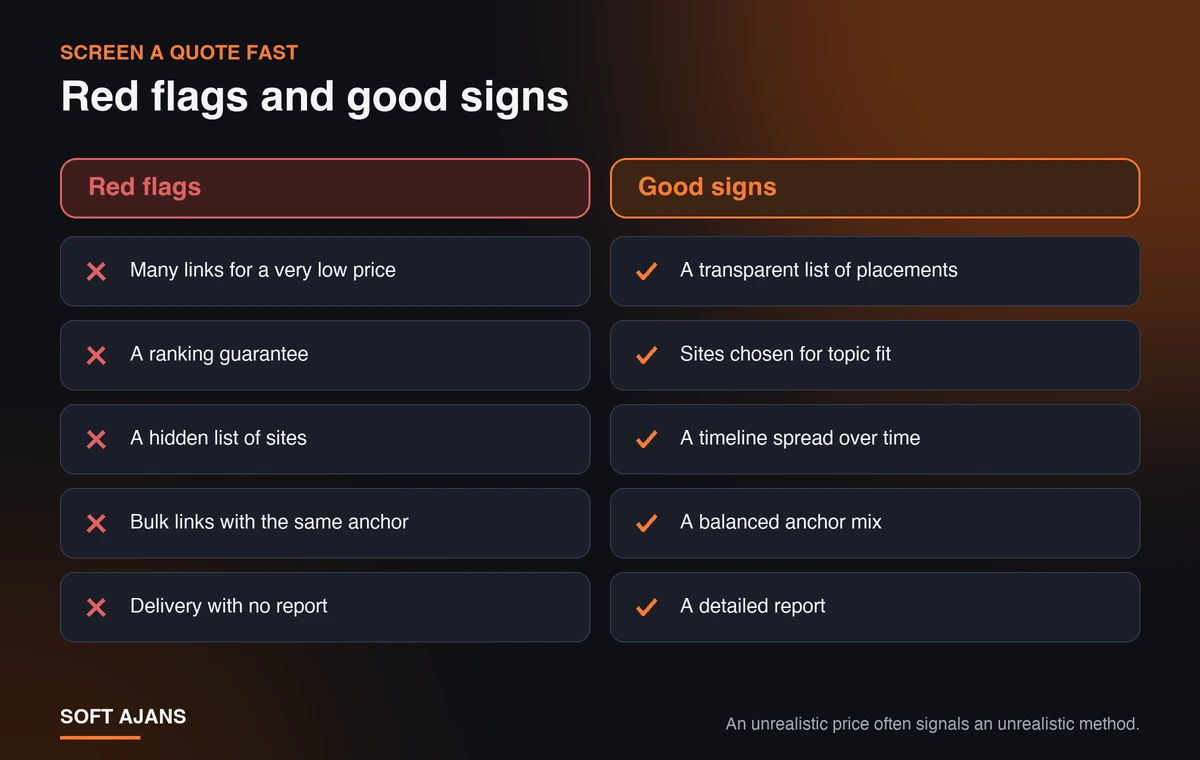
Use the comparison in the image to screen an offer quickly. Red flags: many links at a very low price, a ranking guarantee, a hidden list of sites, bulk anchor text with the same keyword and delivery with no report. Good signs: a transparent list of placements, sites chosen for topic fit, a timeline spread over time, a balanced anchor mix and a detailed report. Price alone is not a quality indicator, but an unrealistic price is often a sign of an unrealistic method.
Check Your Existing Profile Before You Buy
Before getting new links, look at the state of your current profile. In Search Console, review the links report, whether there is a manual action notice and the sites that link to you most; our guide on how to do a backlink analysis walks through it step by step. If there are suspicious, spam-looking links, deal with those first; see what is a spam link and how to clean it for that.
Ways to Earn Links Besides Buying Them
Paid placement is not the only way, and often not the most lasting one. Ways to earn a link by deserving it include:
- Link-worthy content: Original data, a guide drawn from your own experience, a free tool or a template. Create content others will want to cite; we publish free tools (Turkish) and downloadable templates for this reason.
- Digital PR: Offering expert comment, news or an interview to trade publications.
- Partnerships and references: Appearing on the sites of brands, suppliers and associations you work with.
- Local and sector directories: Creating profiles in real, relevant, moderated directories.
- Turning brand mentions into links: Politely asking publications that mention you without linking to add a link.
These routes are slow but carry no risk. Think of purchased placements as a complement to this work, not a replacement.
Backlinks Alone Are Not Enough
Without strong content and a sound technical foundation, backlink work gives limited results. If your page doesn’t answer the searched question well, or has crawling and speed problems, links won’t make up for it. Check the foundations first: the guides on technical SEO and how long SEO takes give a realistic picture of the process. Link work should be one item in the budget, not all of it; to plan the budget, see how SEO prices are set.
Common Mistakes
- Looking only at price: The cheapest offer often means automated or low-quality links.
- Always linking to the home page: Service and blog pages need links too.
- Always using the same keyword: It creates an unnatural pattern.
- Not asking for the report: Paying without knowing what you received.
- Expecting results in a few weeks: The effect shows gradually; anyone promising quick results is a warning sign.
- Treating links as the only fix: Content, technical SEO and user experience matter just as much.
What Soft Ajans Does in Backlink Packages
We start by reviewing your existing backlink profile and the link sources of your competitors. We plan links not only by authority but from sources that are relevant to your sector and trustworthy; we keep the anchor text mix varied and spread link earning over time. Every month we provide a report with the placement URL, target page, anchor text and link status. We don’t give ranking guarantees. For scope and packages, see our backlink packages service page, and we can also discuss planning it together with SEO consulting. You can get in touch about your needs.
Frequently Asked Questions
Can buying backlinks lead to a Google penalty?
The risk is not zero. Google treats buying or selling links to influence rankings as against its policies. What reduces risk is hand-picked, topic-relevant placement, a natural timeline, a balanced anchor mix and marking paid links appropriately. Stay away from companies that ask for or give guarantees.
Does a backlink package guarantee rankings?
No. Rankings are the result of content, technical structure, user experience, competition and the link profile together. An offer that gives a guarantee is not trustworthy.
How many backlinks should I get?
There is no fixed number. It varies with the site’s age, current authority and sector competition. A small number of relevant, trustworthy links is better than many low-quality ones.
Is there a difference between dofollow and nofollow links?
Yes. Dofollow links may allow search engines to follow the link; nofollow and sponsored links carry a different signal. A natural profile contains different link types, and marked links can still bring brand visibility and traffic.
When will the effect be visible?
It varies with the site’s condition, the competition and the quality of the placements, and is usually seen gradually. Offers promising clear results within a few weeks are not realistic.
Can a brand-new site buy a backlink package?
It can, but it is better to earn links at low intensity, on a natural timeline and with brand-focused anchor text. For a new site, getting the content and technical foundation right first is often the higher priority.